
Subscribe

Lavender cultivation is expanding in Jammu and Kashmir as farmers look for crops better suited to warmer winters, erratic rainfall and shrinking irrigation sources.
Scientists say lavender needs little irrigation, grows well on sloping land, resists many pests and can flower for nearly two decades after planting.
CSIR-IIIM says more than 1,200 hectares are now under aromatic crop cultivation in the Union Territory, supported by nurseries, distillation units and training programmes.
The crop is creating new income streams through essential oil, dried flowers, lavender honey, self-help group products and seasonal rural tourism.
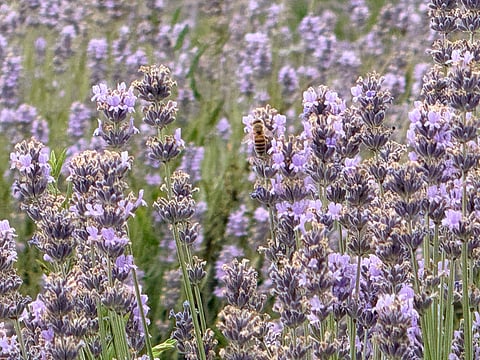
In the July heat, workers move through neat rows of lavender at the Council of Scientific and Industrial Research-Indian Institute of Integrative Medicine’s (CSIR-IIIM) field station in Bonera, Pulwama, cutting shoulder-high plants heavy with purple flowers.
Within hours, the flowers are taken to a nearby distillation unit, where steam is used to extract the fragrant oil used in perfumes, cosmetics and medicines.
“This is a living laboratory,” said Shahid Rasool, scientist-in-charge of the Bonera Field Station. The research plots, he said, are where cultivation techniques are tested before they are recommended to farmers across Jammu and Kashmir.
Zabeer Ahmed, director of CSIR-IIIM, said the institute never intended lavender to remain confined to research farms. “The idea was always to take science to farmers’ fields,” he told Down To Earth. “The Purple Revolution demonstrates how scientific interventions can help farmers adapt to climate change while creating new livelihood opportunities.”
Long before lavender fields began attracting attention in Bhaderwah, Sirhama in Anantnag or Ganderbal, scientists at Bonera were uncertain whether a Mediterranean herb could survive Kashmir’s temperate climate.
The experiment began in 1970, when scientist Akhtar Hussain introduced lavender from Bulgaria. At first, it was grown only in research plots at Bonera in Pulwama and Mansbal in Ganderbal.
More than five decades later, the experiment has grown into one of Jammu and Kashmir’s major agricultural diversification stories. According to CSIR-IIIM, more than 1,200 hectares are now under aromatic crop cultivation across the Union Territory, supported by an expanding nursery and processing network. Bhaderwah, in Doda district, has emerged as a major centre and is often called India’s lavender capital.
The crop’s rise comes as Kashmir’s climate is changing. Farmers who once relied heavily on maize and paddy now face warmer winters, reduced snowfall and thinner streams that feed rain-dependent farms. About 60 per cent of the region’s farmland still depends entirely on rainfall.
Scientific studies have documented a warming trend across Kashmir. A 37-year analysis by researchers at Sher-e-Kashmir University of Agricultural Sciences and Technology found that average annual temperatures rose by 0.8C between 1980 and 2016. Another SKUAST study, published in 2022, found that mean maximum temperatures rose by nearly 2 degrees Celsius between 1980 and 2020.
Speaking at the Lavender Festival in Ganderbal this year, Chief Minister Omar Abdullah said rainfall had become increasingly erratic, arriving either in excess or not at all, making rain-fed agriculture more vulnerable.
Scientists say lavender is better suited to these changing conditions than many conventional crops. The perennial shrub grows well on sloping land, needs only one or two irrigations during the growing season, is naturally resistant to many pests and can continue flowering for nearly two decades after planting.
Farmers and scientists have also begun integrating beekeeping with lavender cultivation. Around 200 farmers have adopted the model by placing bee colonies near lavender fields.
“Lavender flowers provide nectar during a period when other floral resources are scarce,” Rasool said. “Farmers are earning from premium lavender honey while managed pollination improves fruit set in nearby orchards.”
The approach allows farmers to earn from both essential oil and honey, while also supporting pollination in surrounding orchards.
Ahmed said the programme’s significance lies in combining cultivation with value addition.
“Through the Aroma Mission, we have combined quality planting material, field demonstrations, scientific training and processing technologies so farmers can capture greater value from what they produce,” he said.
The spread of lavender has accelerated in recent years. Abdul Hamid Shah, a floriculturist with the Agriculture Department, said officials distributed 1.5 lakh lavender saplings in 2023-24. This rose to 2.75 lakh the following year and four lakh in 2025-26.
“When people think of Kashmir, they immediately think of apples,” Shah said. “We are working to ensure that, in the coming years, lavender also becomes synonymous with the region.”
According to CSIR-IIIM, the Purple Revolution has unfolded in phases. Scientists first focused on building a supply of planting material, producing nearly 50 lakh rooted lavender cuttings through nursery programmes. Cultivation later expanded to about 910 hectares, involving more than 2,500 farmers. Essential oil production crossed 3,000kg, while revenues approached Rs 8.09 crore.
In the next phase, another 552 hectares were brought under cultivation and more than 1,500 new farmers joined the programme. Revenue from lavender crossed Rs 10 crore, reflecting a shift from cultivation alone to a wider rural economy built around processing, nurseries and value-added products.
To support the expansion, CSIR-IIIM established 55 distillation units across cultivation clusters and organised more than 120 training and awareness programmes. Decentralised processing allowed growers to distil flowers closer to their fields, reducing post-harvest losses and improving returns.
Ahmed said the aim was not just to persuade farmers to grow lavender, but to help them participate in the entire value chain.
According to CSIR-IIIM assessments, farmers who previously earned Rs 40,000 to Rs 60,000 per hectare from conventional crops such as maize can earn Rs 3.5 lakh to Rs 5 lakh per hectare after shifting to lavender and participating in processing and nursery development.
Industry estimates place India’s annual demand for lavender oil at 30,000kg to 40,000kg, driven by the cosmetics, pharmaceutical, fragrance and wellness sectors.
Lavender has also created opportunities for women in rural Jammu and Kashmir. In Uri, near the Line of Control, women organised into Self-Help Groups under the J&K Rural Livelihoods Mission have begun producing soaps, candles, room fresheners and essential oils from lavender. The products are packaged locally and sold through exhibitions and online platforms.
Ahmed said the Purple Revolution had become a platform for entrepreneurship, with young people building start-ups around essential oils, wellness products, cosmetics and rural tourism.
In Doda district, the transformation is most visible in Bhaderwah. Scientists from CSIR-IIIM identified the hill town as suitable for lavender after feasibility studies in 2009 found that its cool climate, rain-fed slopes and uncultivated land could support the crop.
Among the first farmers to adopt lavender was Touqeer Ahmed Bagban, now widely known in the region as the “Lavender Man”. He said maize had become less profitable because of erratic rainfall, shrinking irrigation sources and crop damage by wild monkeys.
“We realised we did not have to depend on one product,” Bagban said. “If there is demand for oil, we extract oil. If the market wants dried flowers, we sell flowers.”
Fresh lavender is distilled into essential oil, while dried flowers are used in bouquets, incense sticks, candles, soaps, room fresheners and decorative products.
The crop has also created a seasonal tourism economy. Every summer, blooming lavender fields in Bhaderwah attract visitors, photographers and researchers, benefiting hotels, homestays, restaurants, transport operators and local artisans.
A similar model is emerging in Kashmir. At Nunner in Ganderbal district, lavender fields at the Model Floriculture Centre have become a popular stop for tourists travelling towards Sonamarg and pilgrims heading to the Amarnath cave shrine.
Officials hope such seasonal attractions can be developed into a broader rural tourism circuit centred on aromatic crops, linking climate-resilient farming with local enterprise.