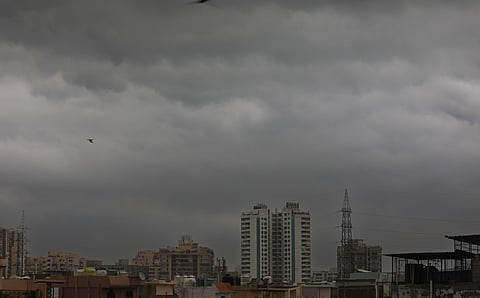


The Southwest Monsoon picked up pace June 29 onwards and has covered many areas in northwest India, including Delhi, by July 2, 2026. But the India Meteorological Department’s (IMD) forecast for July shows below normal rainfall after a large countrywide deficit of 40 per cent in June. Many regions could also suffer from above normal day time and night temperatures during July.
On July 2, the IMD stated in a press release that “the Southwest Monsoon has further advanced into some more parts of Gujarat, remaining parts of Uttar Pradesh, entire Delhi, most parts of Madhya Pradesh, Haryana & Punjab, and some parts of Rajasthan.”
The first low pressure area of the monsoon season also developed in northwest Bay of Bengal close to north Odisha and West Bengal coasts in the morning hours of July 2. The lack of low-pressure areas was one of the factors for reduced rainfall in June.
The seasonal monsoon low pressure trough extends from northwest Rajasthan to the centre of the newly formed low-pressure area with embedded cyclonic circulation over southwest Uttar Pradesh, north Madhya Pradesh and north Chattisgarh. There is an offshore low-pressure trough that extends from south Gujarat to Karnataka. These systems would aid in the occurrence of rainfall over parts of central and northwest and western coastal India.
On June 30, IMD published its monthly outlook of rainfall and temperatures for July. The weather agency stated that the rainfall for India in July is most likely to be below normal (<94 per cent of the long period average). Most regions could experience below normal rainfall, except some areas in northwest, northeast, east-central and eastern peninsular regions where there could be normal to above normal rains.
Places with normal to above normal rainfall include areas in Jammu and Kashmir, Ladakh, Sikkim, Arunachal Pradesh, Maharashtra, Madhya Pradesh, Chhattisgarh, Odisha, Telangana, Andhra Pradesh and Tamil Nadu.
July is an important month for monsoon rainfall and contributes 32 per cent of the seasonal total. Many farmers in the rain-fed regions of the country, especially in central India would be waiting for good rainfall in July for sowing kharif crops after a lean sowing season in June due to decreased rains.
IMD expects daytime temperatures to remain above normal across most parts of India, except a few isolated areas in the west-central region, where normal to below maximum temperatures are likely. Nighttime temperatures are also likely to be above normal over most parts of the country with exceptions in isolated areas of central and northeast India where normal minimum temperatures could occur.
El Niño conditions are prevailing in the Equatorial Pacific Ocean and the IMD expects them to strengthen during the rest of the monsoon season. This could be one of the reasons for the suppression of rainfall in July like it was for June. The Indian Ocean Dipole (IOD) conditions also remain in neutral phase and could continue to be so for the rest of the monsoon season. The development of positive IOD conditions could have counteracted some of the negative impacts of El Niño.
The crucial performance of the monsoon in July would depend on the activity of the seasonal monsoon low pressure trough, the off shore trough and the formation of low pressure areas in the Bay of Bengal, the Arabian Sea and over land.