
Subscribe

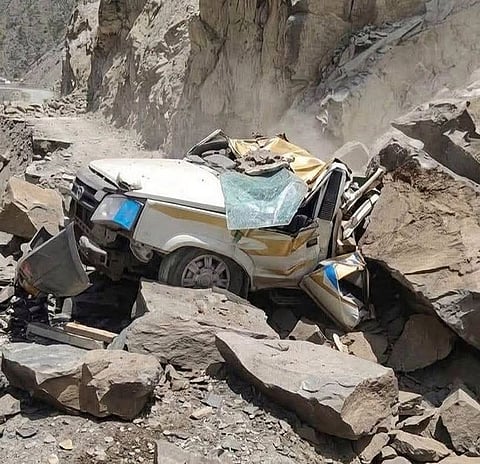
With the onset of the southwest monsoon in Himachal Pradesh, incidents of floods, cloudbursts and landslides have intensified. On July 24, a vehicle going from Kullu to Pangi was hit by rocks falling from a hill on the Sansari-Kilad-Thirot-Tandi road near Kadhu Nala in the Udaipur subdivision of Lahaul-Spiti district. In the accident, 13 people in the vehicle died on the spot, while two people were seriously injured. The dead include eight men, five women and a six-month-old infant.
Member of Legislative Assembly for Pangi-Bharmour, Janak Raj, said 11 of the deceased were from his constituency, while two were residents of Lahaul-Spiti district. He said treatment of the injured was underway and the district administration, Border Roads Organisation (BRO) and other agencies were engaged in restoring the road for traffic. “There is a need to scientifically study the reasons for increasing natural disasters during the monsoon in Himachal and prepare an effective strategy for the future,” said Raj.
The impact of incessant rains is not limited to roads alone. At present, 121 roads are closed in the state, while drinking water, electricity and communication services are also disrupted in many areas. Due to this, people are facing difficulties in trying to commute as well as to satisfy everyday needs. According to the State Disaster Management Authority, with the onset of monsoon, the graph of disasters in the state has increased rapidly. So far, 19 major incidents of landslides, 11 incidents of flash floods and six incidents of cloudburst have been recorded.
The farmers of Lahaul-Spiti have been most affected. They have not able to transport their finished cabbage and pea crops to the markets due to a local bridge being washed away by repeated overflows in the Jahalma drain. Many farmers have been forced to destroy their crop in the fields. Rahul Dushi, a young farmer from Lahaul, said the problem of Jahalma drain has been persistent since 2023. “This situation arises every monsoon and the finished crop does not reach the market. This causes huge financial losses to farmers. But so far, no permanent solution has been found.”
Both the frequency and intensity of monsoon disasters have increased in Himachal Pradesh during the last few years. According to the state government’s disaster assessment report, 276 people lost their lives in monsoon disasters in the year 2022. This number increased to 428 in 2023 and 468 in 2025. In these years, the state has also suffered an economic loss of more than Rs 20,000 crore.
These increasing incidents are not only a case of natural disasters but are also raising serious questions on climate change, vulnerable geography, infrastructure development and disaster risk management preparedness in the Himalayan regions. Experts believe that if development plans and disaster risk reduction in mountainous areas are not carried out, the impact of the monsoon may be more severe in the coming years.
