
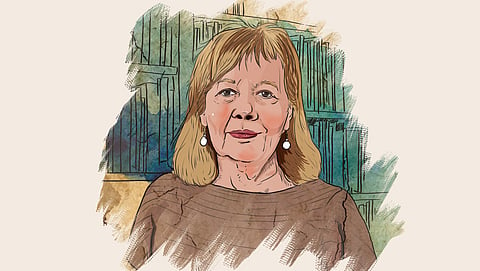
‘Recognise indigenous solutions’

Akshit Sangomla (AS): At international events such as the UN Climate Conferences, indigenous knowledge is discussed in the context of climate change adaptation. But have the indigenous and scientific knowledge systems integrated?
Annamária Lammel (AL): There are two aspects to consider here. First is the recognition of the importance of indigenous knowledge, which involves provision of time, eco-systemic approaches, and nature-based solutions for conservation and protection. Knowledge systems of various intergovernmental organisations like the Intergovernmental Panel on Climate Change (IPCC) and Intergovernmental Science-Policy Platform on Biodiversity and Ecosystem Services (IPBES) recognise the importance of indigenous knowledge. Second is ensuring that this recognition leads to providing real power to indigenous communities so that they can take part in global decisions. We should recognise that indigenous knowledge could have good solutions sometimes. We now know that human beings are the origin of the triple environmental crises—biodiversity loss, pollution and climate change, and land degradation. There are two ways to handle this problem: nature-based and traditional solutions, and the much more technical approach. I think a mix of both would be good for solution pathways.
AS: How is integration of indigenous and scientific knowledge systems considered in IPCC’s assessment reports?
AL: I was a lead author in the fifth (AR5) and sixth (AR6) assessment report cycles. For AR5 I insisted on integration of indigenous knowledge perspectives in decision-making chapters. We gave some important indicators that climate services can be useful for adaptation, but these services have to be understandable for indigenous people. We also considered that decision-makers should include representatives from indigenous groups. For AR6, within the Working Group 2 (WG2) report, we integrated indigenous decision-making processes and their usefulness for adaptation in the form of nature-based decision-making processes. For the UN Environment Programme’s Global Environment Outlook 7 (GEO7) report, there was a task force on indigenous and local knowledge, and every chapter integrated indigenous knowledge.
AS: Are there good examples of indigenous knowledge integration within international, national or even local institutions?
AL: In Scandinavia, the Sami parliaments have shown how traditional practices of the Sami people can be integrated into the adaptation process. In Australia, which has seen several fire incidents, indigenous knowledge on fire management is integrated in state- and province-level policymaking. Similarly in France, local knowledge on forest fires has been integrated in national-level policymaking. At the UN level, indigenous communities are much more integrated in the decision-making processes, but the major problem is at the national level, where decision-makers live in protected environments–and many of them even believe that climate change is not happening, or represent big extractive companies and lobbies. For instance, in Mexico, despite much effort indigenous people do not really have decision-making power. France does not recognise the existence of indigenous people because of egalitarianism where everybody is considered equal. In French Guiana, the Amerindian people are not recognised by the French government even though at the United Nations level they are recognised.
Often, indigenous communities participate in decision-making through intermediary organisations.
AS: Have indigenous communities come together to form their own organisations to push for more integration in policy?
AL: There are two different movements. In Mexico, indigenous organisations—which a lot of times do not have legal status—are now recognising that they have to fight together to protect their agricultural heritage. The Totonac people in the Veracruz province of Mexico are organising and fighting to protect their corn, which is under threat. But they do not have any financial facilities for organising themselves. The UN Development Programme also has a lot of programmes to help local and indigenous people to protect their environment, but these are top-down projects. In France and its overseas territories such as New Caledonia, French Polynesia, French Guiana and some islands in the Caribbean region, there is a special ministry and administration for them, but as far as I know, there is no particular institution protecting indigenous local knowledge.
AS: What are some of the ethical concerns around extraction of indigenous knowledge from the communities?
AL: For the IPCC AR7 report, a workshop was organised around these ethical questions on gaining access to this knowledge and making some kind of database to help in adaptation. [The report “IPCC workshop on engaging diverse knowledge systems” was released on June 11]. But it takes a lot of time to understand the communities’ language and knowledge. In a society where we want quick understanding, we often hear repeated phrases stating that indigenous knowledge is “holistic” and “dynamic”. This is not a deep understanding of the indigenous knowledge system. For instance, I began working in the Veracruz region of Mexico with the Totonac people 30 years ago. They do not have a word for space, but they do have one for time-space, because for them, in time there are various spaces. It takes a lot of time to understand their philosophy. There is a lot of literature around indigenous knowledge. We have published three books on the anthropology of climate in which many scientists have described aspects such as agricultural calendars of different indigenous groups. But there is more knowledge out there.
I have worked in New Caledonia with the aboriginal Kanak people, who told me that their elders can speak with the wind and rain, but they are not allowed to share this sacred knowledge. In 1985, I was in the Baffin Island in the Inuit region of Canada, when communities there told me that the “white people of the south” were putting into the air something that was changing the colours of the snow, which would bring big changes. Recently I was in the Amazon and found that the people there observe very small changes in climate and impacts that you cannot read about anywhere. To be able to adapt to climate change, the focus has to be on indigenous practices; we have to observe what communities are doing and how they are changing their practices.
This interview is part of the cover story "Ancient signals", originally published in the August 1-15, 2026 print edition of Down To Earth