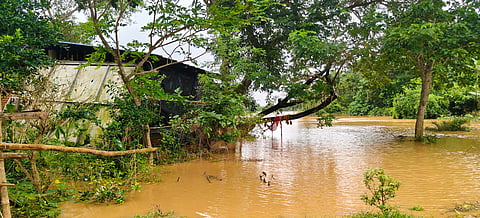


In Nepal’s Nuwakot district this year, a turquoise house became an unlikely symbol of hope. A glacial flash flood swept away the buildings around it. The house, built with a reinforced concrete frame on a bedrock foundation, stayed standing and sheltered its occupants.
The image fits this year’s theme for the International Day for Disaster Risk Reduction on October 13, 2026: “Resilience Starts at Home.” The UN Office for Disaster Risk Reduction (UNDRR) calls the home the place where disasters are most acutely felt and where resilience must begin. But a miracle house is no model for the millions of families whose homes stand on riverbanks and riverbeds. Read closely, the theme has three components. The house must be resilient. The land beneath it must be safe and secure, with a patta (land title) for the people who live on it. And the people inside, especially the most vulnerable, must be prepared. Remove any one and the home is not resilient.
Satyabhama Mallick, 61, a widow from a Scheduled Caste community, has lived alone in Rahania village of Bhadrak district, Odisha, for nearly three decades. Her daughter is married and lives elsewhere. She survives on a widow pension and ration grain, with no stable livelihood, savings or alternative shelter. This year’s monsoon floods destroyed her house.
Rebuilding is not simply a matter of bricks and roofing sheets. The land she has occupied for about 30 years is recorded as anabadi, uncultivated government land, which leaves her eligibility for housing reconstruction support in doubt.
Too frail to reach the relief distribution point, she was visited at home by an ActionAid team, and on 20 August received a grocery kit and a shelter-cum-hygiene kit. They mattered. But she now lives in a thatch structure that is barely holding together, and the question of her land is unresolved. Relief is a bridge, not a destination.
Her case exposes a question disaster policy often skips: what makes a house a home? A house can survive a flood and a family can still lose their home if their right to the land is uncertain.
Land that is cheap or available is often land exposed to hazard. The same insecurity that pushes the poorest towards riverbanks and marginal plots later keeps them out of reconstruction assistance.
Odisha’s Revenue and Disaster Management Minister told the Assembly on 24 September that this year’s floods affected 32,48,943 people in 22 districts and damaged 18,076 houses, with ₹33 crore released as housing assistance. But a damaged house must first be identified, the family assessed, eligibility established, land found where needed and aid delivered. For a family without secure land, every stage is another place to fall through.
The scale of the land problem is documented. A 2024 audit by the Comptroller and Auditor General found 46,949 landless households on Odisha’s PMAY-G Permanent Waiting List as of February 2021: eligible for a house, with nowhere to build it. The survey meant to identify homestead-less families had last been done in 2018.
The state has since moved. The Awaas+ 2024 survey identified about 2.01 lakh landless households among roughly 37.89 lakh surveyed. In late 2025, Collectors were told to give landless families priority in house-site allotment, and block officials and tehsildars were asked to meet on the first Saturday of every month to settle pending land issues. The Vasundhara framework also allows the state to buy private land for homestead-less families where government land is unavailable.
Implementation is the test. As of September, the Permanent Waiting List was still to be prepared, and the government told the Assembly that no houses had been sanctioned under PMAY-G in Odisha in 2025-26 or 2026-27. Land allocation should not wait for sanctions.
A strong house on secure land still fails the person who cannot get out in time, or whom nobody thinks to look for. Preparedness matters most for older persons, persons with disabilities, single women and widows. UNDRR’s theme itself calls for stronger household preparedness and for early warnings that reach everyone at risk.
The global gap is wide. UNDRR’s 2023 survey of persons with disabilities found that 84 per cent had no personal preparedness plan, up from 71 per cent in 2013, and reported that in some cases persons with disabilities die in disasters at two to four times the rate of others. These figures are global, not India-specific, but they describe the gap local preparedness must close.
Closing it takes two things. The first is community preparedness training that includes vulnerable people and their families, not only able-bodied volunteers: drills, known evacuation routes and shelters, a plan for who helps whom, and safekeeping of documents, including land records. The second is training first responders, from village volunteers and Gram Panchayat members to disaster management committees and officials, to identify and prioritise these groups for evacuation, relief and rehabilitation. That needs vulnerability lists updated before every monsoon, not names collected after a disaster.
The Humanitarian Schools run by ActionAid and other agencies aim to build exactly this capacity among communities and local responders. They deserve to be strengthened: wider coverage of flood-prone villages, refresher training before each monsoon, a firmer focus on inclusion, and formal links with Gram Panchayats and district disaster management authorities so that what is learnt becomes part of the official plan.
First, landless households identified through Awaas+ or any other scheme should receive house sites without waiting for sanctions. Housing assistance leads to a durable home only where there is land to build on.
Second, eligibility for families on government land should rest on verified long-term residence and vulnerability, within the legal framework, not on land classification alone. A technical label should not be a dead end for someone with nowhere else to go. Third, surveys of homestead-less households should be held at least once a year, so families are identified before a disaster deepens their vulnerability.
Fourth, damage assessment and scheme enrolment must reach people who cannot travel to camps or block offices because of age, illness or disability, through home-based verification. Fifth, households whose homes are destroyed need polythene or tarpaulin at once, not only dry food, as a bridge until permanent housing and any land allocation come through.
Finally, civil society can bridge the last mile through vulnerability surveys, case tracking and follow-up with Gram Panchayats and block administrations, and by strengthening community and first-responder training.
Resilience does start at home. A resilient home is a house built with stronger materials in a safer place; land that is secure, with a patta or other recognised right for those who live on it; and people, especially older persons, persons with disabilities, single women and widows, who are prepared and known to those who respond.
After a flood, the question should not only be how many houses were damaged. It should also be how many families have the land, documents and support to rebuild, and whether their most vulnerable members were prepared and prioritised when the water rose. For Satyabhama, resilience will not arrive with another relief kit. It will arrive when she has a durable home on land that is securely hers, and someone who knows she is there when the next monsoon comes.
The authors Debabrat Patra is Associate Director and Humanitarian Lead and Sandeep Chachra, Executive Director work at ActionAid Association. Views expressed are the authors’ own.