
Subscribe

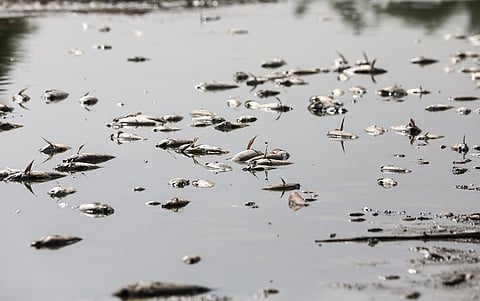
The images emerging from Sanjay Lake in Delhi are disturbing: cracked lakebeds, shrinking pools of water, and hundreds of dead fish floating to the surface during an intense heatwave. Authorities attributed the incident to a leaking pipeline and reduced inflow during repair work. But a city does not lose a lake ecosystem merely because of one damaged pipe. What collapsed at Sanjay Lake was not only a water supply system — it was an entire system of urban ecological accountability.
This is not an isolated environmental accident. It is part of a larger urban pattern playing out across Indian cities, where lakes are increasingly treated as decorative spaces or real estate buffers rather than living ecological infrastructure. And as heatwaves intensify due to climate change, these neglected systems are beginning to fail visibly.
Urban lakes perform functions that cities often notice only after they disappear. They regulate temperature, recharge groundwater, absorb excess rainwater, support biodiversity, and reduce the urban heat island effect — the phenomenon where built-up concrete areas become significantly hotter than surrounding regions. In rapidly expanding cities, these water bodies are among the few natural cooling systems left.
But Indian cities have spent decades weakening them.
Take Bengaluru, once known for its interconnected network of lakes. A IISc-linked study found that the city now contains nearly 200 “heat archipelagos” — clusters of urban heat islands created by dense construction, disappearing green cover, and degraded water bodies. Built-up areas in Bengaluru increased from 8 per cent in 1973 to 87.6 per cent in 2025, while vegetation and water systems sharply declined. Surface temperatures in some parts now touch nearly 48°C during peak summer.
The ecological decline of Bengaluru’s lakes has become internationally symbolic. Bellandur Lake repeatedly caught fire due to toxic sewage inflow and chemical pollution. The lake also produced massive toxic foam that spilled onto nearby roads. Scientists and activists have long warned that untreated sewage, encroachments, and fragmented governance transformed what was once an interconnected water system into an ecological hazard.
Delhi may not have Bengaluru’s historic lake network, which makes its remaining water bodies even more important. Yet incidents like Sanjay Lake reveal how vulnerable these ecosystems have become. A single pipeline disruption reportedly reduced inflow enough to trigger ecological stress and fish deaths during extreme heat. That should concern us deeply, because resilient ecosystems are not supposed to collapse so quickly.
Heatwaves amplify every weakness cities already carry. When temperatures rise, oxygen levels in stagnant water decline, evaporation increases, and aquatic systems become fragile. Lakes already stressed by pollution, sewage inflow, shrinking catchments, or poor maintenance become highly vulnerable. Climate change does not create these weaknesses from nothing, it exposes and intensifies them.
And yet, urban governance continues to respond in fragments. There is always a technical explanation: a leak, a maintenance delay, a sewage overflow, an encroachment dispute. Rarely is the crisis acknowledged as systemic.
This is where the conversation must move beyond advisories. Every summer, governments urge citizens to stay hydrated, avoid afternoon heat, and remain indoors. These are necessary public health measures, but they cannot substitute structural environmental governance. A city cannot “adapt” to climate change while simultaneously destroying the ecosystems that regulate heat and water security.
The deeper issue is that environmental protection in India is often treated as secondary to urban expansion. Lakes shrink because buffer zones are reduced, construction pressure increases, and enforcement remains weak. In Karnataka, environmental groups recently opposed moves to reduce lake buffer zones, warning that this would worsen flooding, biodiversity loss, and urban heat impacts. These warnings are not theoretical anymore; cities are already experiencing their consequences.
What happened at Sanjay Lake should therefore not be viewed as an unfortunate episode involving dead fish. It should be understood as a climate warning.
Because when lakes disappear, cities lose more than water. They lose cooling systems, flood buffers, biodiversity corridors, and public ecological spaces. They also lose resilience.
The uncomfortable truth is that Indian cities are still planned as if ecology is optional. Water bodies are revived cosmetically, not systemically. Rejuvenation projects often focus on beautification while ignoring sewage inflow, groundwater connections, catchment restoration, and long-term ecological monitoring. Even where restoration efforts begin, implementation frequently stalls. At Bellandur Lake, for example, large-scale rejuvenation work launched years ago continues to face delays, disputes, and concerns over ecological effectiveness.
Climate change demands a different imagination of urban governance.
Cities must begin treating lakes as essential climate infrastructure. That means strict protection against encroachments, continuous ecological monitoring, transparent public reporting of water quality and inflow systems, and stronger accountability across agencies. It also means recognising that sustainability is not merely about planting trees or issuing green pledges, it is about protecting the ecological systems that make urban life survivable.
Citizens cannot remain detached from these failures. Public resources are often seen as the government’s responsibility alone, until collapse becomes visible. But environmental accountability also depends on sustained civic pressure, questioning illegal construction near lakes, demanding transparency around restoration projects, and recognising that ecological decline affects everyone, regardless of class.
The dead fish at Sanjay Lake are not only casualties of a heatwave. They are evidence of how fragile Indian cities have become in the face of climate stress.
Ritu Kumari is a development professional. She holds an MA in Development from Azim Premji University, Bengaluru and has worked with Gram Vikas in Odisha
Views expressed are the author’s own and don’t necessarily reflect those of Down To Earth