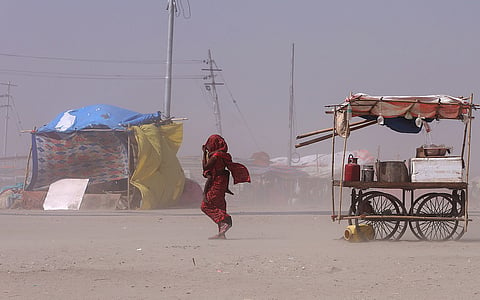


In the summer of 2024, Uttar Pradesh did not just face a heatwave — it endured the longest stretch of extreme heat India had recorded since 2010. Temperatures across the state’s plains breached 40°C for an entire month. Across India, more than 44,000 cases of heatstroke were reported, and independent monitors documented hundreds of heat-related deaths that official tallies chose not to count. Uttar Pradesh, home to over 240 million people, is among the ten states with the highest aggregate heat risk in India. Cities such as Kanpur, Varanasi, and Prayagraj — once classified as dry-heat zones — now record humidity levels that compound thermal stress far beyond what temperature readings alone convey.
The science of heat stress in the Indo-Gangetic Plain is settled. What remains dangerously unsettled is the governance. Researchers, meteorologists, and public health experts have spent two decades generating data, projections, and warnings. Yet the institutional machinery designed to translate that knowledge into protection — Heat Action Plans, disaster relief funds, and early warning systems — continues to fail the people most exposed. India’s heat crisis is real; but the deeper crisis is political and administrative.
Uttar Pradesh does maintain a Heat Wave Action Plan. The UP State Disaster Management Authority published its 2024 version, and in a genuinely significant step, the state became the first in India to establish district-specific heatwave thresholds across all 75 of its districts — a three-tier alert system calibrated to local temperature baselines, ranging from yellow (36-40°C) to red (above 41°C). This is a meaningful policy advance. But a threshold system without an enforcement chain is little more than a weather forecast.
The structural problem is that most Heat Action Plans in India lack vulnerability mapping — the identification of which communities, occupational groups, and geographies face the highest risk within a district. A CEEW review of 15 publicly available state-level Heat Action Plans found that only two had undertaken heat risk and vulnerability assessments — the very assessments that determine where resources go and which populations receive protection first. UP’s HAP, despite its district-threshold innovation, does not differentiate between the agricultural labourer in Banda working in open fields and the construction worker in Kanpur working on a concrete site. Both face extreme heat; both face it differently; and neither receives a differentiated response.
A threshold system without an enforcement chain is little more than a weather forecast. UP’s district-specific alerts represent progress — but alerts that reach no one protect no one.
The last-mile communication gap compounds this. A training workshop convened in Lucknow in July 2024 by NRDC and India’s NDMA explicitly identified governance and last-mile delivery as the binding constraints on HAP effectiveness — not the absence of plans, but the absence of accountability for implementing them. ASHA workers, block-level health officers, and gram panchayat heads — the actual frontline of any emergency response in rural UP — receive no structured training on heat protocols, no heat-specific communication scripts, and no defined role in the activation chain when a red alert is triggered.
India’s disaster finance system operates through two principal channels: the State Disaster Response Fund (SDRF) and the National Disaster Response Fund (NDRF), constituted under the Disaster Management Act of 2005. Together, these funds account for the overwhelming majority of the country’s disaster management expenditure. Their central limitation, where heat is concerned, is structural: heatwaves are not classified as a notified disaster under the Disaster Management Act. The current notified list includes twelve categories — cyclone, drought, earthquake, flood, landslide, and others — but heatwave is absent.
The practical consequence is severe. States are only permitted to use up to 10 per cent of their SDRF allocation for disasters they self-classify as local or state-specific, and NDRF support is unavailable to them entirely. For a state like Uttar Pradesh — with 75 districts, over 240 million people, and one of the highest aggregate heat-risk profiles in the country — a 10 per cent access ceiling on an already limited fund is not a safety net; it is a bureaucratic fiction.
Heatwaves in the Indo-Gangetic Plain now kill more people annually than most notified disasters. The 15th Finance Commission’s refusal to add heat to the notified list reflects a fiscal calculus, not a scientific one.
The resistance to notifying heatwaves as a national disaster is not primarily scientific — it is financial. Notification would require the government to pay Rs 4 lakh in compensation for each confirmed heat-related death, which creates an immediate incentive to suppress mortality counts. States have raised the demand before three successive Finance Commissions; all three declined to expand the list. The 15th Finance Commission’s reasoning — that the existing list covered state needs adequately — is impossible to reconcile with the data. Approximately 57 per cent of India’s districts, home to 76 per cent of the population, now face high to very high heat risk. No credible reading of the data supports the conclusion that the current funding architecture is adequate.
India’s meteorological infrastructure has improved significantly. The India Meteorological Department now issues colour-coded heat alerts — yellow, orange, and red — and has introduced a Heat Index that incorporates humidity alongside temperature, providing a more accurate measure of physiological heat stress than temperature alone. UP’s SDMA has built on this foundation with its district-threshold system. The warning infrastructure, at the technical and institutional level, now functions reasonably well.
The failure is at the delivery layer. Relative humidity across the Indo-Gangetic Plain has increased by up to 10 per cent over the last decade, transforming cities such as Kanpur and Varanasi from dry-heat zones into zones of dangerous moist heat stress. Research shows that temperatures exceeding 32°C combined with humidity above 60 per cent create hazardous physiological conditions — yet IMD’s public communication system does not yet routinely present wet-bulb or Heat Index readings to lay audiences. The red alert reaches the District Magistrate’s office; it does not reliably reach the agricultural worker at 7 AM deciding whether to enter the field.
The economic toll of this communication gap is quantifiable. A one-degree increase in mean temperature reduces daily earnings of informal workers by 16 per cent; during peak heatwave periods, earnings fall by 40 per cent compared to other days. UP’s informal economy — construction, agriculture, street vending, brick kilns — absorbs this shock silently, without compensation, without recorded attribution, and without institutional response.
The red alert reaches the District Magistrate. It does not reach the agricultural labourer deciding at dawn whether to enter the field. That gap is not a technology problem — it is a governance design problem.
The Indo-Gangetic Plain does not lack data on heat risk. It lacks a governance architecture that treats heat as the public emergency the data says it already is. Three institutional corrections are both necessary and actionable. First, UP must operationalise its district-threshold system by embedding heat-alert protocols into the existing ASHA, ANM, and gram panchayat communication networks, with specific early-morning dissemination before 9 AM on red-alert days — reaching workers before they enter the field, not after. Second, the Union government must notify heatwaves as a Tier-1 disaster under the Disaster Management Act, unlocking full SDRF and NDRF access and eliminating the perverse incentive to undercount heat deaths. Third, IMD’s Heat Index must move from its current experimental status to a standardised public communication tool, displayed alongside temperature in all public forecasts and integrated into HAPs at the district level.
The science of heat stress in the northern plains has never been the constraint. Political will and institutional design are. Every summer that passes without these corrections is a policy choice — and its costs are borne entirely by those with the least ability to bear them.
Ankit Mishra is a Research Scholar at Govind Ballabh Pant Social Science Institute, Prayagraj, where his work focuses on environment, climate change, public policy & governance.
Views expressed are the author’s own and don’t necessarily reflect those of Down To Earth