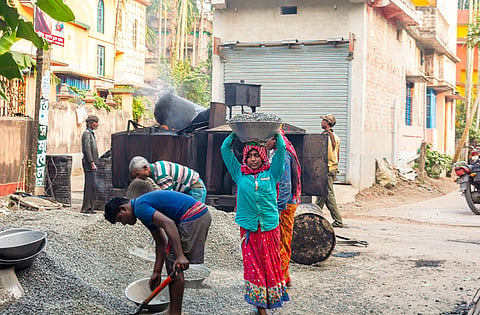


India’s summers have become longer and more intense. Heatwaves now begin as early as February in the south, persist through October in the east, and each year arrive sooner, affect more regions and temperatures break new records; with 40°C now routine rather than exceptional. Nights offer no respite, safe working hours shrink, earnings fall, and homes turn uninhabitable after dark — especially in cities. For India’s millions of informal workers and marginalised communities, heat has become a daily reality.
Since Ahmedabad’s pioneering Heat Action Plan (HAP) in 2013, over 250 cities and districts across 23 states now operate HAPs built on graded alerts, public advisories, cooling shelters, and initiating inter-departmental coordination and to a certain extent institutionalising heat as a public health emergency. Yet their shortcomings run deeper than just legal enforceability or funding: the core problem is design of our HAP framework. Most HAPs treat heat as an event rather than centre the people it affects most. The last decade tells us that weather thresholds, generic advisories and limited funding cannot shield those whose exposure is shaped not by temperature alone, but by occupation, housing, and socio-economic status is the precise gap where most HAPs, including Delhi’s, fall short. Informal workers, the homeless, migrants, and women (outside of pregnant women) groups constituting the majority of India’s urban population appear, if at all, as afterthoughts; rarely does a HAP include dedicated analysis by occupation, settlement type, or social position.
Delhi’s HAP, among the country’s more comprehensive, articulates graded alert levels to trigger department-wise action for the informal workers, directs the Labour Department to shift outdoor work away from peak hours, and mandates rest sheds, drinking water, and worksite health check-ups. Its 2026 update also added provisions for water supply and cooling shelters in informal settlements, naming pregnant women and the elderly for special care. Yet when measured against Delhi’s actual number of informal workers and diverse communities, even this plan’s general vulnerability categorises obscure a vast population. Across at least 14 occupational categories, from construction workers and street vendors to waste pickers, domestic workers, sanitation workers and other workers are an estimated 50 lakh (5 million) workers face acute heat exposure without protections calibrated to their conditions. And find themselves without any mention, acknowledgment and actions for them in the Delhi HAP.
The gap is structural to HAPs in India. Close to 90 per cent of India’s workforce is informal without contracts, fixed worksites, or social security yet HAPs miss this population group without designing for it. Nearly every entitlement the HAP describes is attached to a fixed worksite and a registered employer, the two conditions that the vast majority of Delhi’s informal workers simply do not have. Street vendors, numbering over 2-3 lakhs across the city’s markets, have no employer to receive an inspection and no worksite to mandate provisions. Delhi’s construction workforce numbers close to a million, yet only a small fraction are registered with the welfare board that gates most heat entitlements. Heat, for these communities, is not a periodic emergency. It is a daily occupational and also a residential condition. A plan that does not recognise this distinction cannot be designed around those who experience it.
Most HAPs, Delhi’s included, treat “informal outdoor workers”, “women” and “the elderly” as flat risk categories without differentiating by occupation category, housing/settlement types, or social position. This is not merely an analytical shortcoming. It is a design failure with direct consequences for who gets protected and who does not.
Heat vulnerability is not a natural characteristic of certain bodies. It is structurally produced. A street vendor in direct midday sun, a home-based worker under a tin roof, and a sewer-cleaning sanitation worker all appear as “outdoor” or “informal worker” in most plans, yet each requires an entirely different intervention. Caste, gender, settlement type, and occupational informality intersect and compound: who someone is, where they live, and what work they are pushed into? These intersecting factors are conspicuously absent: yet they determine which workers are locked into the most hazardous occupational categories, like women-led home-based workers — inhabit the most heat-trapping homes and are systematically excluded from the welfare registries that gate most HAP entitlements. The problem here is: the vulnerability framing identifies who is at risk without explaining why. It treats as natural what is structurally produced placing the burden on communities to cope rather than on systems to change. A social inclusion framework begins from the opposite premise: that the conditions producing risk must be named, mapped, and addressed through targeted intervention.
The communities most exposed to heat are not passive recipients of risk, they are its most detailed witnesses. Workers navigating heat daily across markets, construction sites, and informal settlements carry lived knowledge about exposure, timing, and coping that no HAP currently captures. A planning framework that ignores this does not merely miss an opportunity. It designs around a workforce that does not exist formal, contracted, and reachable through employer mandates. State action alone cannot close this gap. Community networks, worker associations, and local institutions are not supplementary to heat planning; they are the infrastructure through which plans can realistically reach those most at risk. A social inclusion framework treats these communities as co-designers of heat response, not just targets of it.
First, HAPs need an explicit social inclusion framework rooted in placing the most marginalised communities at the centre of heat planning, not at its margins. Vulnerability must be understood not as a static characteristic but as the outcome of structural conditions: who someone is, where they live, and what work they are compelled to do.
Second, HAPs must discard their oversimplified vulnerability framing. The shorthand of “outdoor workers, women, pregnant women, children, and persons with disabilities” does not produce sector- or group-specific action. Indian cities contain a wide variety of outdoor and indoor workers mostly informal, whose residential vulnerabilities are further compounded by social and economic marginalisation. Without an expanded vulnerability framework that reflects this complexity, HAPs will remain tokenistic documents rather than genuine instruments of protection.
Third, every HAP must include a dedicated chapter on communities, organised by occupation, settlement type, economic and social location. Building on the NDMA’s 2025 advisory on informal workers and vulnerable groups, such a chapter should detail estimated numbers, working-living conditions, and specific vulnerabilities, the only basis on which group- and sector-specific heat actions can be meaningfully planned and resourced. Furthermore, specific financial percentage allocations to the expanded vulnerable-marginalised communities is also essential to ensure dedicated actions.
Fourth, community participation must move from tokenistic consultation to genuine co-design, drawing on the worker-community-association partnerships already piloted in Delhi to institutionalise the community’s participation in planning, implementation and monitoring. Given the scale of the challenge and the limits of public resources, this is not merely desirable; it is operationally necessary. Effective heat responses depend directly on community knowledge, networks, and preparedness.
Finally, HAPs must shift from coordination to genuine collaboration, co-governance and co-ownership across departments responsible for labour, housing, health, urban development, and social welfare. A heat plan that cannot speak the language of social protection, housing, and labour rights is not yet a plan for the communities it names. Treating worker and community vulnerability as separate silos will continue to misallocate resources away from those who need them most.
Heat justice begins with designing plans for people. Closing the gap between recognition and protection requires changing how HAPs are written and implemented, not just what they state on paper.
Aravind Unni is an urban practitioner and policy researcher working on cities, informal work, and climate justice. Shalini Sinha is Asia strategy lead at Women in Informal Employment: Globalizing and Organizing (WIEGO). Niutoli Yepthomi is pursuing a master’s in urban studies at Dr. B. R. Ambedkar University Delhi.
Views expressed are the authors’ own and don’t necessarily reflect those of Down To Earth