
Subscribe

Climate experts have expressed serious concern about the future of winter games even as less than a week remains for the next Winter Olympics which start on February 6, 2026.
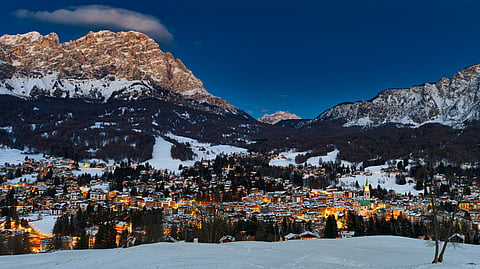
The games are to be held in Cortina d’Ampezzo, in the heart of the Italian Alps. However, a recent study has noted that even the high-altitude Alps do not seem to have enough snow at the peak of winter to hold Winter Olympics due to the impact of climate change.
Experts have also highlighted how the temperature of Cortina has warmed up by 3.6 degree Celsius (°C) in the last 70 years from 1956, when it last hosted the winter Olympics.
An analysis from Climate Central, a global organisation of scientists working on climate change, warned that the signature global athletic event will be affected deeply by rising temperatures, disappearing snow and increasing reliance on artificial snow.
“Rising global temperatures, driven by the burning of fossil fuels, are reshaping the very foundation of winter sports. Our analysis shows that host regions for the Winter Olympics have warmed substantially over the past decades, with fewer freezing days and less reliable natural snow cover than in the past,” Kristina Dahl, Climate Central’s vice president for science told this correspondent recently.
The Climate Central analysis found that the town experiences 41 fewer freezing days annually than it did in 1956.
The average February snow depth in Cortina has gone down due to climate change-induced temperature rise by about 15cm between 1971 and 2019, the analysis noted. It also pointed out that average February temperatures in the last 19 host cities had risen by 2.7°C between 1950 and 2021.
The analysis cited a 2024 study by Robert Steiger and Daniel Scott which claimed that of 93 potential host cities, only 52 will have the conditions to host the Winter Olympics in the 2050s.
“Given the depletion of natural snow under impact of global warming, the Winter Olympics this year will require more than 3 million cubic yards of artificial snow, despite being hosted in the high-altitude Italian Alps,” says an expert associated with the study.
The events will be centred around Cortina in northern Italy. Most of the indoor events will take place in Milan and most outdoor events will be hosted near Cortina.
Given the circumstances, concerns about the long-term viability of outdoor winter sports are being raised. Use of artificial snow also raises concerns about the safety of the outdoor games.
“I prefer real snow, and I am confident that many others would say the same. Nowadays, almost all ski races are held on artificial snow,” Björn Sandström, a Swedish professional cross-country skier, told this correspondent recently.
“The situation turns challenging when there is little or no natural snow, a trend becoming more frequent each year, and only a short period of cold temperatures exists before a race. In those cases, the ski track is often both shorter and narrower than it should be. This leads to competitions that are not fair for athletes starting further back in the field, because passing becomes almost impossible. So warm weather clearly results in poorer and less fair competition,” added the athlete.
“I hardly have played on artificial ice and always played on natural ice in Gulmarg and found it extremely convenient … I feel natural snow should be much better for winter sports,” Muskaan Nabi, a national level curling player from Kashmir told this correspondent earlier.
The future looks worse for the Winter Paralympics, to start this year on March 6. Only 22 of 93 potential host cities will have the right conditions for the event in the 2050s, due to climate change-induced temperature rise.
The analysis pointed out that climate change is affecting specific winter sports, including alpine skiing, snowboarding, and bobsledding. Shortened seasons, event cancellations, fairness and safety challenges are all linked to warming and artificial snow and ice.
As warming continues, fewer locations will reliably produce natural snow in February — the traditional month for the Winter Games. The pool of cities able to host without heavy reliance on snowmaking will shrink significantly by the 2050s, and outdoor snow sports competitions will face increasing challenges to safety and fairness, said Dahl.
Quizzed about whether the use of less natural snow increases costs, the official responded in the affirmative: “Yes, these climate-driven shifts are already increasing costs. Producing and transporting artificial snow — and in some sports, refrigeration systems — requires substantial energy and water, adding to the budget of winter sport events.” The experts pointed out that artificial snowmaking, though more efficient compared to earlier, still carry a carbon footprint, especially if powered by fossil energy.
The concern also covers athletes.
Resistant and hard surfaces are a prerequisite for elite winter competitions, as they ensure fair and safe conditions for athletes.
If surfaces do not refreeze, the risk of injuries goes up. Athletes who feature later in the start list are likely to experience less favourable conditions, says the analysis.
With rising temperatures, it has also become difficult for athletes to find places to practice for the winter sports.
