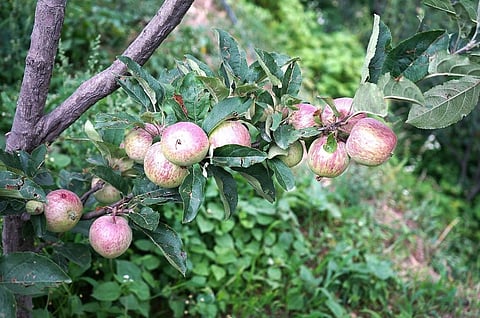


Apple orchards in Uttarakhand’s Ramgarh–Mukteshwar belt are caught in a cascading chain of risks, from inadequate winter chilling and shrinking pollinator habitats to rising pests, wildlife attacks and extreme weather.
Field interviews with farmers and experts reveal how uncoordinated chemical use, poor market access and lack of storage push growers into uncertainty, eroding yields and livelihoods.
Within Uttarakhand, districts such as Almora, Pithoragarh, Tehri Garhwal, Uttarkashi, Chamoli and Nainital form the backbone of apple production, with Uttarkashi leading the charts. But in the mid-hill belt of Ramgarh–Mukteshwar, at an elevation of 1,400–2,400 metres in Nainital district, where apple farming once flourished, farmers now speak of a slow but steady decline.
This article is based on field interactions with local farmers, officials, ecology experts and horticulture specialists. It looks at how the decline in apple production is not an isolated event, but part of a complex web of risks. From winter chilling and pollination to wildlife, labour and market access, each stage influences the next, turning one disruption into another.
Apple cultivation begins with winter, long before the trees start flowering. Apple trees require 1,000–1,500 chilling hours, with temperatures below 7 degrees Celsius, to break dormancy and resume normal growth. But these chilling conditions are becoming increasingly difficult to achieve.
Farmers across the region report declining snowfall and erratic winters. ‘It used to snow 2–3 feet earlier. Now we wonder what snow even is,’ says Bacchii Singh Bisht, a farmer from Supi village.
Insufficient winter chilling does not only delay flowering. It also affects fruit quality, reduces colour development and increases susceptibility to pests and diseases such as apple scab and red spider mites. According to a representative of the Horticulture Department, the decline in production is closely linked to changing winter patterns.
For two to three weeks each year, apple orchards depend heavily on pollinators. This short blooming period has now become a critical bottleneck.
Deewan Singh Thapa, an experienced farmer, points to a less visible challenge: shrinking forest patches. ‘Wild pollinators used to move freely between forests and orchards. Now, those interconnections are weakening,’ he says.
Pollination is a landscape-level process. It does not stop at farm boundaries. While some farmers keep beehives, others depend entirely on wild pollinators. At the same time, pesticide and weedicide applications are often carried out independently by individual farmers.
This uncoordinated use of chemical sprays can disrupt pollinator habitats and movement, creating a shared risk. The decision of one farmer can affect pollination services for many others. The consequences often become visible only months later, when poor pollination leads to lower fruit set and reduced harvests.
Even when flowering is successful, the transition to fruit remains uncertain. Farmers often struggle to understand why fruit setting fails. Some attribute losses to pests, others to erratic weather or declining pollinator numbers. This lack of clarity leads to reactive decisions.
‘Farmers here don’t want to rely on chemicals, but most of the time uncertainty pushes them towards more spraying,’ says Than Singh Mer from Dubkhad village.
This cycle of doubt, precaution and increased chemical use not only raises costs, but also risks long-term ecological imbalance.
As fruits begin to mature, farmers face risks that are largely beyond their control. Monkey and wild boar attacks are common, often damaging both trees and produce. Girish Chandra Sharma from Hartola village says such losses directly reduce yields.
Extreme weather events such as hailstorms and heavy rainfall are also becoming more frequent. A single spell can put an entire season’s produce at risk. Despite these recurring losses, compensation mechanisms remain limited or difficult to access, leaving farmers exposed.
At the harvest stage, farmers encounter another layer of vulnerability: market access.
The absence of local storage and processing infrastructure forces farmers to depend heavily on intermediaries. Smaller farmers often sell their produce early to pre-harvest contractors, while larger growers navigate commission-based markets.
‘Without cold storage or direct market links, we cannot control when and where to sell,’ says Chandan Singh Gaur from Satbunga village.
This dependency weakens bargaining power, often forcing farmers to accept lower prices. In effect, value moves away from growers and towards traders.
Beyond climate and markets, another shift is underway. Younger generations are moving away from agriculture in search of more stable livelihoods. This has led to a decline in the traditional knowledge needed for orchard management.
As a result, many orchards are either poorly maintained or abandoned altogether, raising concerns about the long-term future of apple cultivation in the region.
The reasons behind declining apple cultivation remain contested. Vishal Singh, a translational ecologist, says the decline cannot be explained by climate change alone and points to policy failures as an important factor.
The Horticulture Department, meanwhile, highlights its Programme for Advanced Development of Apple Cultivation, which is designed to support farmers through the provision of saplings, tools and other inputs. Farmers, however, tell a different story. Many believe that benefits from government schemes are unevenly distributed, often favouring larger or more influential growers.
The story of apple cultivation in this belt of Uttarakhand is therefore not about a single risk. It is about interconnected risks reinforcing one another.
Ecological vulnerabilities dominate the pre-harvest phase, from winter chilling and pollination to pests, wildlife and extreme weather. After harvest, institutional and market limitations determine how much value farmers are able to retain.
Addressing these challenges requires a shift from fragmented interventions to a landscape-level strategy that integrates climate resilience, ecological restoration and fairer market systems.
With a more coordinated approach, apple production in this belt of Uttarakhand may still recover. But resilience will depend on recognising that farmers are not facing one problem at a time. They are facing a chain of risks, and each link needs attention.
Views expressed are the author’s own and don’t necessarily reflect those of Down To Earth