

For months I had been watching El Niño build on a screen — El Niño Southern Oscillation (ENSO) probabilities climbing week after week, sea-surface temperatures warming in the equatorial Pacific, the seasonal outlooks tilting steadily towards “below normal.” It is one thing to read a risk in a dashboard. It is another to feel it in the soil. So, I set out to do the latter: a 400-kilometre, nine-hour drive from Pune to Sambar village in Parbhani district, into the heart of Marathwada, to see whether the field would tell the same story our forecasts were telling.
It did.
I usually return home in late June to the familiar rhythm of the southwest monsoon — a drizzle that settles in and builds towards heavier July rains. This year that rhythm was missing. In conversations with family and neighbours across Pune and the drought-prone districts beyond, the message was the same: little rain, and a monsoon that was arriving late. The realisation was painful, because our recently launched ENSO outlook had already flagged exactly this. India had entered June with a rainfall deficit of around 38 per cent as the monsoon stalled on its way inland, and the India Meteorological Department’s seasonal forecast points to a below-normal season of roughly 92 per cent of the long-period average — driven, in large part, by an El Niño that the United States National Oceanic and Atmospheric Administration has now confirmed is present and strengthening, with a strong chance of intensifying to a very strong event by winter.
Marathwada and Vidarbha — districts such as Parbhani, Nanded and Beed — sit precisely where these shocks land hardest. They are among the least-developed and most frequently drought-affected regions of Maharashtra, where a failed or delayed monsoon does not just dent yields; it compounds debt, distress and migration. This is the terrain where a forecast has to translate into a decision a farmer can actually act on.
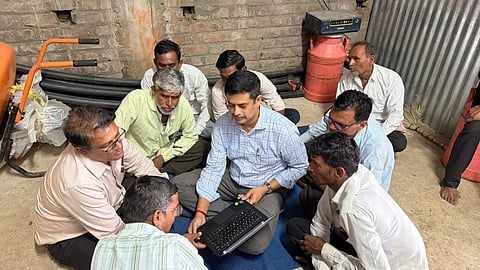
My first stop was Vasantrao Naik Marathwada Krishi Vidyapeeth (VNMKV) in Parbhani, where I met agricultural scientists to understand conditions on the ground and, through them, ran an online demonstration of SukhaRakshak AI for the State Agriculture Department. SukhaRakshak AI is a multilingual, AI-enabled drought advisory system developed by International Water Management Institute and supported by CGIAR Programs on Climate Action and Sustainable Farming, and Digital Transformation Accelerator to put timely, actionable climate and agronomic guidance directly into farmers’ hands. More than 100 officers joined the session to explore how the drought advisory tool could support preparedness and mitigation — not only for the immediate sowing window, but across the rest of the Kharif season and into Rabi planning. The response was encouraging: officers saw it as a practical companion to the excellent groundwork the Government of Maharashtra is already laying through its Maha-VISTAR AI farmer-advisory initiative.

Then I went to where it matters most — the field. In Sambar, I sat with farmers, opened the app in their own language, and watched them read it for themselves. What struck me was not just their interest, but how quickly the advisory moved from information to intention.
Vikas Chavan explained the contrast plainly. Last Kharif, unseasonal rainfall of over 150 mm between May 15 and 30 let him complete his soybean sowing on time. This year, with the rains delayed, nothing beyond ploughing had begun.
Prabhakar S Chavan had already changed his plan because of the app. With SukhaRakshak AI flagging an extended dry spell over the next two months — one that would strike soybean at its vulnerable flowering stage — he intended to switch to cotton with a short-duration variety. “Better to reduce the risk and protect some yield and income,” he said, “than face total loss.” For him, the recommendation was not abstract; it was the difference between a harvest and none.
Shivaji S Chavan reached a similar conclusion from a different starting point. Acting on the advisory, he plans to move away from soybean to pigeon pea, using the short-duration BD711 variety better matched to the shortened, drier window.
Sachin K Chavan looked further ahead, to in-season management. With reliable weather updates and advisories in hand, he saw the app guiding day-to-day decisions: timing fertiliser application to wind conditions, managing pests and disease, and optimising sprinkler irrigation around wind speed to cut losses.
Four farmers, four different but disciplined responses to the same emerging threat — each one a small act of anticipation in place of a costly reaction. That is exactly what climate-smart advisory is meant to enable: not predicting the future perfectly but helping people plan sensibly against the odds.
This visit is a beginning, not a conclusion. In the coming weeks, working with VNMKV, we will run a series of interaction programmes to test how SukhaRakshak AI can complement existing information channels — including Maha-VISTAR AI — and to gather the regular, ground-level feedback that keeps a tool honest and useful. Every conversation in Sambar sharpens the next version.
The deeper lesson is one I carried back along that long road to Pune. With a strong El Niño shaping this season, the value of an advisory lies in its timing. Guiding farmers early — before sowing decisions are locked in — turns a looming dry spell from a disaster into a manageable risk. That means looking past this Kharif alone to the full-season outlook and on to Rabi planning, anticipating the compounded shocks that drought brings rather than chasing them after the damage is done.
For months, El Niño was a probability on my screen. In the fields of Marathwada, it became a question farmers were already answering — and, with the right knowledge in their hands, answering well.
Giriraj Amarnath is Research Group Leader, Water Data for Climate Resilience, International Water Management Institute (IWMI)
The views and opinions expressed in this article are those of the author and do not necessarily reflect the official position of the International Water Management Institute (IWMI) or of Down To Earth