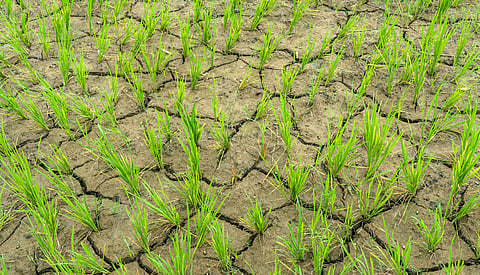


On May 15, the India Meteorological Department (IMD) forecast that the southwest monsoon would reach Kerala by May 26, five days ahead of the usual date. It arrived on June 4, three days late. That nine-day gap, at the coarsest scale the monsoon is tracked, an entire coastline rather than one farmer’s field, is this year’s monsoon story in miniature. If the model can move nine days at the scale of a state, the room for error at the scale of a single sowing decision is larger still. For the roughly half of India’s cultivated area that depends on rainfall alone, with no canal or borewell to fall back on, that gap is not academic. It is the difference between a crop and a reseeding bill.
IMD’s second stage forecast, issued on May 29, put the 2026 southwest monsoon at 90 per cent of the long-period average for the June to September season, with a model error of about 4 per cent. Read as a single national number, that is a mild deficit, not a crisis. The distribution behind the number is less reassuring. IMD’s own five-category forecast placed an 84 per cent probability on below-normal or worse rainfall and a 60 per cent probability on an outright deficient season, below 90 per cent of the average. Then June delivered. The month closed about 40 per cent below normal, the fifth-driest June since national records began in 1901, before rainfall revived in July.
On June 11, the US National Oceanic and Atmospheric Administration issued an El Niño advisory, confirming conditions India’s own long-range models had flagged through the pre-monsoon months. El Niño tends to suppress Indian monsoon rainfall, but the relationship is real without being deterministic: it interacts with the Indian Ocean Dipole, the Madden-Julian Oscillation, and intraseasonal breaks and revivals in ways that resolve only in hindsight. IMD itself attributed the steep June deficit partly to a weak Madden-Julian Oscillation and an absence of low-pressure systems, not to El Niño alone. Nor is the dipole offering a cushion in time. It is neutral through the sowing months, with a positive phase, which would tend to support rainfall, forecast only towards the end of the season, after most sowing decisions have been made. What can be said is that the agriculture ministry has flagged 315 districts as exposed to possible El Niño-linked stress, of which 111, all with under 25 per cent irrigation cover, are treated as high priority. The seasonal aggregate reassures at the national level while telling a farmer almost nothing about the next ten days.
The sowing data makes the gap between the aggregate and the ground concrete. As of July 10, Kharif crops had been sown across 531.25 lakh (53.125 million) hectares against 632.69 lakh (63.269 million) hectares in the same week last year, a shortfall of about 16 per cent, itself an improvement on the nearly 21 per cent gap recorded five days earlier as July rainfall picked up. The recovery is uneven across crops. Paddy is down only 8.6 per cent, and its acreage still sits above the normal for this point in the season. Cotton is down about 15 per cent. Oilseeds are down 21 per cent, coarse cereals 22.5 per cent, and pulses are the worst hit at 23.3 per cent.
This unevenness is not incidental. Pulses, coarse cereals, and oilseeds, precisely the categories showing the steepest shortfalls, are the crops most concentrated in India’s rainfed tracts: roughly 83 per cent of pulses, 85 per cent of coarse cereals, and 70 per cent of oilseeds are grown without assured irrigation. Rainfed cultivation accounts for about 51 per cent of the country’s net sown area and nearly 40 per cent of its food output, according to the Union Ministry of Agriculture and Farmers’ Welfare, and it is also where landholdings run smaller, and the capacity to absorb a failed sowing is thinner. There is a second reason these crops are exposed. They are the most calendar-bound: close to two-thirds of the pulses, oilseeds, and coarse-cereal area is normally sown in July, the very window in which the rains stalled. And the picture is still moving. IMD’s mid-July outlook flagged another likely lull over the plains of northwest India, west-central India, and the southern peninsula, meaning the gap that narrowed between July 5 and 10 is not guaranteed to keep narrowing.
Long before the long-period average, cultivators tied Kharif sowing to Ashar, the solar-calendar month of the rains in eastern India, roughly mid-June to mid-July, and to its lunar counterpart Ashadha across much of the rest of the monsoon belt. That calendar was never a forecast, and it is worth being exact about what it was. Its position in the year is set by the sun and the moon, not by the monsoon, so a late monsoon does not make it fall late. What the month encoded was the average timing of the rains in a given tract, the same kind of long-run expectation that IMD’s normal onset date encodes at the national scale.
The skill that actually guided a sowing decision sat elsewhere. It lay in reading local cues against that fixed anchor: the first real rains, soil moisture, wind, and sidereal markers such as the Ardra nakshatra around June 22, which, unlike a drifting lunar month, stay fixed to the season year after year. That observational layer, not the month itself, told a farmer whether to sow this week, wait another ten days, or resow after a false start, and it worked at exactly the grain, a specific block in a specific week, that IMD’s seasonal aggregate does not reach. A monsoon that moves as erratically as this one, early by five days in the forecast and late by three in fact, steady in one district and stalled in the next, strains that practice, and a shifting climate erodes the regularities it rested on. The point is not that the old calendar out-forecast the model; it could not, because it marked the average year, not this one. The point is that the local, observation-to-decision layer it supported has not been rebuilt, and nothing now fills the gap at the scale where sowing actually happens.
The policy instinct in a below-normal year is to sharpen the seasonal forecast: narrower error bars, more confident percentages. That is worth doing, but it does not close the gap this piece has described, because the gap is not about forecast accuracy at the national scale. It is about the absence of decision support at the scale where sowing actually happens: the week, the block, and the plot.
Two things would close it more directly. The first is sowing guidance that is genuinely local and genuinely current, built and revised through the season from district and sub-district rainfall rather than issued once and left to stand. The country’s 731 Krishi Vigyan Kendras already issue weekly advisories in principle; whether those advisories are granular and fast enough to substitute for place-specific knowledge deserves an honest accounting rather than an assumption either way. The government’s own current advice, to wait for 75 to 100 mm of cumulative rainfall before sowing, is a single national threshold standing in for exactly the local judgment that Ashar once supplied.
The second is a safety net that treats resowing as a normal, insurable event rather than a farmer’s private loss. The Centre has stockpiled a seed buffer, about 1.74 lakh (0.174 million) quintals, earmarked partly for resowing. But seed availability is only half the problem: the farmer still carries the cost and the timing risk. The Pradhan Mantri Fasal Bima Yojana does carry a prevented-sowing provision, yet it is area-based. It triggers only when more than 75 per cent of a notified unit stays unsown, pays up to a quarter of the sum insured, and then terminates the coverage. That design sits awkwardly against the plot-level, resow-after-a-false-start problem described here, and the scheme is voluntary, so coverage is patchy. Whether it reaches farmers at the pace this volatility demands is an empirical question this piece does not attempt to settle.
What can be said with more confidence is this. A monsoon that arrives nine days from where it was forecast, recovers unevenly across crops, and threatens to stall again within the same month it improved is not a forecasting failure. It is a monsoon behaving the way monsoons increasingly do. It is a manifestation of a climate system that is becoming increasingly variable under climate change. Across South Asia, rising temperatures and changing atmospheric circulation are making monsoon rainfall more erratic, with longer dry spells punctuated by intense rainfall events, delayed onsets, and unpredictable intra-seasonal fluctuations. The instruments built to help farmers act on that behaviour, at the pace at which the behaviour actually moves, are still the missing part of the story. Farmers are therefore confronted not only with uncertainty in the timing of the monsoon but also with uncertainty in its behaviour throughout the growing season. In this context, the challenge is no longer simply to predict when the rains will arrive but to help farmers respond to a monsoon that is increasingly dynamic and difficult to anticipate. The critical gap lies not in weather forecasting alone but in developing decision-support systems and advisory tools that translate rapidly changing climate information into timely, field-level actions. As climate change continues to amplify monsoon variability, these adaptive instruments will become as important as the forecasts themselves.
Deepanjana Saha is a doctoral scholar at the Ashoka Trust for Research in Ecology and the Environment (ATREE), Bengaluru, and works on ecosystem services, land use, and social-ecological systems. Prasanna N S is a postdoctoral research associate at ATREE. G Ravikanth is a senior fellow and academy convenor at ATREE.
The views expressed are the authors' own and don’t necessarily reflect those of Down To Earth.