

India recorded extreme weather events on 331 of 334 days between January and November 2025 — up from 295 days in 2024 and 292 in 2022
At least 4,419 deaths were reported in 2025, compared with 3,006 in 2022, alongside a sharp rise in crop losses
Researchers warn that climate extremes are now occurring across all seasons, shrinking the window of “normal” weather
India experienced extreme weather events on more than 99 per cent of days between January and November 2025, underscoring the growing intensity and persistence of climate impacts across the country.
According to an analysis by Delhi-based think tank Centre for Science and Environment (CSE) and Down To Earth, extreme weather was recorded on 331 of the 334 days in the first eleven months of the year. The events ranged from heatwaves and coldwaves to lightning, storms, cyclones, cloudbursts, heavy rainfall, floods and landslides.
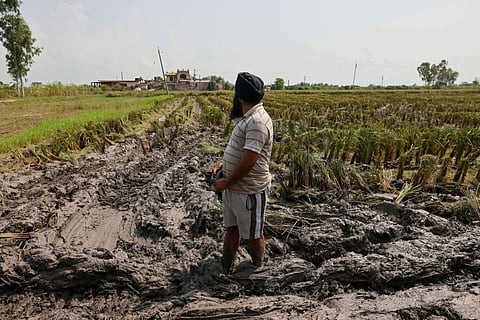
These events claimed at least 4,419 lives, affected around 17.4 million hectares of cropped land, destroyed at least 181,459 houses and killed approximately 77,189 animals. These figures are likely to be underestimates, due to gaps in the reporting of event-specific losses, particularly damage to public infrastructure and agriculture.
The scale of loss marks a sharp rise over recent years. In 2022, reported deaths linked to extreme weather stood at 3,006, meaning fatalities have increased by 47 per cent in just four years. Agricultural damage has risen even more steeply, from 1.96 million hectares in 2022 to nearly nine times that area in 2025.
Himachal Pradesh recorded extreme weather on almost 80 per cent of days during the period, the highest frequency of any state. Andhra Pradesh reported the greatest number of deaths, at 608, followed by Madhya Pradesh with 537 fatalities and Jharkhand with 478. Maharashtra saw the largest area of cropped land affected, at 8.4 million hectares, followed by Gujarat with 4.4 million hectares and Karnataka with 2.75 million hectares.
At a regional level, north-west India experienced the highest number of extreme weather days in 2025, with events recorded on 311 days. The east and north-east followed, with 275 days. The north-west — including Punjab and the Himalayan states of Himachal Pradesh and Uttarakhand — also recorded the highest death toll, at 1,459, while central India reported 1,120 deaths.
The year also saw a series of broken climate records. January was India’s fifth driest since records began in 1901, while February was the warmest in 124 years. In March, the country’s mean maximum temperature was 1.02°C above normal, even after the India Meteorological Department (IMD) revised its baseline for temperature anomalies from the 1981-2010 average to the warmer 1991-2020 period in 2024. This revision means that today’s “normal” temperatures are already higher than in previous decades.
September recorded India’s seventh-highest mean temperature for the month, with minimum temperatures ranking as the fifth highest on record. October also saw minimum temperatures at their fifth-highest level in 124 years.
Researchers say the figures reflect a broader pattern in which extreme events that were once considered rare are now occurring with increasing regularity. Vulnerable populations are particularly exposed, often lacking the resources needed to recover from repeated shocks.
Lightning and thunderstorms were among the deadliest hazards, killing 1,538 people during the year. Relentless monsoon rains and cloudbursts triggering widespread flooding and landslides together accounted for 2,707 deaths.
Extreme weather occurred every day in nine of the eleven months analysed: February, April, May, June, July, August, September, October and November. By comparison, daily extremes were recorded in six months in 2024 and five months in 2023. This four-year trend, spanning winter, pre-monsoon, monsoon and post-monsoon periods, indicates that extreme weather in India is becoming more frequent and persistent, rather than being confined to a few peak seasons. The presence of daily extreme events across most months points to a shrinking window of what can be considered “normal” weather.
For the third consecutive year — 2023, 2024 and 2025 — all 36 states and Union Territories experienced extreme weather events during the January to November period. Between January and November 2025, India recorded extreme weather on more days than in the same period of 2024 (295 days), 2023 (296 days) and 2022 (292 days).
While the country has faced at least one disaster a day in each of these years, 2025 saw both the highest number of extreme weather days and the greatest overall loss and damage, according to the CSE–DTE analysis.
A season-wise breakdown shows that extreme weather in 2025 was not only persistent but intensified as the year progressed, from winter through to the monsoon.
Winter, typically a relatively dry period, saw extreme weather on 97 per cent of days, compared with 64 per cent in 2022. This increase was driven largely by a sharp rise in heavy rain and flood events, from just six days in earlier years to 51 of the 59 winter days in 2025. Heatwaves were also recorded unusually early, with three heatwave days in February across Goa, Maharashtra and Karnataka.
Goa and Maharashtra experienced India’s first heatwave of the year on 25 February — the first time a heatwave has been recorded during the January-February winter period as defined by the IMD. The IMD confirmed February 2025 as the hottest February on record.
February also saw the widest geographical spread of extreme events, affecting 31 states and Union Territories, up from 16 in 2024 and six in 2023.
The pre-monsoon season marked a sharp escalation. Between March and May, extreme weather occurred on almost every day, rising from 88 per cent of days in 2022 to 99 per cent in 2025. Heavy rain, floods and landslides replaced hailstorms as the most common events, while heatwaves spread across 19 states, including Himalayan regions such as Himachal Pradesh, Jammu and Kashmir and Ladakh, indicating warming at higher altitudes. At least 990 deaths were reported during this period, more than three times the 302 deaths recorded in 2022, underscoring the growing severity of “non-monsoon” extremes.
All 122 days of the monsoon season, from June to September, recorded extreme weather events across 35 states and Union Territories. Heavy rain, floods and landslides occurred daily, alongside lightning and storms on 104 days, cloudbursts on 17 days and heatwaves on eight days. This came despite rainfall deficits in around one-fifth of India’s districts. By the end of the monsoon, 147 districts — about 20 per cent of the country’s 727 districts — had received deficient or largely deficient rainfall, highlighting the uneven and erratic nature of the season.
The monsoon proved the most destructive period, accounting for the highest number of deaths and the greatest crop losses. At least 11 million hectares of cropped land were damaged across 23 states, representing around 65 per cent of the total affected nationwide. This figure is likely to be an underestimate because of incomplete state-level data.
Post-monsoon extremes continued into October and November. All 61 days of the two months recorded extreme weather across 34 states and Union Territories. Himachal Pradesh was again the worst affected, with events on 50 days, followed by Andhra Pradesh with 38 days and Kerala with 26.
The southern peninsula recorded an unusually wet October, the 13th wettest since 1901. Coldwaves also arrived earlier than in recent years, beginning on November 7 compared with November 21 in 2022. In previous years, November coldwaves were confined to Maharashtra and Rajasthan. In 2025, however, coldwave conditions were reported in 13 states across all four regions of India (seven states in the northwest, four in central India, one in the east and northeast, and one in the southern peninsula), indicating a significant expansion in geographical spread.
The seasonal patterns indicate a collapse of clear seasonal boundaries, with year-round exposure to climate extremes and growing risks to lives, livelihoods, agriculture and the wider economy.
Sunita Narain, director general of the Centre for Science and Environment, said the scale of the crisis demands a global response. “Given the intensity and frequency of extreme weather events, the country no longer needs to count just the disasters. What we need to understand is the scale — the scale of mitigation that the CoP30 at Belem focused on, the scale on which the whole world has to come together. But it is also about what we need to do, keeping in mind that there will be more and more such disasters,” she said.
Taken together, these trends signal a widening ecological backlash and underscore the urgency of meaningful climate action. Without decisive efforts to cut risks and emissions, the disasters we face today risk becoming the norm tomorrow. Yet development cannot grind to a halt—climate change is not a justification for paralysis. Instead, it must drive smarter planning and more resilient, equitable choices for the future.
