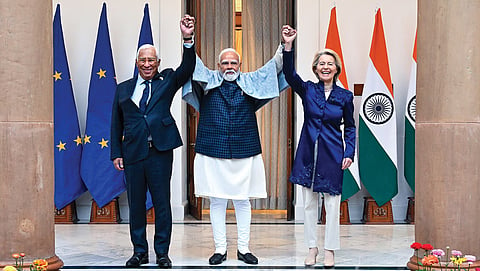


After nearly two decades of negotiations, on January 27 India and the EU signed a robust free trade agreement (FTA), allowing for closer trade ties. The India-EU Trade Deal, expected to benefit 2 billion people, will likely be rolled out in early 2027, after approval from the Indian Cabinet, European Parliament and the Council of the European Union.
While the FTA saw intermittent negotiations over the years, the vigour to reach an agreement rose in 2022. Its finalisation now appears to be a hedge against renewed US protectionism. India faces steep US tariffs since mid-2025, with labour-intensive sectors warning of permanent market loss. EU-US trade relations also remain volatile despite a limited framework agreement. The pact also strengthens the EU’s Indo-Pacific strategy and reduces reliance on China.
After signing the FTA at the 16th India-EU Summit in Delhi, Ursula von der Leyen, President, European Commission, said the deal sends a message that “rules-based cooperation still delivers great outcomes”. Prime Minister Narendra Modi added that the FTA will boost manufacturing and expand services-related sectors in India.
Preferential market access on both sides remains the focus, with duty reduction or elimination across tariff lines. According to a factsheet on the FTA released by the Union Ministry of Commerce, the deal delivers unprecedented market access for more than 99 per cent of India’s export by trade value.
Key labour-intensive sectors such as textiles, apparel, marine products, leather and footwear, gems and jewellery, which account for 70.4 per cent of India’s tariff lines, will see immediate duty elimination. Certain marine products, processed food items, arms and ammunition, (20.3 per cent tariff lines), will see duty reduced to zero over three-five years.
In the remaining 6.1 per cent of tariff lines, goods like certain poultry products, preserved vegetables and bakery products, will see a tariff reduction, while cars, steel, some shrimp or prawn products will see tariff rate quotas (TRQs). TRQs implies zero duty up to a set quantity.
For the EU, industrial machinery and electrical equipment, aircraft and spacecraft, optical and medical instruments, pharmaceuticals, chemicals (49.6 per cent of tariff lines) will see immediate duty elimination in India. Automobiles and auto parts, certain machinery and capital goods, iron and steel products, and some consumer durables (39.5 per cent of tariff lines) will see phased elimination over five, seven or 10 years. Agricultural and horticultural products (3 per cent of tariff lines), will see phased tariff reduction or TRQs.
The robust changes across major sectors have resulted in the FTA being informally dubbed “mother of all deals”. At the same time, it raises questions on protection of domestic markets and producers. Down To Earth (DTE) analyses a few sectors to understand how the deal addresses these concerns:
Wider market access on both sides with in-built safeguards
With little to no duties on most agricultural products, Indian farmers gain wide market access in the EU, increasing the potential for higher incomes. Preferential market access for tea, coffee, spices, grapes, gherkins and cucumbers, dried onion, fresh vegetables and fruits as well as for processed food products will make them more competitive in the EU, says the Union commerce ministry factsheet. Exports of shrimp, frozen fish and other marine goods will benefit coastal communities.
Similarly, the EU will see improved market access in India for wine and spirits, olive oil, fruit juices, processed foods and sheep meat. The EU and India are also negotiating a separate agreement on …
This article was originally published in the February 16-28, 2026 print edition of Down To Earth