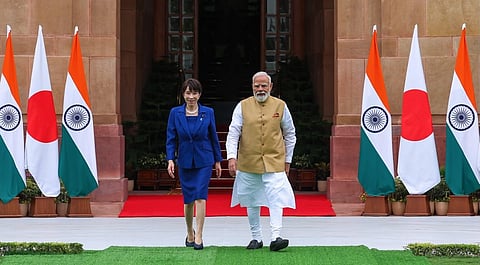


The three-day visit of Japanese PM Sanae Takaichi to India for the 16th India-Japan Annual Summit is the most opportune time to consolidate and accelerate the India-Japan development partnership to a strategic geo-economic alliance. The visit of the Japanese PM resulted in substantive upgrades in bilateral ties in crucial areas, benefiting both countries, namely defence, advanced technology, resilient supply chains, clean energy, and people-to-people ties. This enduring legacy of mutual trust now underpins one of the Indo-Pacific’s most consequential strategic partnerships, which is essential for the safety, security, and economic prospects of both countries.
For much of the post-war period, the India-Japan relationship has been a developmental partnership based on a civilisational bond, democratic values, cultural roots, and mutual trust, in which Japan has helped India develop its infrastructure through Official Development Assistance (ODA). Today, however, the partnership is undergoing a fundamental shift. Intensifying geopolitical uncertainties, disruptions to global shipping routes, growing concerns over economic coercion, and the reconfiguration of global value chains have elevated economic security to the centre of international relations.
Against this backdrop, India and Japan possess an exceptional degree of economic complementarity. Japan’s strength lies in capital, advanced manufacturing, frontier technologies, and industrial expertise, while India offers scale, a large domestic market, engineering talent, competitive manufacturing capabilities, and a rapidly expanding digital economy. This convergence extends beyond trade and investment into semiconductors, critical minerals, clean energy, digital infrastructure, advanced manufacturing, logistics, and maritime connectivity. As both countries seek to build resilient and trusted networks, the partnership is evolving from a development relationship into a comprehensive geo-economic alliance capable of shaping the region’s industrial architecture and long-term economic security.
After nearly three decades of ultra-loose monetary policy, which has led to negative/lowest interest rates, persistent labour shortages, and the fastest-ageing populations, Japanese firms continue to be encouraged to diversify overseas in pursuit of returns, resilience, and long-term growth. Since the 1990s, prolonged low growth and the search for new production bases and consumer markets have made Japanese overseas direct investment a defining feature of the country’s internationalisation strategy. The United States has remained the largest destination, particularly in finance, automobiles, and advanced manufacturing, while Europe has attracted significant investment in pharmaceuticals, technology, and high-value manufacturing. ASEAN economies, including Thailand, Vietnam, Indonesia, and Malaysia, accounting for nearly one-fifth of Japan’s outward FDI, have emerged as manufacturing hubs for Japanese firms, benefiting from export-oriented industrial policies, established supplier ecosystems, competitive labour costs, and regional trade agreements such as the RCEP.
China was another major recipient of Japanese investment for over two decades, but geopolitical tensions, rising labour costs, regulatory uncertainty, and slowing economic growth prompted Japanese firms to diversify their production networks. This realignment has been reinforced through the Supply Chain Resilience Initiative (SCRI) between India, Japan, and Australia to reduce concentration risks and strengthen trusted Indo-Pacific value chains. India is increasingly emerging as Japan’s most promising long-term partner. Over the past decade, the Government of India has undertaken a series of structural reforms to address long-standing investor concerns relating to regulatory complexity, infrastructure gaps, land availability, and project implementation. Flagship initiatives such as the Production-Linked Incentive (PLI) schemes, PM Gati Shakti, the National Industrial Corridor Programme, the National Single Window System (NSWS), and the National Logistics Policy have significantly improved the investment ecosystem by providing integrated infrastructure, streamlined approvals, multimodal connectivity, and lower logistics costs. Notably, India has established a network of Japanese Industrial Towns (JITs) across multiple states, offering plug-and-play infrastructure, investor facilitation, and institutional support to attract Japanese investment.
These reforms have fundamentally strengthened India’s investment proposition. Backed by a large domestic market, favourable demographics, a skilled workforce, expanding manufacturing capabilities, and growing strengths in electronics, semiconductors, renewable energy, digital technologies, and advanced manufacturing, India offers Japanese firms a unique combination of production efficiency and market access. As companies seek to diversify, particularly from China, India is well-positioned not merely as an alternative manufacturing base but as a strategic investment partner capable of supporting both export-oriented production and sustained domestic demand.
India-Japan infrastructure cooperation has been a cornerstone of bilateral economic relations, with Japan emerging as India’s largest development partner through Japan International Cooperation Agency (JICA). While the Delhi Metro remains its flagship project, cooperation has expanded to urban transport, logistics, and industrial corridors. Beyond transport, collaboration extends to water, sanitation, energy efficiency, disaster resilience, and smart cities. However, it is time to move beyond infrastructure projects. The next phase of JICA engagement should focus on building integrated industrial ecosystems, including multimodal logistics parks, port connectivity, last-mile freight systems, smart industrial townships, and green logistics corridors linked to manufacturing clusters.
The next frontier lies in sectors that are central to both countries’ strategic priorities. Japan can play a catalytic role in strengthening India’s manufacturing ecosystem in electronics, automotive and EV components, precision engineering, industrial machinery, and advanced materials, complementing the PLI schemes and dedicated Japanese Industrial Townships. The semiconductor ecosystem offers particular promise. While India is rapidly building fabrication, assembly, testing, and packaging capabilities under the India Semiconductor Mission, Japan’s global leadership in semiconductor materials, silicon wafers, photoresists, speciality chemicals, manufacturing equipment, and precision engineering can help develop a complete semiconductor value chain. Similar opportunities exist in critical minerals, where joint investments in processing, recycling, and secure sourcing can support batteries, semiconductors, renewable energy, and defence manufacturing.
Beyond manufacturing, the partnership should increasingly focus on frontier technologies and the green economy. Combining Japan’s strengths in robotics, industrial automation, advanced manufacturing, quantum technologies, and hardware innovation with India’s software capabilities, digital talent, AI ecosystem, and Digital Public Infrastructure can create globally competitive technology partnerships. In digital economy cooperation, both sides should expand collaboration in fintech interoperability, cybersecurity frameworks, and data governance standards to support trusted digital ecosystems.
Expanding cooperation in space technologies, satellite applications, earth observation, and defence manufacturing, supported by Japan’s eased defence export norms and a growing emphasis on trusted technology partnerships, can further strengthen India-Japan convergence in strategic high-technology sectors. Equally, a deepening climate and energy transition partnership, anchored in Japan’s strengths in hydrogen, battery storage, circular economy practices, and energy-efficient manufacturing and India’s net-zero ambitions, can unlock collaboration in green hydrogen, offshore wind, electric mobility, battery ecosystems, carbon capture, and climate-resilient infrastructure.
A critical yet underexplored dimension of the India-Japan partnership is the integration of MSMEs into industrial cooperation. Japan’s manufacturing strength rests on a dense SME network, accounting for over 99 per cent of enterprises and about 70 per cent of employment, supplying precision components and advanced materials to large firms within tightly integrated value chains driven by Kaizen, Lean Manufacturing, Just-in-Time production, and Total Quality Management. The next phase of cooperation should prioritise MSME-led industrial integration rather than focusing only on large corporate investments. A dedicated MSME Partnership Framework can be institutionalised to enable technology transfer, supplier development and skill development in key sectors. Initiatives such as Kaizen programmes, joint testing and technology centres, cluster-based manufacturing, and co-innovation hubs can further strengthen industrial capabilities in manufacturing ecosystems. MSME integration should be treated as a core pillar via supplier development programmes, certification frameworks, and technology upgradation to embed Indian firms in Japanese value chains.
Despite being one of India’s earliest and most comprehensive free trade agreements, the India-Japan CEPA has fallen short of expectations. Bilateral merchandise trade has remained largely stagnant at around US$20-25 billion for much of the past decade, reflecting that tariff liberalisation alone is insufficient to drive trade. The agreement has been constrained by low utilisation, particularly among Indian exporters, due to complex rules of origin, divergent regulatory standards, burdensome conformity assessment procedures, and limited awareness of CEPA’s provisions.
The next phase of the India-Japan partnership will be defined less by conventional trade and infrastructure cooperation and more by a structured, outcomes-oriented framework anchored in investment facilitation, technology co-development, and supply-chain integration. Realising the full potential of the India-Japan partnership requires simplifying and modernising rules of origin, reducing non-tariff barriers, operationalising mutual recognition of standards, digitising customs and conformity assessment procedures, and strengthening existing institutional mechanisms for regulatory dialogue. Improving awareness and utilisation of CEPA among businesses, while aligning the agreement with industrial corridors, supply-chain initiatives, and state-level investment facilitation, can significantly enhance its effectiveness. Complementing these reforms, closer alignment with PLI schemes, enhanced financial cooperation, and deeper integration into regional value chains can transform CEPA from a preferential trade agreement into a comprehensive geo-economic framework for investment, technology collaboration, and resilient Indo-Pacific supply chains.
Cooperation can also be expanded in critical minerals processing through jointly funded R&D centres. In skills, deeper collaboration between technical institutions and industry-led apprenticeships is essential to build a future-ready workforce. Industrial corridors and logistics infrastructure must align with Japan’s participation in multimodal transport, smart townships, and port-led connectivity to reduce logistics costs.
Overall, India presents an opportunity for Japan to combine its technological depth with India’s scale, engineering talent, cost competitiveness, and expanding consumer base, thereby enabling more demand-driven, large-scale industrialisation outcomes. By bringing together Japan’s patient capital, advanced technologies, and manufacturing excellence with India’s scale, engineering talent, expanding innovation ecosystem, and vast local market, the partnership is poised to move beyond a traditional development cooperation model into a deeper technology and industrial alliance. This convergence carries significance beyond bilateral gains, offering a pathway to co-create resilient, secure, and sustainable value chains across the Indo-Pacific and positioning both nations as pivotal architects of the region’s evolving economic order.
Pooja Teotia is Consultant at Niti Aayog, Economics & Finance Cell
Pravakar Sahoo is Senior Lead, NITI Aayog and Professor, IEG
Views expressed are the author’s own and don’t necessarily reflect those of Down To Earth