
Subscribe

Women-led Self-Help Groups (SHGs) across the hills and fertile landscapes of Ri-Bhoi district are steadily reshaping the rural economy. With support from government livelihood missions, community institutions, non-profits, and Corporate Social Responsibility (CSR) initiatives, these groups are generating sustainable livelihood opportunities in areas such as weaving, livestock rearing, fisheries, poultry farming, turmeric cultivation, horticulture, honey production, and other micro-enterprises.
The success of women-led SHGs and enterprises in Meghalaya can largely be attributed to the region’s unique social structure, strong community networks, and economic realities. Among the Khasi and Garo communities, the matrilineal system grants women greater inheritance rights, social recognition, and participation in decision-making. As a result, women entrepreneurs in Meghalaya often encounter fewer social barriers compared to many other parts of India.
Government-backed schemes under the National Rural Livelihoods Mission (NRLM) and Meghalaya’s rural development programs have played a major role in strengthening women-led enterprises in Ri-Bhoi. SHGs are receiving support through seed capital, revolving funds, technical training, and access to banks and cooperatives. Recent initiatives in the district have focused on promoting organic farming, handloom, food processing, poultry, piggery, and small businesses.
The Union Ministry of New and Renewable Energy, CSR and non-profit organisations are also contributing significantly.

K P Rajendran, CEO, Society for Action in community Health (SACH) says that in Ri-Bhoi district, which is predominantly inhabited by the Khasi community, traditions of collective work, village cooperation, mutual support, and clan-based solidarity remain deeply rooted. Women actively contribute to the local economy, while strong community trust and familiarity with collective action create a favourable environment for SHGs to thrive.
SACH has collaborated with HDFC bank under its CSR initiative ‘Parivartan’ since 2015 and supported hundreds of women SHGs which are gradually becoming the mainstay of livelihoods. “These groups not only improve access to finance but also help transform traditional skills into viable income-generating enterprises. Furthermore, women’s participation in economic activities outside the home is socially accepted and encouraged, enabling SHGs to play a significant role in strengthening livelihoods and promoting inclusive rural development”, he said.
Most of these initiatives began as small savings collectives and evolved into a strong grassroots movement empowering women economically and socially. Through training, access to credit, market linkages, and skill development, SHGs are helping rural women become entrepreneurs, producers, and community leaders.
The expansion of SHGs in Meghalaya has been significantly supported under the NRLM, which has enabled women to access revolving funds, enterprise support, and financial inclusion programs. Ri-Bhoi has emerged as one of the districts where SHGs are increasingly contributing to livelihood diversification and rural enterprise development.
MOSONiE Socio-economic Foundadtion, a women-led organisation based in Pillangkata, Ri-Bhoi, has been actively working to strengthen rural livelihoods through initiatives in Eri silk training, agriculture, animal husbandry, and women’s entrepreneurship. Through its efforts, the organisation has established training centres and created improved livelihood opportunities for women in rural communities.
Likewise, Diya Foundation has been instrumental in supporting women’s SHGs and women-led Farmer Producer Organisations (FPOs) in Ri-Bhoi and neighbouring areas. Its programmes focusing on horticulture, turmeric and ginger cultivation, as well as sericulture, have enhanced women’s involvement in rural enterprise and livelihood generation.
In addition, CSR-supported livelihood initiatives are opening up new avenues in beekeeping, piggery, and agro-based enterprises. These projects seek to equip women and farmers in Ri-Bhoi and East Khasi Hills with skills in beekeeping, piggery, nursery development, and sustainable market linkages.
Weaving continues to be one of the most culturally important livelihood activities for women in Ri-Bhoi. For generations, Khasi women have practiced traditional weaving, and today SHGs are playing a major role in preserving and modernising this heritage craft.
Women-led weaving collectives are producing Eri silk fabrics, handwoven shawls, stoles, and traditional attire using a blend of traditional knowledge and improved weaving methods. Through government schemes and SHG initiatives, women have gained access to looms, raw materials, weaving sheds, and training in design development and marketing skills.
Studies on women weavers in Ri-Bhoi indicate that SHGs have not only helped safeguard traditional weaving practices but have also created new economic opportunities for rural women. With support from government agencies and community organisations, the modernisation of the handloom sector has increased women’s participation in weaving while reinforcing cultural identity.
Examples such as the Nongtluh Weaving Cooperative Society highlight how SHGs are encouraging rural entrepreneurship and strengthening livelihood opportunities through traditional crafts.
Livestock and poultry farming have emerged as important supplementary income sources for women-led SHGs in Ri-Bhoi. Activities such as backyard poultry, piggery, duck rearing, and goat farming are widely preferred because they require relatively low investment while providing steady returns.
Women’s groups are collectively pooling resources to purchase feed, improve veterinary support, and adopt better livestock management practices. Government-led training programmes and cooperative initiatives are helping women farmers enhance productivity and reduce costs.
According to the Indian Council of Agricultural Research (ICAR), training and extension programmes conducted by institutions such as ICAR-KVK Ri-Bhoi are encouraging SHGs to adopt integrated farming systems that combine horticulture, piggery, and livestock-based livelihood activities.
Mokidul Islam, Principal Scientist and Head of ICAR-KVK Ri-Bhoi, emphasised the vital role women play in strengthening families and communities through SHGs. He also noted that ICAR-KVK has been supporting CSR initiatives aimed at improving piggery and livestock value chains through skill development and business planning support for women farmers.
Women-led SHGs in Ri-Bhoi are increasingly exploring fisheries and aquaculture as part of integrated farming practices. Fish pond management and small-scale aquaculture are gradually becoming viable livelihood opportunities in villages with suitable water resources.
Groups such as the Sunshine SHG are promoting agriculture and aquaculture-based enterprises while encouraging environmentally sustainable practices and women’s self-reliance.
Fish farming is not only providing additional income but is also contributing to household nutrition and food security. Many SHGs are integrating fisheries with horticulture and livestock farming to create diversified livelihood systems that help reduce economic risks.
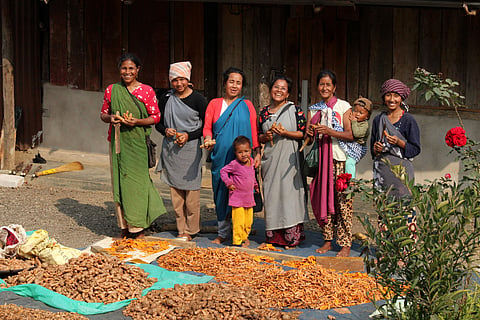
Turmeric cultivation has become an important income-generating activity for women SHGs in Ri-Bhoi. Inspired by Meghalaya’s growing reputation for premium-quality turmeric, women’s groups are cultivating turmeric alongside ginger, black pepper, and arecanut.
One such example is the Iaidshaphrang SHG from Nongdewsaw village, a collective of 12 women who have been cultivating turmeric for several years. Initially, they cultivated turmeric individually on small plots, making it difficult to expand production and generate substantial income. Their situation improved after receiving support through an HDFC Bank CSR initiative, which provided them with 400 turmeric saplings.
Today, the group has successfully harvested nearly 800 kilograms of turmeric. They are now focusing on drying and processing turmeric into powder, although the absence of their own processing unit remains a challenge. Currently, they depend on private facilities for grinding and processing. Their long-term goal is to expand cultivation, establish a processing unit, and market their own branded turmeric powder.
Organisations supporting women-led FPOs are also helping farmers move beyond selling raw produce toward processing and value addition. SHGs are increasingly involved in turmeric powder production, packaging, and marketing, allowing them to earn better returns.
Efforts are also being made to strengthen forward and backward market linkages for the export of Meghalaya’s renowned Lakadong turmeric. Optimism remains high among stakeholders regarding export opportunities to countries such as South Korea and Morocco.
Ri-Bhoi’s favourable climate also supports horticulture-based livelihoods. Women SHGs are actively engaged in cultivating pineapples, bananas, vegetables, citrus fruits, and spices. Agricultural training programmes are helping women adopt improved farming techniques and enhance productivity.
The growth of FPOs and women-led cooperatives has further strengthened collective marketing systems and improved access to larger markets for horticultural produce.
Beekeeping and honey production are emerging as sustainable livelihood opportunities for women SHGs in Ri-Bhoi. CSR-supported programmes are providing training in scientific beekeeping, honey harvesting, and marketing techniques.
At the same time, women-led SHGs are expanding into eco-friendly micro-enterprises by utilising locally available natural resources. In villages such as Nongspung, women’s groups are manufacturing bamboo spoons, areca leaf plates, bowls, and biodegradable tableware products as sustainable alternatives to plastic items.
These enterprises are not only generating additional income but are also promoting environmental sustainability and preserving indigenous craftsmanship.
The impact of women-led SHGs in Ri-Bhoi extends far beyond economic benefits. Through collective savings, enterprise management, and participation in community activities, rural women are gaining confidence, leadership abilities, and greater financial independence.
Many women who previously had limited livelihood opportunities are now managing businesses, handling banking transactions, participating in cooperatives, and negotiating directly with markets and institutions. SHGs are also strengthening community solidarity and encouraging women to play more active roles in local development processes.
Ri-Bhoi’s experience demonstrates how coordinated support from government schemes, CSR programmes, NGOs, and community institutions can help build sustainable rural livelihoods. By combining traditional knowledge with modern enterprise models, women-led SHGs are transforming weaving, agriculture, livestock farming, fisheries, poultry, horticulture, honey production, and rural micro-enterprises into drivers of inclusive economic growth.
As Meghalaya continues to invest in community-based development, the women of Ri-Bhoi are showing how grassroots entrepreneurship can become a powerful force for economic resilience, cultural preservation, and sustainable rural transformation.
Surendra Panwar is a senior journalist with a career spanning over 20 years. He currently works as a freelance writer with a focus on tribal and social exclusion issues
Views expressed are the author’s own and don’t necessarily reflect those of Down To Earth