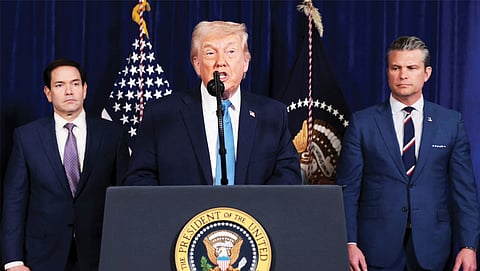


Early in the morning of January 3, US forces entered Venezuela and abducted President Nicolás Maduro along with his wife, Cilia Flores. Hours later, US President Donald Trump declared that Washington was now effectively in control of the South American nation. Speaking at his private club Mar-a-Lago a day later, Trump said US oil majors would “go in, spend billions of dollars, fix the badly broken infrastructure, the oil infrastructure”, signalling a US-led overhaul of Venezuela’s oil sector.
The announcement comes against a stark backdrop: Venezuela holds about 303 billion barrels (one barrel equals nearly 159 litres) of crude oil—about 18 per cent of the world’s proven reserves, as per the Organization of the Petroleum Exporting Countries. Yet it produces barely one million barrels a day, about 0.8 per cent of global supply, a fraction of the 3.5 million barrels per day it pumped at its peak in the late 1990s.
Despite the dramatic rhetoric, oil markets have reacted cautiously. Oil prices reacted modestly when Trump announced, on December 16, 2025, a blockade of sanctioned vessels entering and leaving Venezuela. Brent crude, a global benchmark oil market, briefly rose above US $60 a barrel on December 16-17, while West Texas Intermediate (WTI), a benchmark market for oil in North America, traded at around $55 a barrel, before easing. Prices firmed again in January amid heightened tensions following the US capture of President Maduro, with Brent crude trading at $60-61 a barrel and WTI at $56-58 a barrel. Analysts say ample global supply and weak demand growth prevented a sustained rally. “This shows the limited impact—a few dollars per barrel—because it simply does not produce enough oil today to make that big a difference,” Prashant Vashist, vice president at credit ratings agency ICRA Ltd, tells Down To Earth (DTE). Even if global access to Venezuelan crude is restored immediately, analysts say it would take years and tens of billions of dollars to revive production.
Petróleos de Venezuela (PDVSA), Venezuela’s state-owned oil company, has acknowledged that pipelines have not been upgraded in five decades. Estimates suggest $58 billion would be required just to restore output to earlier peak levels. Rystad Energy, a Norway-based research and energy intelligence company, puts the investment need even higher—at $53 billion over the next 15 years merely to maintain current production, and up to $180 billion to raise output meaningfully.
Vashist points out that Venezuela’s decline is rooted in “economic crisis, under-investment in oil and gas infrastructure, and sanctions”. While most of its oil blocks are onshore—making them theoretically easier to monetise than offshore reserves—the crude itself is heavy and sour, raising costs and technical complexity.
The nature of Venezuelan crude is central to the current scramble. About two-thirds of the country’s production is heavy oil, which makes up roughly 4.5 per cent of global heavy oil supply. “Heavy oil is exactly what certain refineries in the US, China and India are designed to process,” Lorne Stockman, research director at Oil Change International (OCI), a Washington-based advocacy organisation, tells DTE.
China has been the primary buyer of Venezuelan crude, with Cuba taking smaller volumes. Those shipments have effectively stalled since the US imposed its blockade. At the same time, US involvement in Venezuelan oil had already been quietly expanding. Chevron Corp, a major American energy company, increased shipments of Venezuelan oil from around 128,000 barrels per day in October 2025 to about 150,000 barrels per day in December 2025, reports Al Jazeera.
While Trump had previously halted Venezuelan oil exports to the US, those flows resumed earlier this year under a new licence granted to Chevron because US refineries require heavy crude to blend with lighter domestic oil. Venezuelan heavy, sour crude is particularly well-suited, giving US companies a commercial incentive to secure access. “If more of this crude is diverted to the US, Chinese and Indian refiners would be losers, and heavy oil prices in the Asia-Pacific region could rise,” says Stockman.
In the short term, Stockman sees two likely scenarios: either US actions divert heavy crude away from Asia, or they trigger further instability that reduces Venezuelan exports altogether. “Both outcomes are bad for Asian heavy oil importers,” he says. Over the longer term, even if the US succeeds in stabilising Venezuela and boosting production, most additional output could flow to the US. “The US has the highest concentration of heavy oil refining capacity in the world,” Stockman notes, cautioning that any production increase would be slow, costly and uncertain.
For global investors, Venezuela’s sudden re-entry into headlines has sparked fresh interest. In a press release on January 5, Nigel Green, CEO of UK-based financial advisory organisation deVere Group, describes the moment as a “rare convergence of political change, asset repricing, and reconstruction demand”. He says, “Venezuela has spent years cut off from capital, expertise, and trade. The moment investors believe that the wall is coming down, valuations start to reset.” Venezuelan sovereign and state-linked debt—long considered near-worthless—has already rallied, reflecting expectations of restructuring and normalisation. But Green warns of risks. “Political stability is still being tested. Investor protection and contract enforceability will be decisive.”
“Large fossil fuel companies, like Chevron, are best positioned to benefit from Trump’s imperialistic bullying,” says Stockman. Its stock price is already rising. “People in Venezuela and in the US are being set up to pay the price.”
For India, the immediate oil market impact appears limited. “Indian refineries never fully depended on Venezuelan crude,” Deepak Mahurkar, oil and gas sector expert at international financial consultancy PricewaterhouseCoopers, tells DTE. Global sanctions against Venezuela in the past decade had already reduced India’s exposure.
The larger concern lies with stranded investments. Indian firms including ONGC Videsh Ltd, IOC Ltd and OIL India Ltd have stakes in projects such as San Cristóbal and Carabobo in Venezuela, with around $536 million in dividends stuck since 2014, according to ONGC Videsh’s latest annual report. “If sanctions are lifted and an investor-friendly regime emerges, there is potential for recovery,” Vashist says, “but geopolitics will matter as much as technical feasibility.”
Beyond oil supply, Trump’s move revives the petrodollar debate—the dollar-dominated system that underpins global oil trade and gives Washington outsized financial leverage (see ‘Petrodollar system’).Venezuela under former president Hugo Chávez and Maduro sold oil in euro and yuan, partly to evade sanctions. That experiment, analysts say, was always constrained by sanctions and low export volumes. “If a US-aligned regime takes shape, Venezuelan oil will almost certainly revert to dollar-based trade,” says Vashist.
Analysts argue the issue is less about currency disruption and more about power. The timing is notable. China has steadily expanded yuan-based oil trade, while Gulf producers, have signalled openness to settling some oil sales in non-dollar currencies. Saudi Arabia has publicly acknowledged discussions with Beijing on yuan pricing, even as it continues to anchor most exports to the dollar. Analysts say Trump’s hard line on Venezuela may be read in this context—as a signal that the US will resist any erosion of dollar primacy in energy markets.
This article was originally published in the January 16-31, 2026 print edition of Down To Earth