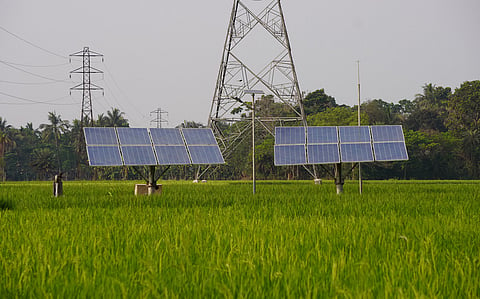


In the lead up to the union budget 2026-27, the Union government is preparing to roll out PM-KUSUM 2.0, a successor to the Pradhan Mantri Kisan Urja Suraksha evam Utthaan Mahabhiyan (PM-KUSUM), signalling a renewed push for decentralised solar in agriculture even as the current scheme continues to draw strong demand from states and implementing agencies.
Government officials told Down To Earth (DTE) that the move reflects sustained interest in PM-KUSUM but stressed that the government is not formally extending the existing scheme. While moratoriums and support provisions already approved will continue for ongoing projects, the present framework will conclude as scheduled.
The current phase, running through March 2026, has an outlay of Rs 34,422 crore to add about 34,800 megawatt (MW) of solar capacity through decentralised grid-connected plants, standalone solar pumps and the solarisation of grid-connected agricultural pumps, including feeder-level projects. A follow-on programme—referred to in policy discussions as PM-KUSUM 2.0—is expected to build on this foundation with revised targets and incentives.
As of November, a total of 10,203 MW has been installed at Rs 7,106 crore under all components of the PM KUSUM Scheme, according to a Union Ministry for New and Renewable Energy (MNRE) statement.
Given the continuing demand, the MNRE is considering a new scheme on the lines of PM-KUSUM, rather than extending the current one, a senior government official said. “The next phase could incorporate updated components and design features to address implementation challenges seen so far.”
Among the options under discussion is the inclusion of agro-photovoltaic (agro-PV) models, which allow cultivation beneath elevated solar structures. The official said, “This could help overcome land constraints in states where farmland is scarce or politically sensitive.”
A stakeholder consultation held in September 2025, involving state implementing agencies, focused on shaping a technically robust, financially viable and farmer-centric framework for PM-KUSUM 2.0. Government officials involved in the discussions said, “The next phase is likely to place greater emphasis on feeder-level solarisation and encourage private participation in decentralised renewable projects.”
The broad financial architecture is expected to remain similar to the existing scheme. Central Financial Assistance typically covers around 30 per cent of benchmark costs, rising to 50 per cent in hilly and Northeastern states, with state governments and beneficiaries sharing the balance.
For feeder-level solar plants under Component C, the Centre currently provides subsidies of up to Rs 1.05 crore per MW, which corresponds to 30 per cent of an estimated benchmark cost of Rs 3.5 crore per MW of solar capacity, while discoms receive procurement-based incentives of Rs 6.6 lakh per year per MW (equivalent to Rs 3.3 million over five years) to buy solar power from farmers and developers.
The official, cited above, informed that the expenditure finance committee (EFC)'s approval has come, but did not disclose the capex for the PM-KUSUM 2.0. When asked about the per-megawatt cost, the official replied that that has not yet been finalised but mentioned that “final capital expenditure and effective cost will rise significantly if agro-PV or other design changes like inclusion of storage are introduced.”
Component A, which supports decentralised, grid-connected solar plants, has seen interest from states but has not scaled up as expected. This is attributed to low discovered tariffs, which often become financially unviable once land, evacuation and financing costs are factored in. Access to finance has emerged as a key bottleneck, with high margin money requirements discouraging farmer participation. Land availability near substations, procedural delays in land conversion and power purchase agreements, and complications arising from domestic content requirement (DCR) norms have further slowed progress.
To address these issues, the government is bringing Component A projects under the Agri Infrastructure Fund to improve access to concessional credit and enhance bankability.
Component C, especially feeder-level solarisation, is now seen by the government as the most critical and scalable element of PM-KUSUM. It is viewed as a way to ensure reliable daytime power for agriculture, reduce dependence on subsidised grid electricity and ease the subsidy burden on discoms. The model prioritises meeting local agricultural demand with solar power, exporting surplus electricity to the grid. However, implementation has been uneven, slowed by delays in feeder separation, payment lags from discoms and varying state-level execution capacity.
Component B, which promotes standalone solar pumps, has performed better than Component A in terms of uptake, particularly in areas with high diesel use and weak grid connectivity. Farmer interest remains strong where electricity supply is unreliable. However, progress varies across states due to differences in subsidy support, implementation capacity and procurement timelines. Upfront costs, quality control and after-sales service have emerged as concerns, along with the risk of over-extraction of groundwater if pumps are not paired with demand-side measures such as micro-irrigation. Unlike Components A and C, Component B does not feed power into the grid and is therefore not central to grid or discom reforms.
Among three, Component C is seen as the main lever for large-scale agricultural solarisation and power sector reform, with Component A facing structural challenges and Component B continuing as a targeted intervention for diesel substitution and energy access—rather than a core element of future PM-KUSUM redesign.
About 667.3 of total 9,964 MW sanctioned has so far been installed across all states and UTs under Component A, 942,189 of 1,308,644 MW under Component B and 1,099,699 MW solarised of 3,583,320 MW total sanctioned capacity (IPS+FLS) under Component C.
While there is no formal proposal to merge Components A and C, officials acknowledge a growing operational linkage, with decentralised solar plants under Component A increasingly being used to supply feeder solarisation under Component C. The official described this alignment as a practical approach rather than a policy shift, and while future schemes may be designed to better integrate the two, no decision has been taken so far.
Component A plants—small, grid-connected solar projects developed by farmers, cooperatives or FPOs—can act as the generation backbone for feeder solarisation under Component C, supplying farm demand first and exporting surplus power to the grid, the official added.
This integrated approach is increasingly seen by policymakers as a scalable template for the next phase, with the added advantage of enabling agro-PV and improving land-use efficiency.
Despite strong policy backing, PM-KUSUM’s rollout has faced hurdles, including delayed payments from discoms, uneven participation across states and slow progress on feeder separation—an essential prerequisite for solarisation. Industry stakeholders argue that payment security, faster approvals and stronger state-level coordination will be critical if PM-KUSUM 2.0 is to scale up meaningfully.
With agriculture, power and climate goals converging, the shape of PM-KUSUM 2.0 is likely to determine how far decentralised solar can ease grid stress, cut subsidy burdens and provide reliable power to India’s farmers in the years ahead.