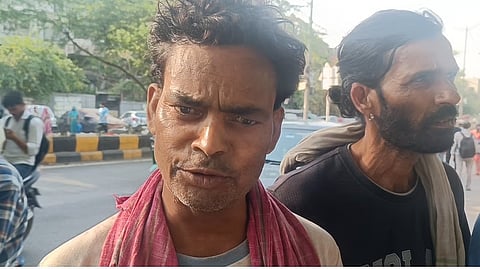


Amid a continuing energy crisis, daily wage workers in parts of Delhi say they are struggling to afford cooking fuel, with many turning to firewood and cow dung cakes to get through the month.
At a busy labour junction in Tughlakabad Extension, in south-east Delhi, workers gather each day in the scorching heat, hoping to find work. But many say jobs have dried up, even as the cost of living continues to rise.
Jameel, a worker from Auraiya district in Uttar Pradesh, said the situation had worsened sharply in recent weeks. He lives in Street No. 26 in Tughlakabad Extension. “Sir, what can I say about the situation? Just today a worker died. His name was Raja. He was hungry and had no work. He fell ill and died,” he said.
Jameel added that he had sent his wife and children back to his village due to the rising cost of liquefied petroleum gas (LPG) cylinders and was now considering leaving Delhi himself.
Another worker, Ram Singh, who came to Delhi from Gonda district in Uttar Pradesh as a 14-year-old, said the crisis had left him with little hope. There’s nothing left for me in the village anymore; if there were, I would have gone back, he said.
“Here, sometimes work stops due to pollution, sometimes due to the pandemic, and now the Iran-US war has created this situation. I am neither getting work nor seeing any hope,” he said.
He pointed to rising prices of everyday items. “A samosa that cost Rs 5 is now Rs 15. We have gas at home, but due to black marketeering, a cylinder that cost Rs 800 is being sold for Rs 1,400.”
Chandan Singh, another labourer at the site, said the cost of refilling smaller gas cylinders of 3-4 kilogrammes had also surged. “Earlier it was around Rs 100 per kg, now it is Rs 300 to Rs 400,” he said.
In nearby Valmiki Mohalla, many residents have stopped going to work altogether. Workers say extreme heat, lack of employment and fuel shortages have worsened an already difficult situation.
Some also told Down To Earth about rising tensions within families, with financial stress affecting relationships at home. Disruptions in gas supply and the strain they’ve placed on daily life have heightened tensions among many working couples, with some relationships even ending in divorce. They claimed that these ongoing disruptions have unsettled family dynamics and, in some cases, left households fractured.

Chandan Singh estimated that around 40 per cent of workers in the area had already returned to their villages due to the LPG crisis.
“There are reports that the war is over, but prices have not come down and gas supply has not improved,” Jameel said, adding that the crisis had pushed many further into poverty and even earning a full day’s wages is a distant dream under the economic crisis.
Subhash, another worker from the same neighbourhood, said that although he had found work in nearby Faridabad, rising fuel costs were affecting his monthly expenses.
In Ghadauli Colony in Mayur Vihar Phase 3, workers said around 30 per cent of labourers had left the area.
Ram Singh said returning to the village, despite fewer job opportunities, at least offered some security. “There’s no work in the village, but there is wood and some ration. At least we won’t die of hunger. Here, we are on the verge of starvation,” he said.
With LPG becoming harder to access or too expensive, many workers said they were relying on traditional fuels such as firewood and cow dung cakes.
“During COVID, we returned home because everything was shut,” Ram Singh said. “But now the city is open and busy, yet our work has disappeared.”
Chandan Singh added that even basic food was becoming unaffordable. “Food we once considered cheap is now expensive. It is becoming difficult to manage,” he said. Workers say that unless fuel prices stabilise and job opportunities improve, the situation is unlikely to ease in the coming weeks.