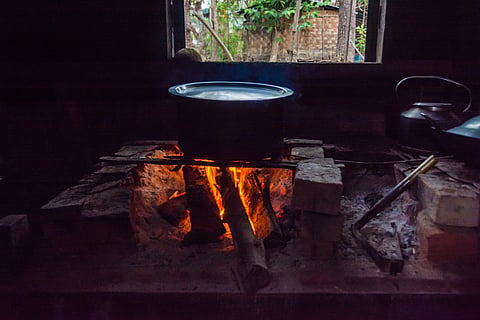


The first carbon credits issued under the Paris Agreement’s Article 6.4 mechanism are facing scrutiny over alleged links to institutions controlled by Myanmar’s military junta.
A report by the Myanmar Policy Institute, Global Forest Coalition and Plan 1.5 has raised concerns over human rights, governance, monitoring and emissions accounting.
The cookstove project became the first in the world to issue credits under Article 6.4 in February 2026.
The groups allege the project may have significantly overstated its climate benefits and have called for further issuance, transfer and use of the credits to be suspended.
The controversy comes as governments meet in Bonn for UN climate talks, where the future of Article 6 carbon markets remains under discussion.
The first carbon credits issued under the Paris Agreement’s flagship international carbon market mechanism have come under scrutiny after civil society groups alleged that the project is linked to institutions controlled by Myanmar’s military junta and may have overstated its climate benefits.
A report released on June 11, 2026 by the Myanmar Policy Institute, Global Forest Coalition and South Korean non-governmental organisation Plan 1.5 raised concerns over human rights, governance, monitoring and emissions accounting in the project. The cookstove project became the world’s first to issue credits under Article 6.4 of the Paris Agreement in February 2026.
Article 6.4 is intended to create a UN-supervised carbon market mechanism with stronger safeguards and higher integrity than earlier offset systems.
The report, Carbon Credits Under Fire: Myanmar, Crimes Against Humanity, and the Crisis of Credibility Facing the UN’s “High Integrity Carbon Markets”, said the project distributes improved cookstoves in Myanmar through a partnership between South Korea’s Climate Change Center and Myanmar’s Ministry of Natural Resources and Environmental Conservation (MONREC).
The findings come as governments meet in Bonn for UN climate negotiations, where discussions on the future of Article 6 carbon markets are continuing.
The report said the project continued operating after the military takeover and was implemented through MONREC, the project’s main government partner. The ministry has been under military control since Myanmar’s February 2021 coup, the report said.
During much of the implementation period, the ministry was headed by Colonel Khin Maung Yi, who was sanctioned by the European Union in June 2021 for supporting Myanmar’s military regime, the report said.
The report also noted that the International Criminal Court has sought an arrest warrant for junta leader Min Aung Hlaing for alleged crimes against humanity against the Rohingya community. Proceedings relating to genocide allegations against Myanmar also remain before the International Court of Justice, the report said.
The civil society groups raised particular concerns about the project’s implementation in Myanmar’s central Dry Zone, including Sagaing Region. The report said the area experienced thousands of conflict-related incidents during the project’s crediting period, including airstrikes, artillery attacks, attacks on schools and healthcare facilities, and widespread displacement.
Sagaing now accounts for more than one third of Myanmar’s internally displaced population, while women and girls have faced high levels of conflict-related sexual violence, according to the report.
The report also questioned whether the carbon credits represent genuine emissions reductions. Its authors raised concerns over monitoring methods, assumptions about cookstove use and verification procedures.
Auditors could not conduct site visits because of security risks and relied instead on remote interviews, according to the report.
An earlier independent analysis by Plan 1.5, Carbon Market Watch and researchers at the University of California, Berkeley found that the project may have been over-credited by more than 14 times under the previous Clean Development Mechanism framework.
A more recent assessment by Carbon Market Watch concluded that, even under revised Article 6.4 methodologies, the project is still likely to be over-credited by a factor of seven.
South Korean campaign group Plan 1.5 said the UN had reduced credit issuance by 40 per cent compared with the previous Clean Development Mechanism methodology, but that the remaining volume still appeared to be significantly overestimated.
The organisations behind the report have called on the Supervisory Body of the Paris Agreement Crediting Mechanism to suspend any further issuance, transfer or use of credits linked to the project. They also called for an independent investigation into whether the project complies with human rights, environmental, social and methodological standards.
“Due to ongoing armed conflict on the ground, the data currently used to justify carbon credit issuance in Sagaing by the Burmese military junta is unverifiable and highly likely fraudulent,” said Zaw Tuseng, foundation director of the Myanmar Policy Institute.
He called for an immediate suspension of credit transfers until a neutral and conflict-sensitive audit could be carried out.
Ma Nini Win of the Myanmar Policy Institute said climate interventions remained necessary in the Dry Zone, which faces worsening drought, irregular rainfall, flooding, water insecurity and environmental degradation. “The real question is whether these interventions are designed and implemented in ways that are locally accountable, conflict sensitive, and responsive to community realities,” she added.
The report said the controversy exposed wider credibility risks for the UN-supervised carbon market mechanism and highlighted South Korea’s role in supporting and using the project.
Credits generated by the cookstove programme have previously been traded through South Korea’s Emissions Trading System, while major Korean corporations have publicly identified the project as part of their climate strategies, the report said.
“From the perspectives of human rights, gender equality and environmental integrity, this cannot credibly be described as a ‘high-integrity’ carbon project,” said Sooyoun Han, policy activist at Plan 1.5.
Han called on South Korea to strengthen safeguards to prevent low-integrity credits from being used within its emissions trading system or counted towards national climate targets.
Munnion said the case also raised broader questions about the reliance on carbon offsets to meet climate goals. “These credits must be revoked immediately, and the UN needs to seriously reassess its reliance on offsetting to meet climate goals,” he said.