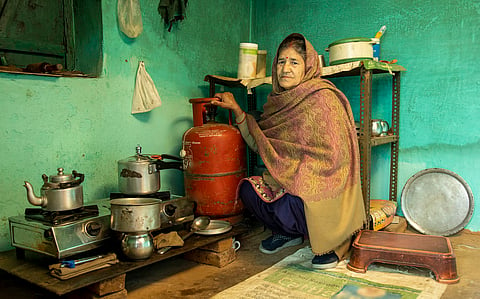


Ethanol is emerging as a powerful but overlooked clean cooking fuel, especially for India, where it can cut deadly household air pollution, reduce LPG imports and support farmers through local feedstocks.
With mature technology, strong international standards and a pay-as-you-go model that suits low-income households, the main barriers are now policy, taxation and distribution, not feasibility.
Billions of people still cook on polluting fuels. The technologies, feedstocks and supply chains needed to change this already exist. Yet one promising solution, ethanol, remains largely overlooked in clean cooking policies.
According to the World Health Organization (WHO), household air pollution from cooking with polluting fuels such as wood, dung, charcoal, coal and kerosene claims nearly 3 million lives every year. Despite decades of commitments and pilot programmes, the world’s clean cooking transition remains far behind schedule. Into this gap steps an unlikely candidate: ethanol, the same renewable fuel increasingly used to decarbonise transport, now emerging as a clean, affordable and locally producible cooking fuel for households.
Ethanol burns cleanly, producing virtually no soot and very low levels of particulate matter, including PM₂.₅ and PM₁₀, making it one of the cleanest cooking fuels available. It can be produced from sugarcane, molasses, agricultural residues, maize, cassava and several other locally available feedstocks. Crucially, unlike LPG, ethanol can be sold in small quantities through neighbourhood retail outlets, making it particularly attractive for low-income households that cannot afford large upfront cylinder purchases. Studies have shown that switching to ethanol cookstoves can reduce household PM₂.₅ concentrations by as much as 84 per cent, from approximately 1,250 microgram per cubic metre (μg/m³) to around 200 μg/m³, well within the WHO’s indoor air quality guidelines. Traditional biomass cooking, meanwhile, contributes an estimated 1.9-2.3 per cent of global CO₂ emissions annually, comparable to emissions from the global aviation sector.
These opportunities and challenges brought together policymakers, researchers, entrepreneurs and technology developers at a recent Global Biofuels Alliance (GBA) webinar on ethanol-based clean cooking. Drawing experiences from Africa, India, the United States and beyond, the discussions converged on one clear conclusion: the barriers to scaling ethanol cooking are no longer technological, they are primarily policy, market and institutional challenges.
The global energy crisis has highlighted the importance of strengthening domestic energy systems. India presents a compelling example. While the country has emerged as the world’s third-largest ethanol producer, it continues to rely heavily on imported LPG, exposing millions of households to international price volatility and geopolitical risks. The mismatch between what India produces and what its households cook with is no longer a resource constraint, it is increasingly a policy opportunity.
India offers a unique opportunity to integrate ethanol into its clean cooking strategy by leveraging its rapidly expanding biofuel ecosystem. India consumed 31.3 MMT of LPG, of which nearly 60 per cent was imported. In parallel, India’s ethanol production capacity has expanded to around 20 billion litres per annum. After meeting the requirements of the E20 blending programme (around 11 billion litres annually) and industrial demand from the potable alcohol, pharmaceutical and chemical sectors (approximately 3-3.5 billion litres), an estimated 5.5-6.0 billion litres, nearly 30 per cent of installed capacity, could potentially be available for new applications such as clean cooking, manufacturing of Sustainable Aviation Fuel (SAF) etc. This surplus alone could substitute approximately 3.1 MMT of LPG, equivalent to 16-17 per cent of India’s current LPG imports, simultaneously strengthening energy security, reducing import dependence and creating a new domestic market for India’s growing bioeconomy.
Globally, however, ethanol cooking remains a niche solution. Sagun Saxena, Founder of CleanStar Ventures and a veteran of ethanol cooking deployments, estimated that only 1-1.5 million households worldwide currently use ethanol for cooking on a regular basis, well below deployment levels envisioned by the International Energy Agency. Fragmented standards, punitive taxation, underdeveloped distribution systems and the absence of coordinated national policies continue to limit scale.
The economics of ethanol cooking nevertheless deserve closer attention. A 14.2 kg domestic LPG cylinder, priced at around Rs 942, contains approximately 655 megajoule (MJ) of energy, while a 19 kg commercial LPG cylinder, retailing between Rs 2,885 and Rs 3,100, contains approximately 875 MJ. Delivering equivalent energy would require roughly 26 litres and 35 litres of ethanol, respectively. At an average ethanol procurement price of Rs 65 per litre, the corresponding fuel costs are approximately Rs 1,690 for the domestic equivalent and Rs 2,275 for the commercial equivalent. While ethanol is presently more expensive than subsidised domestic LPG on an energy-equivalent basis, it is already 20-27 per cent cheaper than commercial LPG, highlighting its immediate potential for restaurants, street vendors, institutional kitchens and small enterprises. Furthermore, ethanol being produced in the country, there will be huge savings in foreign exchange and also ensure uninterrupted availability without getting affected due to Hormuz like shocks. More importantly, ethanol’s greatest advantage lies in its affordability model rather than simply its unit price. Unlike LPG, which requires households to pay the full cylinder cost upfront, ethanol can be purchased in 1-2 litre quantities, allowing consumers to match fuel purchases with daily or weekly cash flows. This pay-as-you-go model, successfully demonstrated in several African countries, addresses one of the principal barriers to sustained clean cooking adoption while complementing, not replacing, India’s successful LPG access programme.
Alicia Koch, Director of Global Ethanol Export Development at the U.S. Grains Council, highlighted that ethanol cooking already benefits from a robust international standards framework. ASTM E3050-22 specifies denatured ethanol for cooking applications, ISO 19867-1 standardises stove performance testing, while ISO 19869:2019 assigns bioethanol stoves a Tier 4 rating, the highest classification for indoor air quality.
Yet technical credibility has not translated into policy parity. Koch noted that ethanol frequently faces import tariffs ranging from 20 per cent to 55 per cent, alongside VAT or excise duties of up to 80 per cent in some countries, even as LPG continues to benefit from government subsidies. She cited the Philippines as a practical example, where ethanol imports were initially encouraged while domestic production capacity was simultaneously developed, demonstrating that energy security and international trade can be complementary rather than competing objectives.
Africa currently provides the world’s most mature experience with ethanol cooking deployment. Sagun Saxena traced the evolution from donor-supported urban pilot projects in Mozambique, Kenya and Tanzania during 2010-2020 to what he described as the “Version 2.0” deployment model in Kenya and Rwanda between 2020 and 2025. Fuel is now distributed through Smart Ethanol Dispensers/ ATMs located in neighbourhood shops, using vapour-tight refillable canisters and mobile money-based payment systems to safely serve more than 1.3 million households.
The affordability model has been central to this success. Ethanol is sold in small-value purchases, often costing less than US$1, compared to an upfront expenditure of around US$7 for an LPG cylinder. For households dependent on daily wages, this difference is transformational. Successful scale depends on five interdependent factors: high-performing products, affordable pricing, proximity to consumers, effective policy support, and standardised platforms that enable multiple private-sector participants.
Isack Danford, Project Manager at Motosafi Limited, demonstrated how operational innovation can be equally important. A simple redesign incorporating silicone seals on ethanol canisters reduced fuel evaporation losses from 1.4 per cent to 0.3 per cent, cutting household cooking costs significantly. He also highlighted that women-led last-mile distribution networks consistently outperform centralized delivery systems in building consumer trust and encouraging sustained adoption.
The African experience has also revealed the importance of resilient business ecosystems. The collapse of a major ethanol cooking company in Kenya in early 2026 underscored how policy uncertainty and implementation delays can undermine otherwise successful technologies. Diversification of feedstocks, financing mechanisms and distribution networks is therefore not optional, it is fundamental to long-term market stability.
Technology continues to strengthen ethanol’s value proposition. One of the most promising innovations presented during the webinar was hydro-ethanol gel, developed through research at IIT Delhi. Snehasish Panigrahy explained that converting liquid ethanol into a semi-solid gel increases the fuel’s flash point from approximately 13°C to over 35°C, substantially reducing the risks of spillage, accidental ignition and misuse.
The gel retains 85-90 per cent of ethanol’s energy content and, when combined with IIT Delhi’s Infrared Cook Stove, achieves thermal efficiencies of up to 71 per cent, approximately 15 per cent higher than conventional cooking technologies. Carbon monoxide emissions were measured at only 5.13 ppm, compared with approximately 110 ppm for LPG. Although hydro-ethanol gel currently costs around 30 per cent more than LPG, efficiency improvements, enhanced safety and lower health costs could significantly improve its long-term competitiveness, particularly if supported through targeted policy incentives.
The fuel is available. Technology has matured. International standards already exist. Supply chains have been demonstrated at scale.
Governments need to recognise ethanol as a strategic clean cooking fuel alongside LPG by establishing enabling standards, creating a level fiscal playing field, supporting market development and encouraging innovation in distribution. For countries such as India, ethanol represents far more than another cooking fuel. It offers an opportunity to simultaneously improve public health, strengthen energy security, reduce dependence on imported fossil fuels, expand markets for domestic biofuel producers, ensure rural prosperity through increasing farmers’ income and accelerate the transition towards a circular bioeconomy and Net Zero.
The ethanol is already in the tank.
It is time to put it in the pot.
Views expressed are the author’s own and don’t necessarily reflect those of Down To Earth