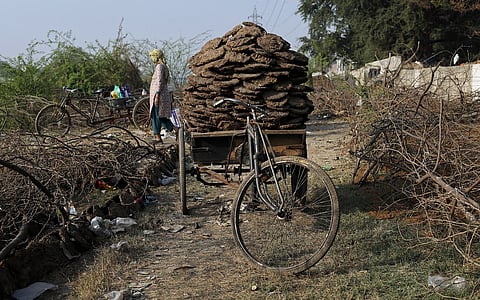


As India grapples with energy security concerns, volatile fossil fuel markets and mounting agricultural waste, two recent developments—a new compressed biogas (CBG) policy in Chhattisgarh and an innovative dung-based biocomposite developed by Indian scientists—highlight a growing shift towards treating cattle dung and farm waste as valuable economic resources rather than agricultural byproducts.
On June 23, 2026, the Chhattisgarh Cabinet approved the Chhattisgarh Compressed Biogas (CG-CBG) Policy 2026, seeking to convert agricultural residue, cattle dung and other organic waste into clean fuel while creating new income streams for farmers and strengthening the state’s rural economy.
Under the policy, agricultural residue, cattle dung, animal waste, municipal organic waste and other biodegradable resources will be scientifically utilised to produce compressed biogas, a renewable fuel that can substitute fossil fuels in transport and industry. The state government estimates Chhattisgarh has the potential to produce nearly 5 lakh tonnes of compressed biogas annually through the effective utilisation of available biomass and organic waste resources.
“The CG-CBG Policy 2026 will create new opportunities for farmers, cattle rearers and the rural economy of Chhattisgarh. Better utilisation of agricultural residue and organic waste will help increase farmers’ incomes and generate employment and entrepreneurship opportunities in rural areas,” Chief Minister Vishnu Deo Sai said.
He added that the policy would help position Chhattisgarh among India’s leading states in clean energy production, green industry, organic agriculture and sustainable development.
The policy comes at a time when India is intensifying efforts to diversify its energy mix and reduce dependence on imported fossil fuels. Energy security has assumed greater importance amid continued instability in West Asia and disruptions to shipping through the Strait of Hormuz, a critical route for global oil and gas trade. India imports nearly 90 per cent of its crude oil requirements and around 55 per cent of its liquefied petroleum gas (LPG), making it vulnerable to global supply disruptions and price volatility.
Against this backdrop, biomass is increasingly being viewed not as waste but as a strategic domestic resource capable of producing energy, fuels, chemicals and industrial materials.
“There is a major focus on using biomass for energy because bioenergy is considered carbon-neutral or even carbon-negative,” Vijay Kumar Saraswat, former member of NITI Aayog and former Director General of the Defence Research and Development Organisation, told Down To Earth earlier. “There is now a strong push to convert biomass into useful products such as biogas, compressed biogas, biomethanol and bioethanol. As a result, biomass has become a valuable feedstock.”
According to Saraswat, cattle dung, once largely considered a low-value resource, is increasingly being used in energy applications. Dung cakes are finding growing use in the production of refuse-derived fuel and other bioenergy applications because much of the moisture has already been removed during traditional preparation, reducing processing costs.
“They have effectively become a resource for producing energy, chemicals, hydrogen and other products. That is why demand has increased,” he said.
The shift is visible beyond the energy sector. Scientists at the Indian Council of Agricultural Research-Indian Veterinary Research Institute (ICAR-IVRI) have developed a cow dung-sheep wool-based biocomposite for livestock sheds, creating a new avenue for converting agricultural and livestock waste into value-added products.
The eco-friendly roofing material is designed to reduce heat stress in livestock sheds, improve animal comfort and enhance productivity while making productive use of locally available waste materials.
Raghavendra Bhatta, Director of ICAR-IVRI and Deputy Director General (Animal Sciences), in a social media post, said such innovations demonstrate how agricultural waste can be transformed into commercially useful products.
He noted that waste-to-wealth technologies provide a practical pathway for utilising cow dung and waste wool in value-added applications while strengthening sustainable livestock production, promoting circular bioeconomy principles and supporting climate-resilient farming systems.
Together, the Chhattisgarh policy and the ICAR-IVRI innovation reflect the emergence of a broader rural bioeconomy in which crop residues, cattle dung, animal waste and other biological resources are increasingly being integrated into energy, manufacturing and agricultural value chains.
The Chhattisgarh policy is expected to support this transition by promoting a circular economy in which waste generated from agriculture and livestock activities is converted into energy and other value-added products. Besides reducing pressure on landfills and open dumping, the policy is expected to improve crop residue management and provide alternatives to residue burning.
Saraswat noted that biomass naturally fits within circular economy principles because waste from one process becomes the input for another.
“Circularity focuses on ensuring that waste is reused and generates value rather than becoming pollution,” he said, adding that biomass-based products are generally considered carbon-neutral because they originate from natural biological cycles that continuously recycle carbon.
The policy is also expected to create an additional revenue stream for farmers through the sale of crop residue and agricultural waste that often remains unused. The government said the establishment and operation of CBG plants would generate employment opportunities in rural areas while encouraging local entrepreneurship and economic activity.
The initiative aligns with the Government of India’s Sustainable Alternative Towards Affordable Transportation (SATAT) programme, which promotes compressed biogas as a clean transportation fuel and seeks to reduce dependence on imported fossil fuels while creating economic opportunities from waste.
To attract private investment, the policy offers capital support, interest subsidies, infrastructure assistance and facilitation for obtaining statutory approvals. These measures are intended to create a favourable ecosystem for developers and investors looking to establish CBG projects in the state.
However, experts caution that scaling up India’s bioeconomy will require overcoming supply-chain and market bottlenecks. “Supply chain challenges are a major issue," Saraswat said, citing the example of a biomass project in the Mohali region that was designed to process around 250 tonnes of biomass a day. According to him, the project’s economics became difficult after suppliers sought higher prices for biomass than initially agreed.
He added that feedstock aggregation, long-term supply contracts and integration of biogas into existing compressed natural gas distribution networks remain key hurdles for the sector.
The Chhattisgarh Biofuel Development Authority has been designated as the nodal agency for implementation and will coordinate with investors, industries, government departments and other stakeholders.