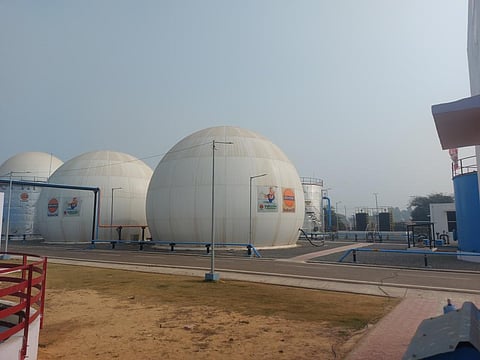


India’s heavy reliance on imported LNG, especially from West Asia, leaves its energy security exposed to conflicts like the Iran-Israel war.
The country has vast untapped compressed biogas (CBG) potential, estimated at up to 90 BCME annually.
Scaling CBG could offset much of India’s LNG imports, turning domestic waste into a strategic fuel buffer.
India’s energy security is once again under scrutiny. The Iran–Israel war has injected fresh uncertainty into global energy markets, particularly for fuels that move by sea. For a country that imports a large share of its natural gas, this is a stark reminder that dependence on overseas supplies is a structural vulnerability. Yet India also sits on one of the world’s largest untapped compressed biogas (CBG) resources. If scaled up, CBG could become a real, domestic buffer against external gas shocks.
India’s natural gas consumption has continued to rise. According to data reported from the Petroleum Planning & Analysis Cell (PPAC), total natural gas consumption in 2024-25 was about 71.3 billion cubic metres (BCM), which works out to roughly 195 MMSCMD over the year. Fertiliser, city gas distribution, power and refineries remain the largest consumers.
On the supply side, India imported around 27 million tonnes of LNG in 2024-25, the highest level so far. This corresponds to about 100-101 MMSCMD of imported gas on a daily basis. In other words, around half of India’s gas consumption is now met through LNG imports, and PPAC data indicate that gas import dependence stood at just over 50 per cent in 2024-25.
Qatar remains India’s single largest LNG supplier. West Asian exporters (primarily Qatar, the UAE and Oman) together account for roughly 70% of India’s LNG imports, with Qatar alone supplying well over 10–12 million tonnes per year. Much of this gas reaches India’s west coast terminals via the Strait of Hormuz, one of the world’s most geopolitically sensitive chokepoints.
This means that any disruption or perceived risk in key producing or transit regions — such as those arising from the Iran-Israel conflict — can quickly translate into higher landed gas costs and heightened uncertainty for India’s power, fertiliser, city gas and industrial sectors.
Compressed biogas, essentially purified biogas upgraded to pipeline or vehicle-fuel quality offers India a rare combination: It is domestic, dispatchable and based on waste and residues rather than imported fossil feedstock. CBG can be injected into existing gas grids, used as a transport fuel, or supplied directly to industry and city gas networks.
The International Energy Agency’s India Bioenergy Market Report estimates that India’s sustainable CBG potential could reach up to about 90 billion cubic metres equivalent (BCME) per year. That is more than India’s entire current natural gas demand.
The IEA notes that more than 45 per cent of the total potential is from crop residues — most of which arise from cereals and grain crops — and about 30 per cet is from animal manure. Biowaste makes up 24 per cent, most of which comes from the organic fraction of municipal solid waste, with the rest stemming from industrial waste and wastewater. This diversity reduces the risk of over-reliance on any single feedstock and allows CBG projects to be tailored to local resource profiles.
Even if only a fraction of this potential is realised, the implications for energy security are profound. With LNG imports currently around 28-30 bcm per year, harnessing just a third of the sustainable CBG potential could, in principle, offset India’s entire LNG import requirement. While real-world deployment will be constrained by logistics, economics and policy, the order of magnitude is clear: CBG is not a niche fuel; it can be system-relevant.
India has already begun to move from concept to implementation. Under the Sustainable Alternative Towards Affordable Transportation scheme, the number of operational CBG plants are rising steadily. Recent government and industry reports and the GOBARdhan unified registration portal data indicate that around 207 CBG plants are now operational and 330 under construction.
In Punjab and Haryana, CBG plants using paddy straw and other residues are supplying gas to city gas networks and transport, while reducing stubble burning and associated air pollution. Sugar mills in Maharashtra and Uttar Pradesh are integrating CBG units with their existing operations, using press mud and other by-products to generate additional revenue and local gas supply.
Urban projects in cities such as Indore, Pune, Goa are using segregated municipal solid waste to produce CBG, simultaneously addressing waste management, landfill methane emissions and local energy needs.
Additionally, the by-product “digestate” produced from CBG plants is used as an organic fertiliser, improving soil structure and reducing dependence on imported chemical fertilisers.
The Government of India has recently strengthened its support for the CBG sector through multiple policy initiatives. Under the Special Assistance to States for Capital Investment scheme for 2026-27, announced on March 27, 2026, a total outlay of Rs 2 lakh crore has been allocated, out of which Rs 3,000 crore is specifically earmarked for CBG. This support is provided as 50-year interest-free loans to states, encouraging them to take up reforms and actions that accelerate the development of the CBG ecosystem.
The focus is on faster project commissioning, better utilization of plants, improved feedstock systems, enhanced market access, and building a more investor-friendly environment. The funds are distributed across policy alignment (Rs 1,300 crore), readiness index (Rs 500 crore), and fiscal co-financing (Rs 1,200 crore).
In addition, on April 6, 2026, the Union Ministry of Petroleum and Natural Gas introduced a “Model State CBG Policy” to guide states in developing a consistent and streamlined approach. The policy is based on best practices and stakeholder inputs, aiming to align state-level actions with national goals and support the growth of a gas-based economy.
Further, the government expanded the CBG–City Gas Distribution (CGD) synchronisation scheme on March 18, 2026 to allow direct injection of CBG into gas pipelines. The scheme, now extended till December 2047, is designed to integrate CBG with the existing gas network, enabling its use in CNG and PNG and creating a more robust market for producers.
To turn CBG into a true shield against external gas shocks like those triggered by the Iran war, India needs to move from incremental growth to deliberate scale-up.
If India acts decisively, CBG can do for gas what ethanol has begun to do for petrol: Partially decouple the country from volatile global markets, turn domestic waste into strategic fuel, and make wars in distant regions less of a threat to India’s energy security. In a world of recurring geopolitical shocks, that is not just an environmental opportunity, it is a national security imperative.
Rahul Jain is a biofuels specialist at the Global Biofuels Alliance. Santanu Gupta is director (technical), Global Biofuels Alliance. Views expressed are the author’s own and don’t necessarily reflect those of Down To Earth.