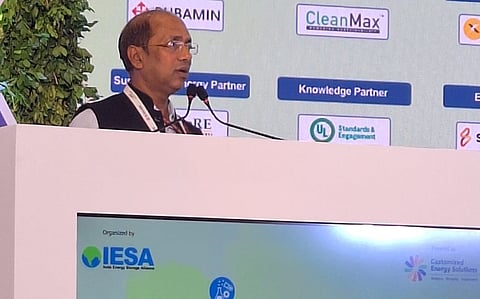


The Union Ministry of Heavy Industries (MHI) plans to expand policy support for battery recycling and advanced chemistry cells (ACC), signalling a broader push to strengthen India’s domestic battery manufacturing ecosystem beyond cell production.
“There have been repeated requests for creating specific policies for niche battery technologies, and going forward, we also see the need to expand the existing incentive system for advanced chemistry cells so that more operators and partners in the field can be covered,” Vijay Mittal, Joint Secretary, MHI, said at the 12th India Energy Storage Week (IESW) 2026 in New Delhi.
Mittal also announced that MHI, along with the Office of the Principal Scientific Adviser to the Prime Minister, has partnered with the European Union to develop pilot projects on battery recycling.
The announcement comes as India looks to reduce import dependence for battery materials while scaling up domestic manufacturing to support electric mobility and renewable energy storage.
It also comes amid concerns that India’s battery manufacturing programme has progressed slower than envisaged. According to a January 2026 report by the Institute for Energy Economics and Financial Analysis (IEEFA), only 1.4 gigawatt hour (GWh) of the 50 GWh capacity targeted under the Advanced Chemistry Cell (ACC) battery storage production linked incentive (PLI) scheme had been commissioned by October 2025 because of supply-chain bottlenecks, implementation delays and domestic value-addition requirements.
The government’s push builds on the Rs 18,100-crore ACC PLI, approved in 2021 to establish 50 GWh of domestic battery manufacturing capacity, with an additional 5 GWh for niche technologies. The scheme selected three firms—Reliance New Energy Solar Ltd, Ola Electric Mobility Ltd and Rajesh Exports Ltd—to set up manufacturing facilities. While the projects have been delayed due to technology choices, financing and supply chain challenges, companies have begun advancing their manufacturing plans, with commercial production expected to ramp up over the next few years.
ACC PLI scheme complements incentives for electric vehicles under the PM E-Drive programme and critical mineral initiatives led by the Union Ministry of Mines.
Another IEEFA report, released in May 2026, argues that India risks replacing oil import dependence with battery import dependence. Battery demand projected to rise from 28 GWh in 2025 to 272 GWh by FY2030. India still depends heavily on imported battery cells. Around 66 GWh of announced capacity outside the PLI focuses mainly on battery pack assembly rather than cell manufacturing.
A report by the India Energy Storage Alliance (IESA) and Customised Energy Solutions, India will need 888 GWh of energy storage capacity by 2035-36, nearly 900 times its current installed capacity of around 1 GWh.
India has commissioned around 7.5 GWh of storage capacity, while more than 140 GWh is under construction, awarded, or under tendering.
The latest announcement suggests the government’s focus is now shifting beyond cell manufacturing to downstream segments such as battery recycling, component manufacturing and niche battery technologies, which are increasingly viewed as critical for securing raw materials and creating a circular battery economy. Reflecting on the sector’s evolution, Mittal said the government’s focus has expanded from electric vehicles to battery manufacturing, battery components, cell technologies, raw material mining, recycling and financing.
“What began as a chapter on electric vehicles has now grown into a dozen chapters... Recycling has become a very significant subject, and financing has also become vital to the ecosystem,” he said.
Mittal added that the ministry is evaluating proposals to support the battery component ecosystem, including an ALMM-like framework for battery components and targeted policies for niche battery technologies. He also noted that the Ministry of Mines has introduced schemes to promote refining of critical minerals required for battery production.
The proposed policy support is significant as battery recycling is expected to become an important source of critical minerals such as lithium, cobalt, nickel and graphite over the coming decade. Industry estimates suggest India’s first wave of end-of-life electric vehicle batteries will begin reaching recyclers at scale towards the end of this decade, making domestic recycling infrastructure crucial for resource security and reducing import dependence.