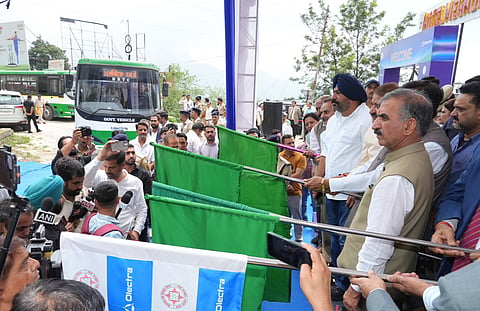


Himachal Pradesh has inducted 297 new electric buses in a single rollout, taking its operational e-bus fleet to 407.
Officials say the new buses will operate on 318 routes and cover about 75% of the state, as Himachal tries to cut transport-related emissions.
The expansion comes as new vehicle registrations in the state have risen nearly 78-fold since 2000, adding to congestion and air pollution concerns.
The transition still faces major hurdles, including high upfront costs, limited charging infrastructure, battery performance in cold and steep terrain, and the need for buses designed for Himalayan roads.
For decades, Himachal Pradesh’s identity has been built around its forests, mountains and clean air. But a drive through its major towns, including the state capital Shimla, offers another image: long queues of vehicles on narrow roads, diesel cars and buses crawling bumper-to-bumper during peak hours, and the smell of exhaust replacing the freshness expected from a Himalayan town.
New vehicle registrations in Himachal Pradesh have risen from just 2,075 in 2000 to a peak of 1,61,959 in 2025, a roughly 78-fold increase over two and a half decades, according to the Union Ministry of Road Transport and Highways’ VAHAN dashboard.
In Shimla, too, the number of new vehicles registered has increased from just 42 in 2000 to more than 2,500 a year in recent years, adding to concerns over congestion and transport-related emissions.
Of the 25 monitoring stations across 12 towns and cities where the state government tracks air pollution, at least 13 recorded annual average particulate matter (PM10) levels higher than the prescribed standard, according to the most recent annual report for 2022-23, published by the Himachal Pradesh State Pollution Control Board.
Seven Himachal towns, Baddi, Damtal, Kala Amb, Nalagarh, Paonta Sahib, Parwanoo and Sundernagar, have been classified by the Central Pollution Control Board as “non-attainment” towns, meaning they have breached national ambient air quality standards.
It is against this backdrop that the Himachal Pradesh government has begun an effort to electrify its public transport system, starting with a major expansion of its electric bus fleet.
In 2016, Himachal Pradesh introduced its first electric bus, running a single tourist route to Rohtang Pass under a National Green Tribunal order. A decade later, the programme has expanded to 407 electric buses — a fleet officials describe as the largest of its kind in any Himalayan state.
On July 30, 2026 the state inducted 297 new buses into the Himachal Road Transport Corporation fleet in a single rollout, taking the total number of electric buses in operation to 407. Officials describe it as the largest such fleet in any Himalayan state.
“This is a step towards making Himachal aatmanirbhar. There is a discussion on getting 1,000 more e-buses and the tender will be passed this year. We are also considering 100 hydrogen buses, so that we can save Himachal’s environment and climate,” Chief Minister Sukhvinder Singh Sukhu said while launching the 297 buses at Kiarighat in Solan district.
Himachal Pradesh’s electric mobility journey formally began with its Electric Vehicle Policy, 2022, notified on January 20 that year.
The policy set a target for 15 per cent of all new vehicle registrations to be electric by 2025. Three years on, the state is nowhere close to that target. Electric and hybrid cars made up less than 1.5 per cent of new vehicle registrations in 2025, according to VAHAN data.
While the push towards electric mobility elsewhere in India has largely focused on private vehicles and individual consumers through incentives, subsidies and tax breaks, Himachal Pradesh’s transition has gathered the most momentum in public transport, particularly the state’s own bus fleet.
An estimated five to six lakh passengers commute every day on state buses across Himachal Pradesh, making them the largest single mode of public transport in the state.
The 297 new buses will operate on 318 routes, together covering an estimated 75 per cent of Himachal Pradesh, Pawan Kumar Sharma, divisional manager (technical) at Himachal Road Transport Corporation, told Down To Earth.
Within a 40 kilometre radius of Shimla alone, 55 of these buses have been deployed, adding to about 70 electric buses already running in and around the capital. The choice to begin with buses rather than private vehicles was deliberate, according to Vijay Saini, Senior Manager at ICLEI South Asia, a sustainability network working with the state transport department on electric mobility. The aim, he said, was to prioritise passenger-kilometres travelled on electric power, not just the number of electric vehicles on the road.
“We assessed that moving one private vehicle from diesel or petrol to electric would bring a benefit of six km, whereas bringing one bus under electric was equivalent to converting 50 to 60 private vehicles,” he said.
Vehicular pollution and greenhouse gas emissions are among the main contributors to the state’s air-quality concerns, and the diesel bus fleet is one area the government can act on directly without waiting for individual buyers, said Neeraj Kumar, director of the Himachal Pradesh Transport Department.
In Himachal Pradesh’s case, a large share of electricity comes from hydropower, reducing the carbon footprint of charging compared with states that rely more heavily on thermal power. The new buses can run 180 km on a single charge. The next phase of induction is expected to bring buses with a range of 250 km to 300 km, enough to cover a full day’s route on one charge.
“We are a pioneer state in mountainous regions to have electric buses in such large numbers. We tested the buses first based on route conditions and the availability of charging stations. We saw that intra-state conventional buses run, on average, for less than 200 km. That is how we launched buses with a 180 km range,” Kumar said.
Even so, HRTC’s fleet remains overwhelmingly diesel-powered. The corporation runs 2,806 diesel buses across the state, with 142 being retired this year to make way for the new electric buses. “We are working to reduce them. A diesel bus emits 1.3 kg of carbon in one km. We are a green state, there is so much vegetation, and we can only save it if we change the system,” Sharma said.
Charging the fleet remains a work in progress. HRTC has prepared a Rs 122 crore detailed project report for 80 charging locations across the state. Of these, 35 are currently operational, with 50 chargers installed. Each charger takes 70 to 80 minutes to fully charge a bus.
For the drivers behind the wheel, the transition has been as much about adapting to a new way of driving as it has been about new technology.
“There is no clutch or gear, only the accelerator and brake. It is much easier to manoeuvre. I had kidney-related surgery last year and I find driving this bus much more comfortable compared with a conventional one,” said Bhim Chand, an HRTC driver who has been driving electric buses in Shimla for the past five to six months. He said he typically charges the bus for about an hour during his shift before completing the day’s routes.
Other drivers Down To Earth spoke to said battery management remains one of the biggest adjustments. The buses have to be recharged once the battery drops to around 30 per cent to 40 per cent, and on some steep stretches, especially with a full load of passengers, the battery can drain faster than expected.
At HRTC’s charging station in Shimla’s MC Parking, where around 70 electric buses come for charging, Om Prakash, who oversees charging operations, said older buses that have been running for nearly five years are developing faults more frequently. He said charging interruptions sometimes require the charger to be disconnected and reconnected several times before charging resumes.
One driver said that when a bus struggles on a particularly steep climb, passengers occasionally have to get off briefly before it resumes the ascent. The challenges become more pronounced in higher reaches. HRTC officials said electric buses are currently not deployed on rough terrain, snow-bound routes or particularly slippery stretches.
Unlike conventional diesel buses, which drivers can sometimes ease out using the clutch, an electric bus that loses traction is harder to recover, they said.
In colder, high-altitude areas, battery performance can drop sharply. Officials cited instances where range has fallen from 30 per cent to 10 per cent within minutes in sub-zero conditions. Routes such as Rohtang Pass require extra caution and, at times, diesel buses on standby.
Officials and drivers said routes are selected carefully based on gradient, weather and charging infrastructure. Padam Singh Thakur, who drives the Shimla-Solan route, including interior stretches such as Naldehra, said his routes are assigned by the government based on where charging points are available. He said he has faced no major issues on his stretch.
This careful route selection also underlines one of the limits of the state’s transition. Extending the fleet across the rest of Himachal’s mountainous road network will require buses designed specifically for Himalayan conditions, officials and experts said. That is where the real bottleneck lies.
The initial challenge was that manufacturers were hesitant to invest in developing a separate design for a small Himalayan market. As a result, the state had to identify routes where existing electric bus models could operate without major structural changes.
Saini said manufacturers typically design buses for large, flat-terrain markets such as Delhi, Mumbai or Chennai, where cities have broadly similar requirements and only battery sizing or floor height may need adjustment between orders.
Himachal’s steep gradients and sharp turns require something different, including a smaller “bus overhang”, the part of the vehicle extending beyond the front wheel, which gives drivers better visibility and manoeuvrability on mountain curves. “The challenge here is that for manufacturers to customise the buses only for Himachal is an additional investment. And it is not a very big market,” Saini said.
To overcome this, the state worked with manufacturers and secured some modifications to the buses deployed in the latest phase. The new fleet has been tested and adapted for Himachal’s conditions, including changes in approach and departure angles, ground clearance and height.
Sharma said the buses inducted this year have an approach angle of around 11 to 12 degrees, compared with 9 to 10 degrees in the earlier electric fleet, allowing them to negotiate steeper stretches more safely. The corporation conducted trials of these buses for five months, from January to June, across different terrains in the state before deployment.
However, Saini said these adjustments are still not a complete solution. “Technology readiness is still a challenge. For the next phase of expansion, dedicated design changes would be necessary, not just for Himachal but for other Himalayan states as well. If we have to move further, there has to be a willingness from manufacturers to tweak designs for mountain conditions,” he said.
While electric buses reduce operating expenses, the upfront cost remains a major hurdle. Each of the newly inducted electric buses costs around Rs 1.26 crore, compared with approximately Rs 35 lakh to Rs 36 lakh for a conventional diesel bus, according to HRTC data.
The corporation has opted for long-term maintenance contracts of 12 to 15 years with manufacturers as part of the procurement model to ensure operational support. Developing charging stations is another major expense, with each site costing an estimated Rs 70 lakh to Rs 80 lakh.
The savings come during operations. Chief Minister Sukhu, speaking to reporters during the bus launch, estimated that running an electric bus costs around Rs 36 to Rs 38 per km, including staff-related expenses, compared with Rs 74 to Rs 86 per km for diesel buses.
In electricity terms, an electric bus consumes roughly one unit per kilometre. While the commercial electricity tariff in Himachal Pradesh is around Rs 7 per unit, taxes and other charges take HRTC’s effective electricity cost to about Rs 14 per km.
By comparison, operating a diesel bus costs the corporation around Rs 25 per km on fuel alone, Sharma said. “The capital expenditure is high, and we have to sustain it financially. But the environmental benefits are equally important,” he said.
The expansion marks a significant step in Himachal Pradesh’s clean transport push, but replacing the diesel buses and vehicles that still dominate its roads will depend on whether the state can scale up charging infrastructure, secure mountain-ready technology and make the shift financially viable.
The next part of this series explores how the state is trying to bring electric mobility to taxis, private cars and its tourism economy, and the challenges that transition presents.