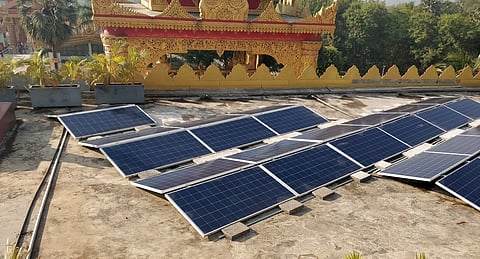


In 2018, Maharashtra led India’s rooftop solar map with 152 megawatts (MW) installed, followed by Karnataka and Tamil Nadu. Gujarat sat fourth, with 94 MW. Seven years later, the map has been redrawn.
As of March 2026, Gujarat has 6,882 MW on its rooftops (the highest in India), while Maharashtra has climbed to 5,442 MW, and Rajasthan and Kerala have surged past 2,090 MW and 1,850 MW, respectively, according to data from the Union Ministry of New and Renewable Energy (MNRE) compiled by reseach organisation Climate Compatible Futures (CCF).
India’s cumulative rooftop capacity reached 25.7 gigawatt (GW) by March 2026, and installers added 2.7 GW in the first quarter of 2026 alone, a 125 per cent jump over the same quarter a year earlier. Residential systems accounted for 82 per cent of that growth, most of it under the PM Surya Ghar Muft Bijli Yojana, the central subsidy scheme launched in February 2024 that pays households up to Rs 78,000 and targets 1 crore (10 million) homes.
But the analysis from CCF shows how unevenly that boom is landing, the organisation said in a statement. A handful of western and southern states now account for the bulk of installed capacity; the top ten states make up close to 86 per cent of the national total. At the other end, the eight northeastern states barely register. Assam, the region’s largest, has 344 MW. Manipur has 11 MW, Sikkim 5 MW, Nagaland 1 MW, and Meghalaya 0.21 MW, which is insignificant compared to Gujarat’s 6.8 GW.

“What the analysis shows is not just a fast-growing market but a lopsided one. Gujarat and Maharashtra have spent years building deep solar ecosystems (installers, financiers and distribution utilities) that move applications through quickly, while large parts of eastern India are still waiting for that groundwork to be laid,” said Manish Ram, Chief Executive Officer, CCF.
Towards northern India, Rajasthan and Haryana, at 2090 MW and 1188 MW, are among the country’s stronger performers, while Uttar Pradesh is at 715 MW but rising fast. UP was one of the top three states for fresh additions in early 2026. Yet Delhi (410 MW) and Punjab (581 MW) remain modest given their incomes, and the hill states lag furthest: Uttarakhand has 274 MW, Jammu and Kashmir 42 MW, and Himachal Pradesh at 67 MW. “The constraint here is not the rooftops (individual homes, homestays and resorts across the hills are well suited to rooftop solar) but the absence of a state-level policy push and easy access to installers and financing,” said Ram.
The sharper line, though, runs west to east. The eastern states have stayed near the bottom: Bihar has 218 MW, Jharkhand 95 MW, Odisha 156 MW and West Bengal just 67 MW; this is a region that is home to a quarter of India’s population.
“Solar potential is not the constraint; the east receives ample solar radiation, but the difference is the ecosystem,” said Ram, adding, “Gujarat, Maharashtra and Kerala built up installer networks, financing channels and consumer awareness years ago, and their distribution companies (DISCOMs) tend to process net-metering applications quickly and view rooftop solar as an asset.” In much of the east, financially stressed distribution utilities are slower and more cautious, the vendor base is thin, and households face weaker access to credit and lower awareness of the subsidy, barriers that analysts say keep adoption low even where the policy and the potential are both present.
The gap matters more now than it did in 2018. In March 2026, the Union Cabinet approved India’s third Nationally Determined Contribution (NDC 3.0) for submission to the United Nations Framework Convention on Climate Change (UNFCCC), committing to a 47 per cent cut in the emissions intensity of gross domestic product and 60 per cent non-fossil installed power capacity by 2035. Most power procurement occurs at the state level, and those targets cannot be met by a few high-performing states alone. Rooftop solar is among the fastest ways to add clean capacity close to where demand sits, without new land or transmission lines, but only if adoption spreads. This can be amplified by the growing storage and electric-vehicle markets.
Experts said that the Northeast’s lag may not be a money problem. Assam offers a combined central-plus-state subsidy of around Rs 1.3 lakh for a 3-kilowatt system, and northeastern states qualify for higher central assistance than the rest of the country. Yet uptake stays low, pointing, as in the east, to thinner utility capacity, slower approvals, limited financing and vendor networks, and low consumer awareness rather than the size of the cheque.
“The economically weaker states in the east need to tap into the financial benefits of cheaper renewable energy to boost their economies. This is also a business opportunity for vendors and installers to expand to these states. However, the utilities have to cooperate and be on board and that directive has to come from the state government, in the larger interest of the state economy,” said Ashish Fernandes, Director, Climate Risk Horizon.
“India’s 2035 targets assume every state pulls its weight, and that will not happen on subsidies alone. The states falling behind need functioning distribution utilities, local vendors and consumers who trust that the savings will actually show up on their bills. That might be a question of execution, not ambition,” said Ram.
For all the recent acceleration, the scheme remains well short of its goal: 9.56 GW of a 30 GW residential rooftop target by March 2026, reaching about 32 lakh (3.2 million) of the one crore (10 million) households it aims to cover.
Whether India closes that gap, and whether the map keeps tilting toward a few states, will depend less on subsidies and more on execution: approvals, financing, and distribution companies willing to treat rooftop solar as an asset rather than a threat.