

Petrol and diesel still account for 90% of India’s on-road transport energy use, with CNG supplying most of the remainder
Data shows CNG adoption is being driven largely by high-mileage three-wheeler passenger vehicles
Higher upfront costs, charging access and reliability concerns continue to slow electric auto adoption
Experts warn that sustained investment in CNG risks delaying a shift to zero-tailpipe-emission urban transport
Compressed natural gas (CNG) once delivered quick public-health wins by replacing highly polluting diesel vehicles in Indian cities. Today, it is shaping the nation’s shift towards cleaner transport fuels. While petrol and diesel still dominate on-road energy use, recent data shows CNG has emerged as the default alternative, raising questions about whether the transition is moving fast enough — or in the right direction — towards zero-emission mobility.
In 2024-25, 49 per cent of the transport sector’s (on-road) energy requirement was supplied by petrol, 41 per cent by diesel, 9 per cent by CNG and only 1 per cent by electricity. The clean-fuel transition in this sector has been very slow, as the graph below shows.

When we look at how the sector is transitioning towards clean energy alternatives, while Auto LPG reliance for transport fuel has decreased, it appears to be getting replaced by CNG. Currently, among alternative sources of transport energy, CNG is dominant, as shows the second graph.
This pattern is not surprising, because CNG has become the low-friction transition fuel for operators. Vehicles are widely available, refuelling is predictable, and financing is familiar. For a high-mileage driver, what matters is not only fuel price per kilometre, but also uptime, queuing time, service ecosystem, and the confidence that the vehicle can earn every day.
In comparison, electric mobility still faces practical frictions that convert directly into income risk, such as uncertain charging access, connection timelines, tariff complexity, and downtime anxiety. As a result, CNG starts behaving like a default pathway rather than a deliberate stepping stone. The challenge is not to dismiss CNG’s past role or its near-term harm-reduction value, but to ensure it does not become a long-term lock-in that slows the shift to genuinely zero-tailpipe-emission options.
Even though electricity as a fuel source consumed by the transport sector is increasing slowly but steadily, the on-road stock of non-petrol and non-diesel vehicles will continue to be dominated by CNG fleets unless clean energy transition policies ensure that purchasing and operating an electric vehicle is objectively more affordable than operating a CNG vehicle.
To understand which vehicle segment is driving CNG adoption, it is important to analyse fuel-wise vehicle registrations over the last few years. Between 2021 and 2025, 63 per cent of all CNG vehicles registered in India were three-wheeler passenger vehicles, and 31 per cent were goods carriers.
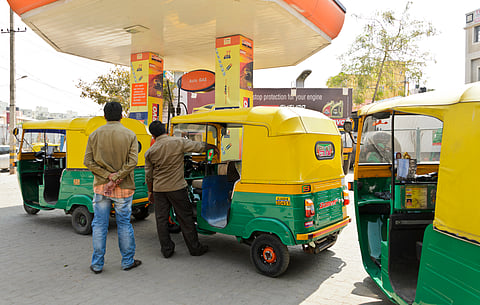
Clearly, the three-wheeler passenger segment, or autos, dominates CNG adoption. Also, because the daily average distance covered by a CNG auto is at least five times more than that of a private CNG vehicle, fuel consumption in the CNG auto segment is correspondingly higher.
A state-wise analysis of auto registrations shows that between 2021-22 and 2025-26 (till January 2026), 56 per cent of the total autos registered were CNG-fuelled, 20 per cent were electric, and about 47 per cent of all autos registered in India were registered in Uttar Pradesh, Maharashtra and Gujarat, as the next graph shows.
Surprisingly, West Bengal registered a higher number of LPG autos than any other fuel, even though the state had waived registration fees for all CNG vehicles. This was due to the nascent CNG infrastructure and limited supply in the state. Hence, West Bengal sits at an opportune position to leverage its current infrastructure status to nudge the auto segment towards electric vehicles by strengthening EV charging infrastructure in a way that aligns with the operational requirements of high-mileage segments such as autos and cab drivers.
To begin with, it is important to examine CNG costs. The price of CNG, much like EV electricity, is not uniform across fuel providers. Between March 2025 and November 2025, the average cost of CNG across Uttar Pradesh, Gujarat and Maharashtra was as follows:
Uttar Pradesh: Rs 82.5/kilogramme (Bagpat Green Energy Private Limited) - Rs 101.3/kg (Hindustan Petroleum Corporation Limited)
Gujarat: Rs 79.5/kg (Maharashtra Natural Gas Limited) - Rs 83.6/kg (Torrent Gas Limited)
Maharashtra: Rs 46/kg (Sholagasco Private Limited) - Rs 96.8/kg (HP Oil Private Limited)
Assuming a CNG auto runs approximately 25-27 kilometre per kg of CNG, the fuel cost for an L5 CNG auto typically works out to:
Uttar Pradesh: Rs 3.05/km - Rs 4.05/km
Gujarat: Rs 2.9/km - Rs 3.3/km (can be lower at some low-tariff sites)
Maharashtra: Rs 1.7/km - Rs 3.9/km
Across these three states, the public-charging fuel cost for an L5 electric auto typically works out to:
Uttar Pradesh: Rs 1.3/km - Rs 1.7/km
Gujarat: Rs 1.1/km - Rs 1.6/km (can be lower at some low-tariff sites)
Maharashtra: Rs 1.4/km - Rs 1.7/km (premium fast charging can push this above Rs 2/km)
Clearly, the surface-level operational costs of electric autos are significantly lower than those of CNG autos, which is already well known. This raises the question of what is incentivising auto drivers to opt for CNG over electric. On average, the difference in upfront cost between an electric auto and a CNG auto is roughly Rs 1 lakh. Although this is high for an average auto driver, it can be recovered relatively quickly through lower operating costs, given that this is a high-mileage segment.
In Maharashtra (with benefits clearly active under the 2025 policy), the net difference in cost between a typical Bajaj CNG auto and a Bajaj electric auto after subsidies is roughly Rs 50,000-Rs 1.1 lakh. In Uttar Pradesh, there are two scenarios:
Case A: If the specific electric auto qualifies as made or assembled in Uttar Pradesh (and is registered there), the difference in cost after subsidies and waivers is Rs 70,000-Rs 1.4 lakh.
Case B: If it does not qualify (likely for many models unless assembled in the state), the difference in cost, with no state subsidy or waiver, is Rs 1 lakh-Rs 1.7 lakh.
In Gujarat (where the 2021 purchase-subsidy window has ended and tax relief applies till March 2026), the current difference in cost is around Rs 1 lakh-Rs 1.6 lakh.
Apart from the upfront cost difference, which is a major consideration for auto drivers, other important criteria include convenience and reliability. A typical auto driver is unlikely to change daily routes or add dead kilometres; if public charging locations are not conveniently located to avoid such detours, drivers are likely to refrain from transitioning to electric autos.
Charging uptime is another critical issue. Most auto drivers would prefer the convenience of charging at home. However, the ability to charge at home has not been codified in urban planning regulations. Many auto drivers, especially in urban areas, do not have access to home charging due to lack of space or compatible backend infrastructure. Parking areas in cities, particularly in urban villages, also lack adequate charging facilities.
Another contributing factor is the availability of tried-and-tested OEM models. Between 2021 and 2025, around 93 per cent of three-wheeler passenger vehicles in Gujarat across all fuels were Bajaj models. The corresponding share was 66 per cent in Uttar Pradesh and 89 per cent in Maharashtra. However, Gujarat’s market introduced an electric Bajaj auto only in 2024, Uttar Pradesh in 2023, and Maharashtra registered only one electric Bajaj auto in 2023.
The delayed introduction of the most trusted OEM model in the electric auto segment has clearly played a role in the slow adoption of electric autos, particularly in large markets such as Gujarat, Maharashtra and Uttar Pradesh.
CNG played a decisive transitional role in India’s clean-air goals when it displaced highly polluting diesel-era fleets and delivered rapid public-health gains. However, CNG is still a fossil fuel, and it does not address today’s more complex air-quality challenge: NOx-driven ozone and secondary particulate formation. With electric alternatives now available for high-mileage urban segments, the policy question is no longer whether CNG is better than diesel, but whether continued investment in CNG risks locking cities into another decade of combustion, thereby delaying the cleaner endpoint.
The priority should be to make electric mobility reliably chargeable and affordable for those who drive the most kilometres every day; otherwise, CNG will continue to win by default.
To ensure the next wave of adoption in the auto segment is electric, state departments (including, but not limited to, power departments, distribution companies, transport departments, and local municipalities or urban development departments) must work in tandem to ensure that the economics of owning and operating an electric auto work for the average auto driver.
Electrification as a policy option to mitigate on-road pollution will succeed only if operating an EV is made economically attractive and the “right to charge” principle is made viable not just for affluent private car owners, but also for electric auto operators.