
Subscribe

ISA launches global AI-for-Energy mission at India AI Impact Summit 2026
Initiative aims to align policy, data systems and finance across 120+ member countries
AI seen as key to improving grid resilience, decentralised renewables and service delivery
India’s digital public infrastructure model presented as template for replication
The International Solar Alliance (ISA) has unveiled a global mission to fast-track the adoption of artificial intelligence (AI) in clean energy systems across its 120+ member countries, placing digital infrastructure and citizen-centric platforms at the centre of the energy transition.
The announcement was made on February 17, 2026 during a high-level session at the India AI Impact Summit 2026 in New Delhi, organised in partnership with the Union Ministry of Power, Ministry of Electronics and Information Technology, and REC Limited.
The session, titled Global Mission on AI for Energy – Scaling through Citizen-Centric India Energy Stack, explored how AI can transform energy planning, grid management and service delivery, particularly in developing economies where reliable electricity access remains uneven.
ISA’s proposed mission aims to bring together governments, industry, financial institutions and multilateral organisations to scale digital and AI-enabled clean energy systems.
The initiative seeks to align policy frameworks, strengthen data infrastructure, build technical capacity and mobilise finance — moving beyond isolated pilot projects towards system-wide transformation.
Officials said AI-driven solutions could help countries bypass legacy infrastructure pathways by improving grid resilience, cutting operational costs and accelerating the deployment of decentralised renewable energy.
India’s digital public infrastructure in the power sector was presented as a model. By integrating consumers, vendors, utilities and financial institutions through interoperable platforms, policymakers said energy services can become faster, more transparent and more inclusive.
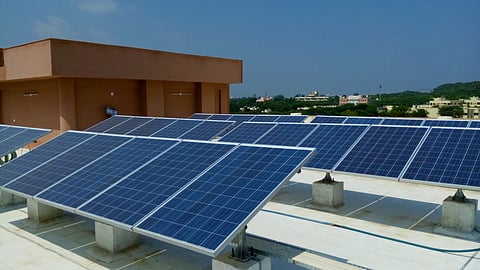
Government representatives highlighted India’s rapid expansion in renewable capacity and distributed energy systems. They noted that technology-driven platforms have accelerated rooftop solar adoption, turning what was once a pilot concept into a scalable national programme.
Speakers also pointed to AI’s growing role in managing bidirectional power flows, forecasting demand and optimising grid operations as more consumers become energy producers.
ISA Director General Ashish Khanna said the global energy transition is increasingly decentralised, with distributed solar installations creating new demands on grids and financial models. Digitisation and AI, he said, are now essential to scale clean energy efficiently while ensuring equitable access.
The summit also saw the release of a report titled Smarter and Citizen-Centric Power for Shared Prosperity: Unleashing the Potential of Digitally and AI-Enabled Power Systems. It argues that clean energy expansion and AI adoption reinforce each other: affordable clean power enables digital growth, while AI supports efficient scaling of renewable energy systems.
ISA showcased several technology solutions designed for replication across member countries.
A Digital Consumer Interface – One Solar App, developed by BSES Rajdhani Power Limited, allows digital registration, net-metering transparency and performance monitoring for rooftop solar users.
Indian start-ups demonstrated Digital Twin Solutions for utilities, creating virtual replicas of electricity distribution networks for real-time simulation, predictive maintenance and renewable integration planning.
Meanwhile, GIS-based distribution modernisation initiatives by Andhra Pradesh Eastern Power Distribution Company Limited use geospatial mapping to improve infrastructure planning, outage management and asset optimisation.
ISA said the mission is intended to ensure that AI-enabled clean energy benefits communities at the grassroots level while supporting economic development and climate goals.