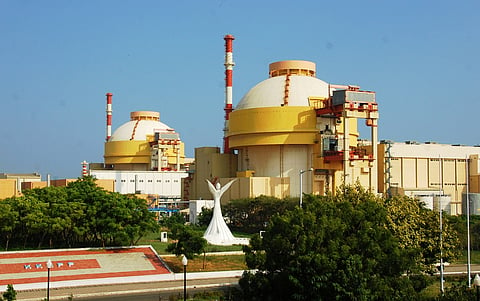


A nuclear power project near Kanyakumari is moving through advanced stages, reflecting India’s cautious but steady push to expand atomic energy capacity under strict safety and cost considerations, a senior official told Down To Earth.
The official added that the Union Budget 2025-26 is expected to provide substantial allocations for the power sector, including continued support for coal-based generation alongside renewables, hydro and pumped storage, to balance energy security, grid stability and the clean energy transition.
Separately, the government is examining the feasibility of repurposing select aging thermal power plant sites for nuclear generation, a move that could allow the country to reuse existing power infrastructure while shifting toward low-carbon baseload supply. The proposal remains at a study stage and would apply only to technically suitable sites, given the extensive land, regulatory and safety requirements unique to nuclear facilities.
This comes after India amended Atomic Energy Act 1962 and civil liability for nuclear damage Act 2010 and introduced the Sustainable Harnessing and Advancement of Nuclear Energy for Transforming India Act, 2025 last month, ending the state’s monopoly over nuclear power generation and opening the sector to private and foreign participation for uranium mining, reactor construction, operation, equipment manufacturing and other aspects of the nuclear fuel cycle, subject to licensing and regulatory oversight, to achieve 100 gigawatt (GW) of nuclear power capacity by 2047.
The official indicated that the southern nuclear project has not yet been commissioned but remains in the pipeline, with progress paced to ensure full safety compliance and technological readiness. Authorities are keen to avoid premature rollout, given the high stakes associated with radioactive waste management and decommissioning costs, which experts say can exceed initial construction expenses.
“There is a plant near Kanyakumari that is in advanced stages, though it has not yet been commissioned. Two other nuclear projects are also under consideration,” the official cited above said, adding, “Progress is intentionally slow to ensure safety and avoid costly mistakes. Disposal of radioactive waste remains a major issue, and much of the technology in this area is still evolving.”
Though the official did not specify the exact project, one major facility in the region is the Kudankulam Nuclear Power Plant in Tamil Nadu’s Tirunelveli district, India’s largest nuclear power station. Built under a long-standing India-Russia civil nuclear partnership, the plant uses VVER-1000 pressurised water reactors. Its development saw delays and local protests over safety and environmental concerns, but it has since become a key part of India’s energy diversification strategy, combining large-scale low-carbon power generation with modern safety systems and bilateral fuel and technology cooperation. Two units are already operational, each producing about 1 GW, while four additional reactors (Units 3-6) are under construction, which will significantly expand the site’s total capacity once completed.
“The Kanyakumari facility is expected to be a relatively smaller unit by global nuclear standards, reflecting India’s current preference for incremental capacity addition rather than large-scale, rapid deployment,” the official added.
By early 2025, the country operated 25 reactors across seven sites, including four in Tamil Nadu. Nuclear plants accounted for approximately 57 terawatt-hours of electricity in 2024-25.
The government is also studying whether some aging and inefficient coal-based plants could be converted into nuclear facilities. However, this is technically and socially complex:
· Nuclear sites require large exclusion zones (5-10 km).
· Regulatory and structural requirements differ sharply from thermal plants.
· Additional land and environmental clearances are necessary.
As a result, only a limited number of existing sites may be suitable.
While nuclear energy is being positioned as part of India’s clean energy transition, officials acknowledge it is not entirely “green.” Beyond radiation risks, nuclear plants have heavy water requirements, sometimes significantly higher than conventional thermal stations. Research is underway into air-water hybrid cooling systems to reduce water use, particularly in water-stressed regions.
India’s present nuclear power capacity stands at about 8.8 GW, with long-term ambitions of scaling up sharply, potentially toward 100 GW by 2047, though planners stress that targets depend on technology access, financing and safety considerations.
A parallel study is also examining whether certain old, inefficient thermal power plants can be repurposed for nuclear generation. However, this faces steep constraints: nuclear facilities require large exclusion zones, extensive regulatory clearances, and substantial additional land, making conversions technically and socially complex.
The government is gradually opening nuclear energy to private sector participation, but with safeguards. The state is expected to retain at least 51 per cent ownership in projects to ensure oversight and prevent safety compromises. NTPC is emerging as a key public-sector player exploring partnerships with international nuclear technology firms.
The focus is not just on building plants, but on technology transfer, enabling India to reduce long-term dependence on foreign suppliers.
Global companies have shown early interest, but concrete partnerships are still evolving as firms seek Indian counterparts and clarity on regulatory and liability frameworks.
The official emphasised that energy transition efforts must not lead to a sharp spike in consumer tariffs. The aim is to expand low-carbon power without pushing electricity prices from current levels to unsustainable highs. Cost discipline is seen as central to long-term economic competitiveness.
Nuclear energy, while low in operational emissions, is capital-intensive, reinforcing the government’s decision to scale gradually rather than pursue an aggressive build-out.
Across both nuclear and thermal sectors, land acquisition remains a key challenge. Projects must maintain green cover norms and manage environmental compliance, while social resistance and water scarcity complicate site development. Efforts to use fly ash in construction materials are aimed at reducing land burdens linked to thermal generation.
The World Nuclear Outlook 2026 positions India as one of the five pivotal countries alongside China, France, Russia and the United States, expected to anchor global nuclear expansion through 2050. The report places India among established nuclear operators with an existing fleet, reactors under construction, and a pipeline of planned and proposed projects, making it structurally important to the post-2035 growth phase of global nuclear capacity. India’s trajectory reflects the dual role highlighted in the outlook: continued operation of existing assets alongside new build, positioning nuclear as part of long-term energy security and system reliability as electricity demand rises.
Looking ahead, the report links India’s nuclear future to broader government-led capacity ambitions, while cautioning that a portion of projected global additions, including in countries such as India, is tied to targets not yet fully backed by identified, finance-ready projects. Delivering on these ambitions will depend on sustained policy support, financing mechanisms, regulatory efficiency, and industrial and workforce scale-up. In this framing, nuclear power in India is not treated as a marginal source but as part of long-horizon system architecture supporting decarbonisation, grid stability and growing demand from electrification and industrialisation.
Major amendments to the Electricity Act and other sectoral policies are expected in the coming months. These reforms are likely to shape market structure, private participation and regulatory oversight across the power value chain.
India’s long-term climate commitment of net-zero emissions by 2070 frames these efforts, but policymakers see 2040 as a critical milestone to assess progress in scaling clean energy while maintaining affordability and reliability.
Even as nuclear plans take shape, the broader power strategy remains diversified. The official indicated that Union Budget 2025-26, scheduled to be announced on February 1, is expected to allocate a substantial budget for the power sector, covering renewables, hydroelectric projects and pumped storage systems, which are being promoted as a greener alternative to battery-based storage. New schemes might also be announced for the power sector, the official informed, without sharing details.
Coal-based power, though under pressure from climate goals, continues to receive policy attention for energy security and grid stability, especially as demand rises.