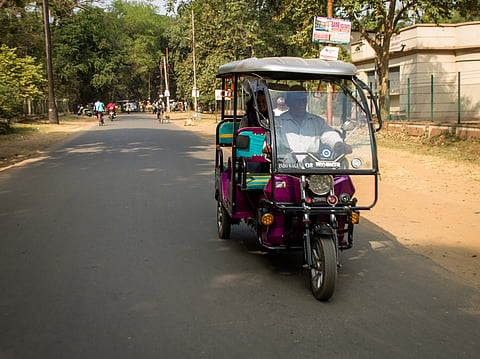


The National Institute of Technology Rourkela (NIT Rourkela) has developed and patented a hybrid energy storage system designed to reduce stress on electric vehicle (EV) batteries during sudden acceleration, braking and changes in speed. The system is optimised for low voltage EV platforms operating in the 24V to 60V direct current range, including electric scooters, motorcycles, e-rickshaws, cargo tricycles and campus and industrial utility vehicles.
The patented technology has been developed by Monalisa Pattnaik, associate professor, Department of Electrical Engineering, along with Pradyumna Kumar Behera and Karan Gupta at NIT Rourkela. The researchers are open to collaboration with EV original equipment manufacturers, powertrain system integrators, fleet operators and EV retrofit start ups.
The development comes as India’s electric mobility market expands and battery performance becomes increasingly important for vehicle efficiency, operating costs and service life. According to a NIT Rourkela statement, electric vehicle sales in India crossed one million in 2022, following the adoption of measures including the National Electric Mobility Mission Plan and Faster Adoption and Manufacturing of Hybrid and Electric Vehicles (FAME) schemes.
EVs rely on battery packs made up of thousands of individual rechargeable cells. Conventional battery packs face limitations such as low power density, limited cycle life and thermal stress when exposed to rapid current spikes, according to the NIT researchers. These stresses can be particularly significant in urban driving conditions, where frequent starting and stopping and rapid acceleration and deceleration place repeated demands on the battery.
The NIT Rourkela system combined the battery pack with a supercapacitor to create a hybrid energy storage system (HESS). Unlike batteries, supercapacitors store charge electrostatically and can charge and discharge within seconds. Their specific power can be an order of magnitude higher than that of conventional batteries, while their cycle life typically exceeds one million charge and discharge cycles with negligible degradation.
In the proposed configuration, the supercapacitor absorbs or supplies transient power during sudden acceleration, deceleration and regenerative braking. This reduces the exposure of the battery to high rate current stress, with the intended effect of extending battery service life.
Battery and supercapacitor systems can generally be connected through passive, semi-active or active configurations. In a passive configuration, the supercapacitor has limited ability to respond rapidly to changing power requirements. Active configurations use separate electronic converters to manage the battery and supercapacitor, but add components and increase system complexity.
NIT Rourkela’s architecture seeks to address these limitations with a smaller number of components. Monalisa Pattnaik said the system consists of three main components: One converter connecting the battery and supercapacitor to the vehicle’s electrical system, an inductor placed in the electrical path and a single control system to manage power flow.
The common converter reduces the number of switches and control components, while the inductor protects against sudden current surges. The single control system manages power flow during both acceleration and deceleration, reducing hardware requirements.
The researchers tested the system under sudden braking and rapid acceleration and deceleration. During the tests, it maintained a stable 48 V voltage, enabled smoother changes in battery current and allowed the supercapacitor to handle sudden changes in power efficiently.
“Our design is highly optimised for low voltage EV platforms operating in the 24 V to 60 V DC range,” Pattnaik said. The target applications include urban light electric vehicles such as electric scooters, electric motorcycles, electric rickshaws, cargo tricycles and campus and industrial utility vehicles, she added.
Beyond electric mobility, the system can also be used in automated guided vehicles, warehouse carts, direct current microgrids and renewable energy charging stations.
For India’s electric mobility transition, the technology addressed a component-level challenge that becomes more relevant as EV deployment expands: Managing short-duration, high power demands without repeatedly subjecting the main battery pack to high current stress. Its stated focus on low voltage vehicles places the technology primarily within the rapidly expanding segment of light electric mobility rather than high voltage passenger or commercial EV platforms. The press release, however, does not provide comparative figures for battery life extension, efficiency gains, cost reduction or energy savings from the patented system.