
Subscribe

The Cabinet Committee on Economic Affairs (CCEA), chaired by Prime Minister Narendra Modi, on February 24 approved enhanced financial delegation to POWERGRID, the largest transmission service provider in the country, according to an official statement.
The CCEA approved raising the permissible equity investment ceiling from Rs 5,000 crore to Rs 7,500 crore per subsidiary while retaining the cap of 15 per cent of the company’s net worth.
The decision modifies the 2010 autonomy framework issued by the Department of Public Enterprises (DPE) for Maharatna Central Public Sector Enterprises, enabling POWERGRID’s board to sanction larger investments in subsidiaries and joint ventures to meet rising infrastructure demands.
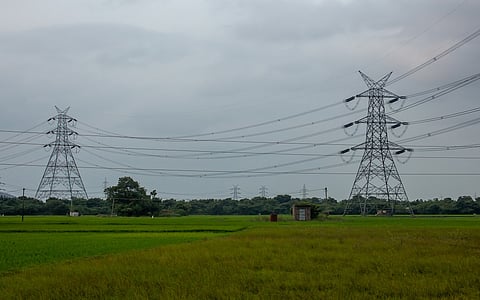
The enhanced limit is expected to strengthen the company’s ability to invest in capital-intensive transmission networks, including advanced Ultra High Voltage Alternating Current (UHVAC) and High Voltage Direct Current (HVDC) systems, and expand inter-regional connectivity under India’s grid modernisation push.
UHVAC is a power transmission technology that carries electricity as alternating current at extremely high voltages, typically 800 kV and above, to move large amounts of power over long distances with reduced losses across interconnected grids. HVDC transmits electricity as direct current at very high voltage levels, offering even lower losses over ultra-long distances, precise control of power flow, and the ability to link grids operating at different frequencies or connect offshore and subsea transmission systems. Together, these technologies enable efficient bulk power transfer and are critical for integrating large-scale renewable energy into national power networks.
It will also allow POWERGRID to compete more effectively in tariff-based competitive bidding for major transmission projects, improving price discovery and project execution efficiency.
This assumes significance in the power sector as stronger investment capacity, especially for technologies like UHVAC and HVDC, directly improves how much electricity can be moved, how reliably it flows, and how cheaply it reaches consumers.
For a transmission major like POWERGRID, higher equity limits mean it can fund larger, more advanced grid projects that evacuate renewable energy from remote generation hubs to cities without bottlenecks. That reduces transmission losses, stabilises the grid as renewable power fluctuates, enables inter-regional power exchange, and ultimately supports energy security and affordable electricity as demand rises across India. In short: better transmission capacity is the backbone of clean energy expansion and reliable nationwide power supply.
The move supports India’s clean energy transition by accelerating the evacuation of renewable power and strengthening grid reliability, key to achieving the national target of 500 GW non-fossil fuel capacity.
This is a calibrated expansion of Maharatna autonomy in response to escalating project sizes and the strategic role of transmission infrastructure in delivering affordable and clean electricity nationwide.
The enhanced limit is expected to strengthen POWERGRID’s capacity to invest in large-scale transmission infrastructure critical for India’s energy transition. As the country’s largest transmission service provider, the company plays a central role in building high-capacity corridors to evacuate renewable energy from generation hubs to demand centres.
India’s National Electricity Plan (2023-2032) envisages extensive grid modernisation, expansion of inter-regional connectivity, and deployment of advanced technologies such as UHVAC, HVDC systems, and synchronous condensers to stabilize the grid.
An official statement said the revised financial delegation will enable POWERGRID to participate more competitively in capital-intensive transmission projects under the tariff-based competitive bidding framework. Greater participation by financially strong public sector entities is expected to improve price discovery and ensure cost-efficient project execution.
The policy move aligns with India’s broader clean energy strategy, particularly the national target of achieving 500 GW of non-fossil fuel-based power capacity. Expanding transmission infrastructure is widely seen as a prerequisite for integrating large volumes of renewable energy into the grid without curtailment.
Renewable energy curtailment has been an issue last year, especially in Rajasthan, pinching developers’ pockets.
By enabling higher equity deployment in subsidiaries, the government aims to accelerate project development timelines, enhance grid reliability, and facilitate the delivery of affordable and clean electricity to consumers.
Maharatna CPSEs, India’s top-tier public sector enterprises, are granted enhanced financial and operational autonomy to undertake strategic investments without frequent government approvals. The latest decision reflects a calibrated expansion of that autonomy in response to rising infrastructure costs and the growing scale of energy transition investments.
Transmission infrastructure projects have become increasingly capital-intensive due to technology upgrades, land constraints, and the geographic spread of renewable generation. Raising the equity threshold is therefore seen as a structural adjustment rather than a one-off relaxation.
The move is expected to:
· Strengthen domestic competition in major transmission bids
· Improve financing flexibility for large infrastructure projects
· Accelerate renewable energy evacuation capacity
· Support grid modernisation and reliability
It underscores the government’s strategy of leveraging financially strong public sector enterprises to anchor critical infrastructure development while advancing India’s clean energy commitments.