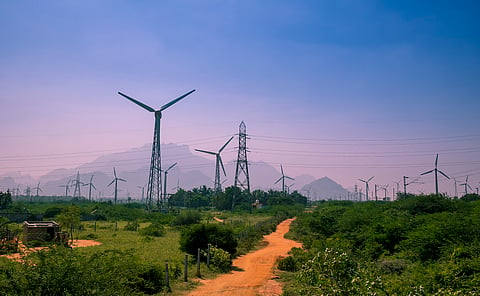


The air in Muppandal, a village in Tamil Nadu’s Kanyakumari district, vibrates with the hum of turbines. Situated in the Western Ghats on the southern tip of India, Muppandal is home to India’s largest onshore wind farm, with an installed capacity of 1.5 GW. The groundwork for Tamil Nadu’s journey to become the pioneer of wind energy in India was laid when the Danish International Development Agency, in partnership with Tamil Nadu Energy Development Agency (TEDA) and MNRE, installed 110 pilot wind turbines across the state between 1985 and 1992. The state’s geographic advantage—consistent monsoon winds funnelled through the ridges of the Western Ghats—gave it a natural advantage that no policy could replicate elsewhere.
Tamil Nadu managed to amplify that natural advantage by smart policy. The state’s success (2006-2017) was powered by a lucrative feed-in tariff (FiT) regime under which renewable energy generators could sell electricity at Rs 2-4 per unit to the state grid, typically through Tamil Nadu Generation and Distribution Corporation.
Power was produced mainly by private wind project owners and independent power producers, not by DISCOMS. Tamil Nadu also introduced energy banking for wind as early as 1986, a move that attracted developers and industrialists alike. “If a captive generator produced 100 units but consumed 80 units, the remaining 20 units were banked in the grid accounting system (not physically stored) and could be drawn later in a specified settlement period, effectively allowing firms to offset future electricity consumption, which is similar to a credit balance in electricity,” explains Francis Jayasurya, India director of Global Wind Energy Council (GWEC), a Lisbon-based industry body, to DTE on the sidelines of a workshop by global non-profit Earth Journalism Network (EJN), in Mumbai in October 2025.
For nearly three decades, wind dominated India’s renewable landscape, adding 1.8-2.5 GW annually between the early 1990s and early 2010s, with Tamil Nadu at the centre of that growth. But a 2017 policy shift—from feed-in tariffs to competitive reverse auctions, where developers compete to supply renewable energy at the lowest possible tariff, implemented nationally through agencies such as Solar Energy Corporation of India—disrupted that momentum. “Tariffs dropped almost overnight,” recalls Jayasurya. Payment delays by DISCOMs compounded the uncertainty, with Tamil Nadu facing backlogs of up to three years. For decades the undisputed leader in wind power, Tamil Nadu was overtaken by Gujarat (14.9 GW) around 2023 and now ranks second with 12.1 GW of installed wind capacity.
In total renewable capacity, it stands fourth nationally at around 27.2 GW as of January 2026. Tamil Nadu Electricity Board (TNEB) chairperson J Radhakrishnan tells DTE that the present phase is a “pause or lull” …
(With inputs from Binit Das)
This article was originally published as part of the cover story Powering transition in the March 16-31, 2026 print edition of Down To Earth