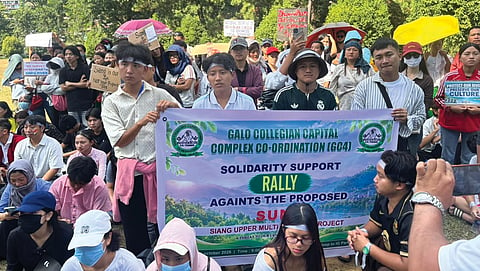


On October 23, Pasighat, the oldest town of Arunachal Pradesh, on the western bank of the Siang river, witnessed an un-precedented escalation in a four-decade-long resistance movement. By evening, protests by local communities against the proposed 11,200-megawatt (MW) Siang Upper Multipurpose Project had turned violent.
Police say the situation deteriorated between 5 pm and 6.30 pm, as darkness fell. A crowd of 200-300 people began pelting police officers with stone. Police fired tear-gas shells after protesters allegedly refused to clear the highway. The violence damaged government buildings, private property and also the Pasighat police station. The office of the National Hydroelectric Power Corporation (NHPC) was reportedly torched. The residences of members of the legislative assembly were reportedly vandalised. Some police vehicles were also set ablaze. As the unrest spread, the Union government air-lifted two companies of the Central Reserve Police Force’s (CRPF’s) Rapid Action Force (RAF), comprising around 800 personnel, to the state in an effort to restore order.
Protesters offer a different account of how the clashes began. Some say they were preparing to disperse when they heard explosions. “Then stones started raining from both sides. After that, the situation escalated,” one protester told Down To Earth (DTE).
By October 27, anti-dam protests had spread to Upper Subansiri district, where opposition to another proposed hydropower project prompted a shutdown amid reports of property damage. On October 31 and November 1, students, community leaders and activists organised a demonstration in Delhi against the Siang hydropower project. At least 26 people, including five juveniles, had been arrested in connection with the October 23 violence in Pasighat, while six others were detained for questioning.
The proposed hydropower project would be built on the Siang, probably near Geku village in Upper Siang district. The river originates in Tibet, flows through Arunachal Pradesh and joins other rivers to form the Brahmaputra…
This article was first published in the November 16-30, 2026 print edition of Down To Earth.