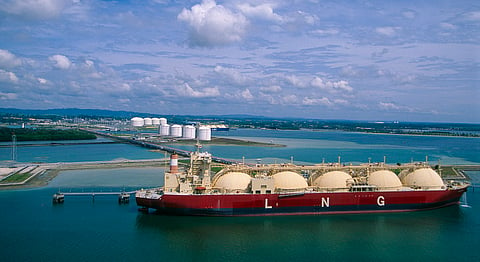


Southern Asia is positioning itself for a major expansion in liquefied natural gas (LNG) consumption, as industry forecasts point to strong demand growth across India, Bangladesh and Pakistan over the next decade, according to a new report.
The push comes amid heightened global energy uncertainty following the escalating Iran-Israel conflict, which has disrupted tanker traffic through the Strait of Hormuz—a route that carries roughly one-fifth of global oil and LNG trade—and triggered volatility in energy markets. The crisis has exposed the vulnerability of Asian LNG importers even as the region plans a major buildout of gas infrastructure.
Data in Global Energy Monitor (GEM)’s Asia Gas Tracker show that India, Bangladesh and Pakistan — three of the world’s most populous and price-sensitive gas importers — are planning a large wave of LNG infrastructure. According to Global Energy Monitor’s Asia Gas Tracker, the region has 110.7 million tonnes per annum (mtpa) of LNG import capacity in development, representing about 17 per cent of the global total, alongside $107 billion worth of planned LNG terminals and gas pipelines.
India dominates the expansion, with 84.6 mtpa of planned LNG import capacity, while Pakistan (12.1 mtpa) and Bangladesh (11.3 mtpa) are pursuing projects that could roughly double their current import capacity.
The expansion is tied to expectations of a global LNG supply surge. A wave of new export projects led by the United States and Qatar is expected to increase global LNG export capacity by about 56 per cent by 2031, potentially easing prices after tight markets earlier this decade.
Industry outlooks remain bullish. Shell forecasts global LNG demand will grow about 60 per cent by 2040, driven largely by Asian markets such as China and India. The International Energy Agency (IEA) expects LNG demand in Pakistan and Bangladesh to rise by around 60 per cent by 2030, as domestic gas production declines and energy demand grows.
Infrastructure plans reflect these expectations. India alone has 19,635 km of gas pipelines in development, the third-largest pipeline expansion globally, while Pakistan is planning 3,893 km and Bangladesh 2,695 km of new pipelines to link LNG terminals with power plants, industries and city gas networks.
Yet the scale of the LNG boom remains uncertain, according to the GEM March report.
The region’s experience during the global gas crisis in 2022 revealed the risks of relying on imported LNG. Spot prices surged to around $70 per million British thermal units (mmBtu) following Russia’s invasion of Ukraine, pricing Bangladesh and Pakistan out of the market and triggering power shortages.
Although prices have since eased to around $11/mmBtu, demand growth has remained weaker than expected. Over the past decade, South Asian countries have cancelled or shelved two to three times more LNG import capacity than they have actually built, reflecting persistent concerns over cost, financing and infrastructure bottlenecks.
Government strategies across the region are also diverging. India is actively promoting gas development and aims to raise the share of natural gas in its energy mix to 15 per cent, supported by the expansion of the national gas grid and new LNG terminals.
Pakistan, however, has signalled a shift away from LNG after the price shocks earlier this decade, while Bangladesh’s new government is expected to prioritise renewables and domestic gas resources.
Even in India, LNG faces growing competition. Renewable power is expanding rapidly, and the country is projected to meet around 42 per cent of its electricity demand with renewables by 2030, potentially limiting the role of gas in the power sector.
For now, South Asia remains a critical market for the global LNG industry. But whether it absorbs the coming wave of supply will depend largely on whether LNG prices fall low enough to compete with coal, renewables and domestic fuels in the region’s energy mix.