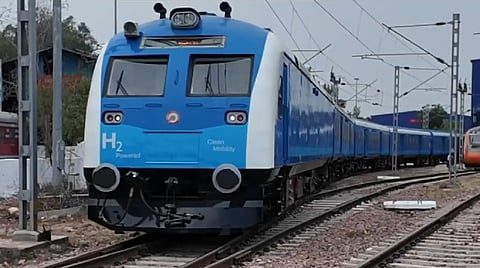


The launch of India’s first indigenous hydrogen fuel cell train by Prime Minister Narendra Modi on July 17, on the Sonipat-Jind route, marks far more than the inauguration of another passenger service. It signals the beginning of a new technological journey—one that extends well beyond railways into India’s larger quest for clean energy, energy security and technological self-reliance.
The train itself is an impressive engineering achievement. Comprising two hydrogen-powered driving power cars with a combined output of nearly 3,200 horsepower and eight passenger coaches, it can carry almost 2,600 passengers, making it the largest hydrogen-powered passenger trains in the world. But its true significance lies not in its size or performance. It lies in what it represents.
History reminds us that transformative technologies often begin modestly. The first steam locomotive carried only a handful of passengers. Early electric trains were slow, expensive and experimental. Yet both went on to redefine transportation and reshape economies.
India’s hydrogen-powered train belongs in that tradition.
For almost two centuries, railways have relied on three principal forms of traction—steam, diesel and overhead electric power. Hydrogen introduces a fourth. Instead of burning fuel inside an engine, the train carries hydrogen that reacts with oxygen inside a fuel cell to generate electricity. That electricity powers the traction motors, while the only direct emission is water.
This is not merely a cleaner train; it is a fundamentally different way of producing energy for mobility.
PM Modi described the occasion as “a landmark day for Aatmanirbhar Bharat.” The phrase captures the true significance of this achievement. Its importance lies not merely in environmental benefits, but in what it says about India’s growing technological confidence.
A hydrogen train is not a single technology. It is the successful integration of multiple advanced systems—hydrogen storage, fuel cells, lithium battery systems, power electronics, traction control, digital monitoring, railway safety and operations. Each of these technologies represents years of research and engineering. Bringing them together into a safe, reliable and commercially viable passenger train is an achievement in itself.
This integrated capability is perhaps the project’s greatest accomplishment.
Equally significant is its indigenous character.
The achievement lies not merely in manufacturing components within India, but in designing, engineering and integrating an entirely new propulsion architecture that meets the demanding operational and safety standards of the Indian Railways. Such capabilities create intellectual capital, strengthen domestic industry and develop highly skilled engineering talent capable of driving innovation across multiple sectors.
The implications extend far beyond transportation.
Every major technological breakthrough generates what economists describe as ‘spillover effects’. India’s space programme accelerated electronics, materials science and telecommunications. Nuclear technology advanced metallurgy, instrumentation and medical applications. Likewise, hydrogen technologies have the potential to catalyse innovation across a broad industrial landscape.
The expertise developed for railway fuel cells can find applications in heavy commercial vehicles, mining equipment, ports, inland waterways, defence logistics, stationary power generation and remote industrial installations. Advances in hydrogen storage, power electronics and safety systems will benefit an entire ecosystem rather than a single mode of transport.
This assumes even greater importance because India faces an enduring strategic challenge—energy security.
Despite remarkable progress in renewable electricity, the country continues to depend heavily on imported fossil fuels. Every geopolitical disruption serves as a reminder that energy security is inseparable from national security.
Green hydrogen offers a unique opportunity to diversify India’s energy basket while making productive use of abundant solar and wind resources. Surplus renewable electricity that might otherwise remain unutilised can be converted into hydrogen, stored for extended periods and transported to applications where direct electrification is difficult or uneconomical.
Hydrogen is therefore not merely another fuel. It is an energy carrier capable of linking renewable power generation with transportation and industry.
History also teaches another important lesson. Countries that master foundational technologies acquire advantages extending far beyond their original applications. Britain’s leadership in steam powered the Industrial Revolution. America’s dominance in semiconductors transformed the digital age. More recently, China’s sustained investment in batteries and electric mobility has given it a commanding position in global manufacturing.
Hydrogen technologies could become one of the defining industrial platforms of the 21st century. India’s entry into this field is therefore not simply an environmental initiative; it is an investment in future industrial competitiveness.
Indian Railways itself illustrates this philosophy.
Throughout its history, the Railways has served not merely as a transporter of passengers and freight but as one of India’s largest engineering laboratories. From indigenous steam locomotives and electric locomotives to modern coach manufacturing and the Vande Bharat programme, each technological milestone has strengthened India’s industrial capabilities. The hydrogen train represents the latest chapter in this continuing journey of innovation.
The indigenous hydrogen train is a major technological milestone. More importantly, it provides India with a national demonstration platform where engineers can refine operational practices, maintenance systems, safety protocols and hydrogen infrastructure under real-world operating conditions before wider deployment.
The road ahead will not be without challenges.
Hydrogen production remains expensive. Storage demands sophisticated engineering. Refuelling infrastructure is still evolving. Fuel cells must demonstrate long-term reliability under demanding operating conditions. Experience from other countries shows that success depends as much on the supporting ecosystem as on the train itself.
Yet every transformative technology begins with experimentation, learning and continuous improvement.
India’s first steam locomotives would appear primitive by today’s standards. Early electric locomotives had limited capabilities. No one judged those technologies by the performance of their first prototypes. Their true importance lay in the technological pathways they opened.
The hydrogen train deserves to be viewed through the same lens.
Its greatest contribution may ultimately have little to do with the number of passengers it carries or the kilometres it travels. Instead, it lies in the scientific capability it builds, the industries it stimulates, the engineers it inspires and the confidence it instils in India’s ability to master emerging technologies.
Countries that aspire to technological leadership cannot afford to wait until every innovation becomes commercially perfect. They must build capabilities, embrace the inevitable learning curve and invest patiently in the future.
The Sonipat–Jind hydrogen train may one day be remembered not for the 89 kilometres it traverses, but for the technological journey it set in motion. Long after the inaugural photographs have faded and the headlines have been forgotten, it may be recognised as the moment India chose not merely to participate in the global clean-energy transition, but to help shape it.
That is why this is much more than a railway milestone. It is a national milestone.
P K Mishra is Former GM, Indian Railways
Views expressed are the author’s own and don’t necessarily reflect those of Down To Earth