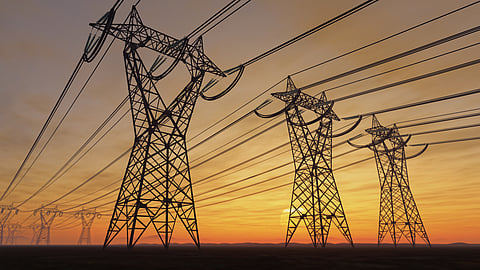


Severe dust storms in Rajasthan collapsed 15-20 transmission towers and disrupted major power lines, causing an estimated 500-600 MW loss in renewable energy generation over several days
The disruption highlights growing concerns over grid resilience as India prepares to add 60-70 GW of renewable energy capacity annually and deepen its dependence on weather-exposed regions
Power sector experts say storage, transmission expansion and grid flexibility are becoming as critical as capacity addition for maintaining reliability in a renewable-heavy power system
A series of severe dust storms and thunderstorms that swept across Rajasthan between late May and early June has damaged power infrastructure, disrupting renewable energy gains in the state and accelerating concerns about the resilience of India's rapidly expanding clean energy system.
In just one week, 15-20 transmission towers collapsed near Chandan and Pokhran in western Rajasthan, disrupting two major 400-kilovolt (kV) transmission lines and two-three 220-kV lines, a senior state government official told Down To Earth (DTE). The damage has resulted in an estimated loss of 500-600 megawatts (MW) of renewable energy generation over multiple days, and has affected electricity supply to the drinking water system in the Mohangarh region of Jaisalmer district, which is primarily powered by the Indira Gandhi Canal.
"We deployed Emergency Restoration Systems and restored one line immediately because it was connected to a major drinking water source," the official told DTE on condition of anonymity, adding, “renewable energy evacuation suffered a hit of around 500-600 megawatt (MW) following the storms.”
The disruption occurred during an unusually intense pre-monsoon weather spell. Between May 30 and June 5, Rajasthan was hit by three major dust storm and thunderstorm systems that brought winds of up to 80 kilometres per hour. These storms damaged electricity infrastructure across several districts and reportedly claimed at least eight lives.
The first storm, on May 30, engulfed Bikaner, Jaisalmer and Jaipur districts in a massive dust storm, reducing visibility to near zero. The second storm between May 31 and June 1 caused extensive damage to power infrastructure in western Rajasthan, including assets operated by Jodhpur Vidyut Vitran Nigam Limited. The third storm system on June 4-5 brought heavy rainfall and strong winds to eastern Rajasthan, resulting in fatalities and infrastructure damage in districts including Bharatpur, Dholpur and Bhilwara.
The recent storms have added another dimension to India’s renewable energy transition. Rajasthan has faced destructive dust storms before, including the severe storms of May 2018, which killed more than 125 people across Rajasthan and Uttar Pradesh and damaged thousands of homes and electricity assets.
But the latest disruptions come as Rajasthan strengthens its position as India’s largest renewable energy hub, hosting some of the country’s biggest solar and wind projects. The state is expected to play a crucial role as India prepares to raise annual renewable energy additions from more than 50 gigawatts commissioned last year to 60-70 GW in the coming years.
Grid operators say extreme weather is only one of several challenges facing renewable-rich states such as Rajasthan. Unlike heavily industrialised states, Rajasthan's electricity demand is dominated by agriculture, creating periodic mismatches between renewable energy generation and consumption.
"Most of the consumption is agriculture power consumption. When there is rain, consumption goes up. If there is no consumption and renewable energy is pumped up, curtailment is necessary," said the official.
Even when renewable generation forecasts are accurate, sudden shifts in demand can force operators to back down the solar and wind generation to maintain grid stability. The challenge is more acute because Rajasthan lacks significant hydropower resources that can provide balancing support. "There is no hydro resource. The resources are either thermal or renewable. Thermal has a technical limit up to which you can back down and coal plants cannot be shut down immediately because in the night there is no solar," the state official said.
Limited storage availability further complicates grid operations. "When we are bringing 6,000-8,000 MW of renewable energy, we cannot bring that much battery power storage," the official added.
Transmission bottlenecks are another concern. According to the official, western Rajasthan's vast renewable energy potential is not yet matched by local industrial demand. "Until industrial load arrives in the western region, it remains a challenge," the official said, adding that renewable-rich western Rajasthan could export more power if adequate transmission infrastructure is built. In contrast, upcoming industrial and petroleum projects in the region may eventually help absorb some of the surplus generation.
The challenges emerging in Rajasthan reflect a broader shift underway in India's power sector, where integrating rapidly growing renewable energy capacity is becoming as important as adding new generation.
Speaking at a Conference on Renewable Energy Transition for Commercial and Industrial Consumers in the Northern Region organised by the Federation of Indian Chambers of Commerce and Industry (FICCI) in partnership with AMPIN Energy Transition, CRISIL and Sumitomo Corporation on June 10, policymakers and industry leaders emphasised that the next phase of India's energy transition will depend on grid readiness, storage and system flexibility.
Ghanshyam Prasad, chairperson, Central Electricity Authority (CEA), said India has already demonstrated its ability to scale renewable energy deployment and must now focus on reliable integration. "India has already crossed the milestone of adding over 50 GW of renewable energy annually and is well positioned to achieve 60-70 GW annual additions in the coming years. The challenge now is ensuring predictable connectivity, grid readiness and reliable integration," Prasad said.
He added that the transition must balance affordable green power for consumers with the long-term financial sustainability of distribution companies.
"We must create a framework where industrial consumers receive affordable green power while ensuring the long-term financial sustainability of distribution companies. Both objectives are critical for India's growth story," Prasad said.
S. K. Chatterjee, chief (Regulatory Affairs), Central Electricity Regulatory Commission (CERC), highlighted the increasingly important role of commercial and industrial consumers in the transition. "Commercial and industrial consumers account for nearly half of the country's electricity consumption and therefore have a defining role in India's journey towards a cleaner energy future," Chatterjee said.
He stressed that deploying renewable energy alone will not suffice to build a resilient power system. "Energy transition is not only about renewable energy generation. Demand response, energy efficiency, distributed energy resources and virtual power plants will be equally important in creating a flexible and resilient power system. The future lies in combining renewable energy with storage and flexible resources to address intermittency while maintaining grid stability and affordability," he said.
Industry leaders said energy storage, grid flexibility and transmission expansion will become critical as renewable penetration rises across the country.
Pinaki Bhattacharyya, founder, chief executive officer and managing director, AMPIN Energy Transition, described renewable energy as central to India's economic and strategic ambitions. "India's renewable energy transition is fundamentally about nation-building. Energy independence is essential for economic development, and renewable energy offers India a historic opportunity to become a global leader in clean energy," he said.
Bhattacharyya noted that industrial and commercial consumers are increasingly adopting renewable energy because of its economic benefits. "Industrial and commercial consumers today are saving between 20 per cent and 40 per cent on energy costs by adopting green power. This makes renewable energy not just sustainable, but economically compelling," he said.
Bhupinder Singh Bhalla, former secretary of the Ministry of New and Renewable Energy, said India has moved beyond proving the viability of renewable energy and is now entering the more complex phase of large-scale integration. "The objective is not merely to create clean energy. The objective is to create green growth. India's energy transition must simultaneously deliver sustainability, affordability, reliability and energy security. We are uniquely positioned to achieve this balance through our strong domestic market, policy commitment and rapidly maturing ecosystem," Bhalla said.
Abhishek Ranjan, Chief Executive Officer of BSES Rajdhani Power Limited, said the next stage of the transition must focus on creating a more resilient power system. "India's renewable energy journey must be both consumer-centric and grid-centric. The future lies in integrating renewable energy through innovative technologies, robust policies and sustainable business models that maximise consumer benefits while ensuring grid security, reliability and investor confidence," he said.
"As renewable energy penetration increases, the focus must shift from merely adding green power to creating a resilient and flexible power system. Energy storage, ancillary services, distributed energy resources and smart grid planning will be critical to managing future demand while maintaining power quality and system stability," Ranjan added.
Ranjan further said the next stage of India's energy transition must focus on creating a more resilient power system. "India's renewable energy journey must be consumer-centric and grid-centric at the same time. The future lies in integrating renewable energy through innovative technologies, robust policies and sustainable business models that maximise consumer benefits while ensuring grid security, reliability and investor confidence," he said.