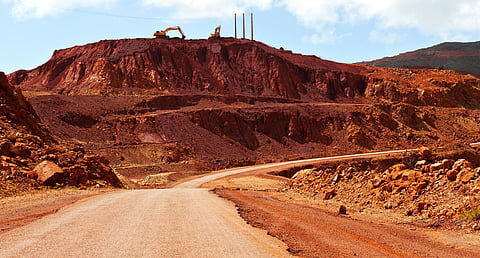


Public transportation, improved recycling programmes, and advanced battery technologies are crucial solutions to limit mineral demand for a green transition, according to a new report.
The report, “Beyond Extraction: Pathways for a 1.5°C-aligned Energy Transition with Less Minerals”, was commissioned by Greenpeace International and has been authored by academics at the Institute for Sustainable Futures at the University of Technology, Sydney (UTS) in Australia.
Using different 1.5 degree C-compatible energy scenarios to explore pathways toward mineral sufficiency and efficiency, the report showed how earth’s minerals can be administered for a clean renewable energy transformation that protects vital Earth support systems from terrestrial or deep-sea mining of so-called critical minerals — Lithium, nickel, copper, and cobalt.
As the demand for these minerals is predicted to grow for energy transition technologies as well as other sectors, its supply chains have become a geopolitical battleground. This has governments scrambling to control supply chains, while companies opportunistically pursue extraction, which can infringe on the ancestral lands of indigenous peoples, and risk the destruction of vital ecosystems.
The study focused on nine key energy transition minerals: cobalt, copper, dysprosium, graphite, lithium, manganese, neodymium, nickel, and vanadium.
Scenario analysis was used in this study to explore how different technological and policy pathways can shape future mineral demand from 2024-2050.
The Greenpeace report compares different future scenarios — One Earth Climate Model Net Zero (OECM), The Progressive Scenario (PRO), Progressive Accelerated Na-ion (PRO-Na-ion), and the International Energy Agency scenarios—to assess mineral demand for the energy transition.
It highlighted that results vary significantly due to differences in assumptions about energy demand, transport systems, recycling, and technology choices.
The International Energy Agency scenarios, including the Stated Policies Scenario (STEPS) and Net-Zero Emissions (NZE), generally project higher mineral demand than the OECM and Progressive pathways. This is mainly because they assume higher transport demand and larger electric vehicle (EV) markets. In contrast, OECM and PRO scenarios emphasise energy efficiency, reduced car production, and expanded public transport, leading to lower overall demand for batteries and minerals.
Among all scenarios, the Progressive (PRO) scenario shows the lowest mineral demand. It combines strong efficiency measures with a shift toward public transport and reduced private vehicle use. Recycling further reduces pressure on mining, with most mineral extraction increasing only 2-6 times compared to 2024 levels, except for vanadium, which rises due to its use in grid storage technologies.
The PRO-Na-ion scenario goes a step further by promoting sodium-ion batteries as an alternative to lithium-based technologies. This shift reduces not only lithium demand but also graphite and vanadium use. If sodium-ion batteries become dominant after 2040, mineral demand could decline even more significantly.
Overall, the comparison shows that reducing material demand is not just about recycling. The Progressive (PRO) scenario can cut total mineral extraction by about one-third compared to OECM, and peak annual demand drops from around 27 million tonnes to just over 10 million tonnes.
As part of the report, potential mineral reserves areas were compared with areas that due to their exceptional environmental, ecological, and social importance — must be off-limits to mining. The analysis finds that there is no need to mine these off-limits areas including the global ocean and protected areas on land for an ambitious energy transition.
The report concluded that a sustainable energy transition should follow five priorities — maximise recycling; reduce reliance on private vehicles through better public transport; adopt battery technologies substitution towards alternatives requiring less lithium, cobalt, or nickel; prioritise mineral use for essential energy transition needs and protect Key Restricted Areas from mining development.
