 international
 smuggling of chlorofluorocarbons (
cfcs) - gases used as a coolants in refrigerators and air-conditioners that lead to global warming - are generating a lot of heat in political circles. September
16, 1997 marked the 10th anniversary of the Montreal Protocol, a path-breaking global agreement to phase out
cfcs after scientists established that these chemicals have been eating a hole into the Earth's protective ozone layer. Recent reports of smuggling of
cfcs may jeopardise the protocol's efforts in phasing out such ozone-depleting substances (
ods). Under the protocol, developed nations agreed to stop their production of
cfcs by 1996 while developing nations assented to do so by 2010.
The erstwhile
ussr failed to meet the 1996 deadline.Consequently, at least seven
cfc -producing factories are still functioning in Russia with a combined production capacity of 52,700 tonnes in 1996, according to the United Nations Environment Programme (
unep). Half of this is for domestic use and the other half for export purposes. These factories are the main source of an international smuggling racket, involving 30,000 tonnes of
cfcs a year. Reportedly, everyone from a factory owner to the local mafia don in Russia has his cut in the resulting profits.
However,
cfc smuggling is no longer restricted to Russia. According to conservative estimates, the annual illegal trade in
cfcs in the
us is to the tune of
us $300 million. In Miami,
cfcs have become the most valuable commodity after cocaine, as this
us state is a comfortable trading point due to lax rules that facilitate easier inflow of contraband.
cfcs are brought into the European Union (
eu) in several ways - in some cases disguised as other chemicals, trade in which is legal, such as hydrochlorofluorocarbons (
hcfc) and recycled
cfcs. Other instances in recent years have also revealed the extent to which
cfc smuggling has evolved. A compilation of such instances by Environment Investigation Agency (
eia), a London-based conservation group included the following instances:
•In September 1996, customs officials at Solerno, Italy, released details of three incidents
of
cfc smuggling. In June 1996, an unlicensed shipment of 8.5 tonnes of
cfc -12 was intercepted in Solerno en route from Malta to a factory in Catania. In July, Solerno customs officials intercepted approximately 30 tonnes of
cfc -12 from Tunisia, which had been labelled as "Algofrene 22" (
hcfc -22), destined for Dimexi, a Turin-based company. Inquiries revealed that another 30 tonnes of
cfc -12 was imported to Dimexi on June 2 at La Spezia - again disguised as Algofrene 22.
•In December 1995, Coordinara de Organizaciones (
coda), a Spanish non-governmental organisation, accused two firms of importing virgin
cfcs from Russia and consciously adulterating them with water vapour before selling them off as reclaimed or recycled
cfcs.
coda also alleged that Liquid Carbonic, a company based in Valencia, imported 800 tonnes of
cfcs in 1994 to manufacture inhalers, but then sold it in the open market.
•In 1996, the Spanish Refrigeration and Air-conditioning Society identified over 20 companies formed after the 1995 phase-out for illicit trading activities, and passed on the information to the Spanish ministry of environment and the
eu . According to the society, the
eu production intended for the export market (as allowed under Article 5(1) of the protocol) was being laundered on to the domestic market.
cfcs appeared in the domestic market in non-refillable bottles meant exclusively for exports. It is illegal to sell these bottles in the domestic market as they do not meet
eu standards for vessels under pressure.
• In 1995, the Dutch environment inspectorate came across several dozen tonnes of virgin
cfcs which had been wrongly and deliberately provided with the label "Regenerated". The difficulty in differentiating between virgin and recycled
cfcs has resulted in a ban on any form of import of
cfcs and halons to The Netherlands after January 1995. The Dutch
cfc committee was of the opinion that this prohibition was the only efficacious method to ensure that virgin
cfcs were not illegally imported as regenerated chemicals.
• Trade statistics compiled by the Austrian finance ministry show that imports of
cfcs had more than doubled from 744 to 1518 tonnes between 1993 and 1994. Most of the imports were not registered at the environment ministry. Companies are believed to have stockpiled
cfcs in 1994, when imports were still unlicensed, with the specific intention of shipping them to other member states after Austria joined the
eu on January 1, 1995.
One indication of the illegal flow of
cfcs into the European market is their low prices despite trade restrictions. "The price of
cfc -12 has increased 12 times in the
us since the phase-out, but it has only increased 3 to 4 times in Europe, even though the phase-out took place a year earlier," said Duncan Brack, a senior researcher at the Royal Institute of International Affairs, London, at the Seminar on environmental crime organised by the
uk's department of environment in October 1996.
Gaps in the European market T he market in Europe
for many
cfc alternatives is yet to pick up for a number of reasons that include costly technology, suspect efficiency levels, and infrequent refrigerant management programmes. However, given these factors, there is an unexplained discrepancy between the size of the
cfc and the market for
cfc -alternatives. In all probability, this represents the size of illegal trade.
The Dehon Group, a European company, possesses about a third of the
cfc business in Europe and their market analysis is the most comprehensive available. The total volume of end-use sales of
cfc can be safely calculated from their share in the market. The total legal supply can be calculated from permitted production, stockpiling, and recycling capacities. The gap between the first estimate and the second is thus, a relatively sound estimate of the volume of illegal trade. In 1995, smuggled
cfcs accounted for approximately 8,000 tonnes of the material in the market. In 1996, it accounted for 6,500 tonnes (see table:
The European story ).
Various companies, such as Du Pont, dropped their production from 800,000 metric tonnes in 1987 to 156,000 metric tonnes last year. Agencies such as the
un Development Programme (
undp) and the World Bank are spending millions of dollars in phasing out
cfcs. Moreover, according to the sixth annual edition of
Vital Signs , a publication of the Worldwatch Institute,
usa , production of
cfc s has been declining for nearly a decade.
But reality belies such investments and declarations. An
eu customs investigation had unearthed a multi-million dollar smuggling ring which imported 1,000 tonnes of illegal
cfc products from China. Dutch customs personnel apprehended a shipment of 150 tonnes of
cfc products in Rotterdam. Earlier, member countries of the
eu officially encouraged recycling of existing
cfc products. But there are indications that restrictions on the import of
cfc gases and a total ban on sale and use of
cfcs is being considered.
According to recent reports,
cfcs manufactured in India, China, Mexico, and Russia are showing up in
us , Canada, and the
eu. An estimated
us $500 million worth of the compound was smuggled into the
us last year. Though the
us has stopped producing and importing
cfcs, it has not banned the sale or use of the compound made before the 1996 deadline. This exemption was meant for the servicing of 130 million cars that still use
cfc air-conditioning. But this has also encouraged a black market to flourish. Smuggled
cfcs are passed on as recycled
cfcs.
Companies producing alternatives to
cfcs have also been affected. Production of
cfc -alternatives has taken longer than expected, encouraging illegal
cfc s imports. It is also feared that smuggled
cfcs contain high amounts of moisture and other contaminants."They could cause air-conditioners and refrigerators to break down," says an official at
srf India, a major producer of refrigerants, on condition of anonymity.
The dumping grounds Dumping of outdated technology also works against the spirit of the Montreal Protocol. Efforts by southern African countries to reduce the use of
cfc -emitting refrigerators in the run-up to the global phase-out is being hampered by the massive dumping of second-hand refrigerators from Europe, according to the
panos Institute, London. In Zambia, a lax import control regime has worsened the situation. Some local companies in collusion with European firms are chasing cheap refrigerators that have been phased-out in Europe. The
cfc -emitting refrigerators are selling briskly in the capital Lusaka and other major towns.
Problems faced by planners in countries such as Zambia arise partly from the Montreal Protocol's efforts to accommodate the interests of all the main parties - developing and developed countries; industry and environment. While the use of
cfcs in industrialised countries has been phased out, they can be produced for exports to developing countries. In the meantime, developing countries have become dumping grounds for
cfc -refrigerators. As long as the facility to use the material is available, the incentive for smuggling will continue to exist.
According to
unep , the consumption of
cfc and other
ods has increased by about 50 per cent in the last 10 years. China, India and The Philippines have increased their consumption, whereas Chile, Colombia, Cuba, Egypt, Ghana, Guatemala, Indonesia, Malaysia, Mexico, Mauritius, Thailand, Turkey and Uruguay have cut it down.
The India connection In 1995, Adi Dara Dubash, a
us citizen born in India, became the first person to be sentenced to 22 months in prison and a fine of
us $6,000 by a federal grand jury for
cfc smuggling under the
us Clean Air Act. Dubash and his partner Homi Patel pleaded guilty and cooperated with the courts to apprehend others involved in smuggling. Since then, India's name has figured prominently in media reports on international
cfc smuggling. In 1995, eight persons including two Indians were arrested in Miami for smuggling 4,000 tonnes of
cfc . About 25 people have been convicted for smuggling or diverting
cfcs into the
us , or for evading Federal excise taxes.
There are enough indications that
cfc is smuggled from India. However, there is no evidence that Indian companies are directly involved in it. Middlemen in countries in the Middle East or in the Caribbean import
cfc from India, which is within the guidelines of the Montreal Protocol.
cfc -manufacturing companies have acknowledged that there are reports of smuggling, but it is difficult to pinpoint the culprits. According to Indian industrialists, they just sell or export
cfc to licensed dealers or industries. They are not supposed to keep track of their product's end use.
However, the government denies that
cfcs are being smuggled from India. Anil Agarwal, director of the Ozone Cell of the ministry of environment and forests (
mef), says, "These are only rumours. There is no firm evidence for saying this. We are in touch with the market and we have strict regulations." However, industrialists indicate that the regulations are minimal. "We are not responsible for the smuggling that is going on. We export only to the developing countries and follow the rules put by the
mef, " says W J Samuel, senior general manager of
srf Ltd. Corroborating Samuel, the company's senior manager (project planning) Rabinder Kaul said: "We always provided our export data to the
mef . Moreover, we keep on asking
us officials about smuggling from India, but to no use."
Meanwhile, there are many theories offered. Ajay Mathur of the Tata Energy Research Institute, New Delhi (
teri), says that it might be possible that Indian companies are exporting their products legally to some developing countries in West Asia or Africa. From there, the smugglers illegally pass them off to local markets or repair shops dealing with refrigerators and air-conditioners as recycled
cfcs. Seconding this, Pankaj Bhatia, also from
teri , explains: "Indian Companies are not in a position to illegally export their products." According to him most of Indian companies are in the
ods phasing out stage." Smuggling of
cfcs is not very difficult. Says Mathur: "Illegal
cfc canisters or cylinders may be mislabelled as propane or hidden inside larger canisters of another chemical. They are brought into
us ports for shipment to Latin America then diverted to the local market."
There are findings to support the theory of misleading labels. A senior official of
undp wrote to
Down To Earth , clarifying that in 1996, refrigerant recovery/recycling experts of the agency spotted
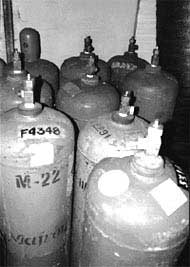
cfc cylinders in some east African countries that bore faint markings in Hindi. The same experts also reported seeing old Du Pont cylinders containing
cfcs in east Africa and central America. "All these are non-returnable to the original companies, so the original companies have nothing to do with them," the official wrote.
The agency concluded that third parties in places such as Dubai may be using old cylinders to illegally tranship
cfcs. Thus, even if a company's name does appear on the cylinder, it is quite likely that the company is completely innocent of wrong doing. There is ample scope for an investigation. Meanwhile, its business as usual.
| The European story |
| Illegal trade in CFCs within Europe (in tonnes |
|
1992 |
1995 |
1996 |
| Total supply/sales |
34,800 |
14,00 |
9,500 |
| Production |
34,300 |
0 |
0 |
| Storage |
0 |
5,000 |
2,000 |
| Recycling |
500 |
1,000 |
1,000 |
| Smuggling |
0 |
8,000 |
6,500 |
| The
major players |
| Major Indian companies trading in ozone-depleting substances |
| Names of
companies |
Production
in metric tonnes |
Navin Fluorine
India Ltd
(CFC-11,HCFC-22) |
3114.3;1730.9 |
Aegis Chemicals
Industries Ltd
(CFC-11,HCFC-22) |
634;96 |
| Mettur Chemicals
Industrial Corporation |
5;99 |
| Hindustan Fluoro
Carbon Ltd |
443 |
| Gujarat
Fluorocarbons Ltd |
300 |

