
Subscribe


 Each resident of Delhi is familiar with it. And when friends and relatives from the smaller cities and towns of India come visiting, they hardly miss an opportunity to remind the residents of the extreme pollution in the capital. The time has now come for Delhiwallahs to start pointing out that the air of most smaller cities and towns in India is as polluted as Delhi, or is fast becoming so, even if it does not attract wide public attention. And if they scoff at it, wave some ambient air quality data from the Central Pollution Control Board (cpcb), New Delhi, under their noses (see graph: As polluted as Delhi, and getting worse). They will surely think about returning with a gas mask or two.
In 1997, an air quality monitoring station in Lucknow, the capital of Uttar Pradesh, recorded the maximum level of suspended particulate matter (spm) at 2,339 microgrammes per cubic metre (g/cum), more than 11 times the permissible limit for residential areas and four times the limit for industrial areas. This is as high as the maximum ever recorded in Delhi: 2,340 g/cum in 1992. What makes this seem even more dangerous is that the World Health Organisation says there are no safe limits of spm. The first comprehensive study on the link between air pollution and its health effects, conducted by the World Bank in 1995, held spm responsible for maximum deaths and health problems in 36 Indian cities. The Centre for Science and Environment, New Delhi, repeated the study in 1997 using data for 1995, and found that one person dies prematurely every hour in Delhi due to high spm load. It also found that premature deaths due to high spm levels had increased by 28 per cent in three years in the cities. The situation in Lucknow is not difficult to imagine.
Something terrible is going on in India's small cities. There are warning signals from whatever data is available -- and that is not much, as cpcb is yet to publish data for 1997, though it did share the data with Down To Earth. The latest data would provide a more accurate picture of the present status. Down To Earth sent its reporters to some small cities and towns with high levels of air pollution to obtain a clearer perspective of the main reasons for this. Although every city had a unique set of problems, there were some common to a majority of cities and towns. The reports overwhelmingly point to a steep rise in the number of polluting vehicles. Rogue industrial units are also to blame, but not as much as vehicles.
So, what is really happening? Simply put, the smaller cities are glaring examples of how public transport systems should not be managed. Cycles, cycle-rickshaws and horse-driven carriages called tongas formed the backbone of public transport till the recent past. But with the cities growing haphazardly, these were found to be inadequate. However, demand can create its own supply. Enter three-wheelers in large numbers. With the government providing cheap diesel in cities in the name of powering the tubewells of rural India, a huge majority of these three-wheelers converted to obsolete, polluting diesel-powered engines. These diesel-powered three-wheelers are today the bane of small-time urban India.
Further, those who had the money opted for two- wheelers, a majority of them using two-stroke technology that is highly polluting. The state governments, which control transport departments, are absolutely clueless about the magnitude of the problem. All they do is 'tailpipery' -- occasionally checking tailpipes and fining vehicles that do not have pollution under control certificates, which can be bought at a ridiculously low price without getting the vehicle checked. And the results are there for all to see.
A report released in January 1999 by the World Resources Institute of Washington, dc, pointed out that Rajkot in Gujarat is the fifth-most polluted city in the world with regard to air pollution. A monitoring station at Dehradun -- the town that has long been considered a haven for retired people to lead a peaceful, untroubled life -- registered the highest spm level recorded anywhere in the country in 1992, an unbelievable 4,809 g/cum.
Moreover, whatever action has been taken in the small towns has been driven by the judiciary, and not the state government, examples being the high courts in Uttar Pradesh and Karnataka. In general, the courts have come down heavily on obsolete diesel three-wheelers being used for public transport, directing that cleaner like battery-powered vehicles should be encouraged.
And then there is the old, oft-repeated story of polluting industrial units that give the impression that India does not have any pollution control laws and pollution control boards. Where does all this leave urban India? That much closer to a diseased half-existence with a poor quality of life. Or death.
The only way out involves at least two clear steps that need to be taken immediately:
• A composite air quality planning exercise on the national level needs to be undertaken. This would identify air pollution 'hot spots' and work out action plans with region-wise air quality targets; and
• An overhaul of public transport systems with a clear move away from vehicles using either diesel or two-stroke technology is a must. Easy loans for replacement of polluting vehicles with cleaner, more efficient ones are a must. There has to be an incentive for people to leave their vehicles home and use public transport.
As the following case studies show, these are not the suggestions of the average government committee but the urgent need of the hour, a desperate cry coming straight from diseased lungs.
| Smoke seekers | |
| The level of monitoring is appaling in India. Delhi should have at least 60 stations but has only 7. The same is true for all town | |
| Number of monitoring stations (1997) | |
| Delhi | 7 |
| Shimla | 2 |
| Kanpur | 6 |
| Pondicherry | 3 |
| Kota | 3 |
| Gajraula | 2 |
| Lucknow | 3 |
| Dehradun | 2 |
| jaipur | 3 |
| Jammu | Nil |
| Rohtak | Nil |
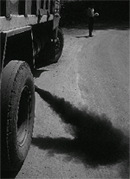 Due to decades of neglect and indifference, air quality in Indian cities has worsened rapidly, triggering a serious public health crisis. Central and state governments are still at a loss in dealing with the problem and except Delhi, no city is taking effective steps to control pollution. Even in Delhi, the drive to deal with pollution is not coming from the government but the Supreme Court. Recently, high courts in Karnataka and Uttar Pradesh have clamped down on the polluting three-wheelers by either banning them or pushing them to run on cleaner fuels.
  It is a sight which Suresh Rawat, a hotelier in the hill station of Mussourie that overlooks the town of Dehradun in Uttar Pradesh, could do without. Every winter, thick blue smoke envelops this town, casting a shadow on one of the most picturesque valleys in Asia. "Doon is a broad valley. This sometimes gives rise to a lateral inversion that does not allow hot air to rise from the valley. As a result the smoke settles over the valley," says Hugh Gantzer, resident of Mussourie and a member of a monitoring committee set up by the Supreme Court to restore the "natural normalcy of the Doon Valley".
 There is no evidence more conclusive about the state of air pollution in Gajraula, a sleepy industrial town in Uttar Pradesh, than the air itself. As one enters the town, breathing becomes difficult. "The residents of the town have got used to the air quality. But visitors generally have difficulty in breathing," says an engineer who works in one of the polluting industrial units. cpcb data for 1997 show both the maximum and average levels of spm way above the prescribed limit.
 One of the most densely populated areas in India, the union territory of Pondicherry has 1,642 persons per sq km. Its air is also one of the densest in the country (see box: Unclean air). In 1997, the maximum levels of both spm and so2 were about three times the permissible limits, while that of nox was more than two times the permissible limit (see graph: Pondicherry: high on gases). Pondicherry is one of very few cities - and the only one among the Down To Earth case studies - where the maximum levels of all the parameters were way above the safe limit in 1997. And this has been the pattern since monitoring started in 1988.
 "Kota is fast becoming like Delhi in matters of pollution. What we have here is an exploding situation," says Nishith Arora, a dentist living in Kota. The story of airpollution in the Rajasthan city begins with industry and ends with vehicles.
  "In Jammu, 90 per cent of air pollution is vehicular," says A B Jandiyal, environmental engineer with the Jammu and Kashmir Pollution Control Board (j&kpcb). A cpcb report has already branded Jammu as one of the most polluted cities of the country. Yet no regular monitoring of the ambient air is conducted. Barring one study each by j&kpcb and cpcb, which showed an alarming picture, there is no other data.
 "In Jaipur city, there are no major air polluting industrial units. Most are small-scale textile units and cause water pollution, not air pollution. The main culprit of air pollution is vehicles," says Rajesh Thakuria, regional officer, rpcb. According to Balakant Sharma, statistical officer at the transport office in Jaipur, the vehicular population in the capital of Rajasthan has increased six times between 1980-81 and 1998-99 - from 81,267 to 544,556. As much as 78 per cent of the vehicles in the city today are two-wheelers.