

India is investing in science-led nutrition solutions, including biofortified crops and integrated farming systems, but older food security systems are being overlooked.
Commons such as forests, grazing lands, ponds, rivers and wetlands provide many rural households with fish, wild greens, fruits, mushrooms, fodder and medicinal plants.
These shared landscapes help support dietary diversity, especially for landless, marginalised and forest-dependent communities.
As commons shrink because of development pressures, conservation conflicts and loss of access, communities risk losing an important buffer against hunger, malnutrition and poverty.
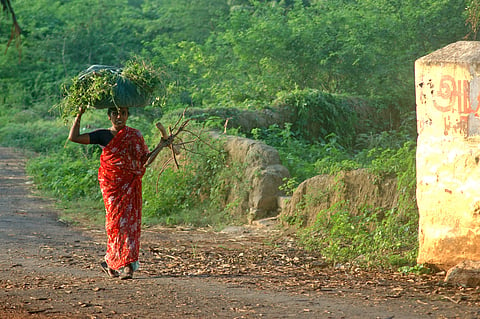
Across many rural landscapes in India, the village commons can function like an invisible supermarket. A pond may provide fish, lotus stems and edible aquatic plants. Forest edges may offer wild greens, fruits, mushrooms, bamboo shoots and medicinal herbs. Open pastures may feed cattle and goats without any cash cost to the farmer, while children gather fruit from shared trees. These spaces are not shops, farms or welfare schemes, but for many households they remain a quiet source of food, fodder, nutrition and resilience.
This invisible supermarket is open through the year and requires no cash to enter or leave. But it is disappearing, and the stakes are high.
The Food and Agriculture Organization of the United Nations’ 2025 report, The State of Food Security and Nutrition in the World, states that 586.5 million people in India were unable to afford a healthy diet. The report also highlights a growing concern: food prices have risen faster than overall inflation in many parts of the world since 2020, making nutrient-rich foods such as fruits, vegetables and high-quality proteins increasingly unaffordable for low-income households.
As families are pushed towards cheaper and less diverse diets, the challenge is no longer simply to produce enough food, but to ensure access to nutritious food.
In May 2026, Union Health Minister J P Nadda launched the Science Excellence for Health through Agricultural Transformation, or SEHAT, mission. It focuses on biofortified crops, nutrient-rich food products, integrated farming systems, dietary solutions for lifestyle diseases and other nutrition-sensitive interventions.
Such initiatives reflect India’s growing reliance on science and technology to address food and nutrition challenges. But while policymakers look towards laboratories, research institutions and technological interventions, a quieter and much older system of food security is steadily eroding: the commons that have sustained millions of rural Indians outside formal markets for generations.
For millions of rural Indians, food security is determined not only by what they can buy from markets or grow on private farms, but also by what they can access from shared lands: forests, hills, grazing grounds, rivers, lakes and wetlands. These are commonly known as the commons.
Often referred to as Common Property Resources, these are resources to which communities have traditionally had collective access and over which no single individual holds exclusive rights. For households that depend on them, these spaces can mean the difference between survival and starvation.
Food security policies tend to focus on ensuring access to food through markets, farms or public distribution systems. But commons offer something that markets and farms alone often cannot: a buffer against the unpredictability of both.
Their significance extends beyond simply providing food. In a country where food security interventions continue to centre largely on cereals, commons provide access to a wider range of foods that conventional policy frameworks often fail to address.
Fish from ponds, wild fruits, leafy greens, mushrooms, edible forest products and other uncultivated foods contribute vitamins, minerals, proteins and other nutrients essential for growth, immunity, repair and overall wellbeing.
Public food programmes remain crucial for addressing calorie deficits. But commons complement them with a nutritional range that cereal-based schemes were never designed to deliver. As these resources erode, communities lose not only sources of food, but also important pathways to nutritional wellbeing.
The numbers tell their own story. The National Sample Survey’s 54th Round, conducted in 1998, formally defined Common Property Resources as resources accessible to, and collectively managed by, an identifiable community, on which no individual has exclusive property rights. Yet these lands are often dismissed as ‘wastelands’.
The same survey found that nearly half of Indian households reported collecting materials from the commons, underscoring their continued importance to everyday livelihoods. For the landless and marginalised, these are often the only such resources they can access.
Dependence on the commons is also gendered. Studies have found that men tend to use these spaces more for commercial purposes, while women use them mainly for domestic needs. For many rural women, the commons are not just shared land; they are kitchens, pharmacies and livelihood systems rolled into one.
The 1996 World Food Summit defined a household as food-secure when all its members have physical and economic access to safe and nutritious food at all times. By that measure, the commons do more than fill gaps.
Evidence from 2019 shows that households that freely collect food from forests, water bodies and other shared resources tend to consume more fish, more green leafy vegetables and a wider range of nutrient-rich foods than those without such access. Where households retain this access, they are often better protected from hunger and food insecurity.
Commons were not always vanishing resources. Over time, colonial and later market-oriented development policies transformed many of them into commercially managed assets.
British demands for reserved forests led to the large-scale clearing of native trees in favour of commercial species. Colonial forest laws converted community-managed ecosystems into state-controlled assets designed to generate revenue. Demand on reserved forests continued in the decades before independence and through the 1980s to serve the needs of industries, tourism and transport.
Plantations, dams and mining projects, pursued by both the state and private actors, have since claimed many commons, deciding how they are used, who controls them and who benefits from them.
The result has been a shrinking of shared landscapes and a sharpening tension between conservation, development and economic survival.
Caught in the middle are forest-dependent communities, particularly those in the lowest socio-economic strata: poor pregnant women, children, Adivasis and Dalits. As access to commons shrinks, displacement rises, and with it the risk of poverty, hunger, malnutrition and loss of livelihood.
This creates a vicious circle. As more people are pushed into poverty, they become more dependent on the commons, even as their access to them continues to shrink. Protecting these shared resources is therefore, at its core, a matter of social justice.
The UN-mandated Sustainable Development Goals and India’s National Food Security Act are built around the ideas of ‘zero hunger’ and the ‘right to food’. But for many of India’s most marginalised communities, it is the commons that provide the practical means to food.
They reduce dependence on markets and, in many cases, sustain a dietary diversity that would otherwise be unaffordable or unavailable.
If India is serious about food security, policy must recognise that access to nutritious food depends not only on markets, farms and welfare schemes, but also on secure access to shared resources. The country’s food future cannot be planned through a ‘farm to plate’ model alone — it is a landscape-level issue.
Anmol Sarah Abraham is research coordinator, BhuSampada Centre, NIAS Bangalore. Views expressed are the author’s own and don’t necessarily reflect those of Down To Earth