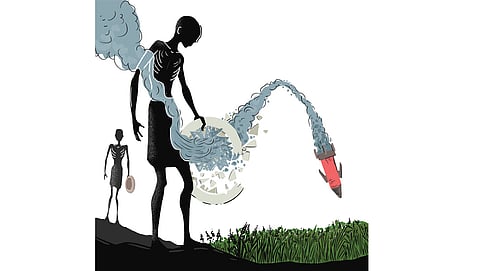


Ongoing wars are weaponizing food supply chains, with the Russia-Ukraine conflict highlighting the devastating impact of food warfare.
Disruptions to agricultural exports and rising costs are straining food-insecure nations.
Coupled with climate challenges like El Niño, the global food system faces a critical test, threatening millions with acute hunger.
A fifth of the calories that a person eats must have crossed at least one border. Harvest in one region is critical to the state of hunger in another, faraway region. The food system has never been so interconnected or globalised. Most food-insecure countries increasingly depend on food imports, while exporting countries have export-dominated economies. This has also made the global food system extremely vulnerable to ruptures that may precipitate food insecurity. This is why ongoing wars are deploying tactics referred to as “food warfare”, not just to inflict physical losses but also to cause long-term food insecurity.
In the ongoing Russia-Ukraine war, food warfare has assumed prominence as a strategic tool. Both Russia and Ukraine have been targeting each other’s agricultural infrastructure and supply-chain facilities like ports and shipping lanes. Both countries are major global exporters of wheat, maize and sunflower oil—essentials and staples for many countries, particularly in Africa and Asia, including West Asia. To put it in context, Ukraine has 25 per cent of the world’s carbon-rich fertile soil, and before Russia's invasion, the country accounted for one-sixth of the world’s corn exports, one-tenth of wheat and nearly half of sunflower oil. One-third of African nations fulfil half their wheat demand from Ukraine. Now, Russia’s stated position is to treat all ships in the Black Sea bound for Ukrainian ports as “military cargo”. The blockade on the ports, which handle 90 per cent of Ukraine’s agricultural exports, has nearly choked the global supply chain. Supply has nearly halved due to extensive damage to food and agriculture infrastructure.
According to reports, due to recent attacks, Ukraine will not have storage facilities this month to accommodate the current harvest, around 9 million tonnes of grain. So, the granary of Europe is becoming a cemetery for the world’s food-insecure people. According to the EU, “with 7.8 per cent of the global population already facing hunger, this assault on trade routes risks tipping vulnerable regions into famine.” The UN Security Council, the EU and the Parliamentary Assembly of the Council of Europe have all condemned Russia's tactic to use food as a weapon of war.
Ukraine has also attacked large grain terminals in Russia’s port of Novorossiysk. Michael Werz, senior fellow, Council on Foreign Relations, writes, “Using food as a lever is a proven military method as old as siege warfare, now conducted at global range. Both Russia’s and Ukraine’s military missions have now illustrated how twenty-first-century warfare is increasingly boundless, asymmetric, and willing to victimise low-income populations in food import-dependent regions of the world.”
The coming year will bear the brunt of food warfare. Prices are turning unaffordable for poor consumers; the West Asian crisis has added another layer, impacting food, fuel and fertiliser segments; and the super El Niño is just unfolding as well. The World Bank estimates that the ongoing El Niño could reduce rice output by 20-50 per cent. In January-July 2026, global wheat prices increased by 24 per cent; rice by 14 per cent; soyabean by 8 per cent; and corn by 8 per cent. Farmers, particularly in developing and poor countries, are forced to cut down fertiliser purchases due to price hikes. Alternative overland routes make food costlier by US $50-70 per tonne, while river routes are becoming infeasible due to low water levels, like in the Danube river that Ukraine used as an alternative export route. Attacks have also been designed to damage alternative supply routes.
In 2025, the world recorded its largest grain harvests. This year, due to El Niño, will see the second-largest harvest. But, half of the world’s 266 million people facing acute hunger due to conflicts. Food warfare will add to the crisis.
This article was originally published in the October 16-31, 2026 print edition of Down To Earth
