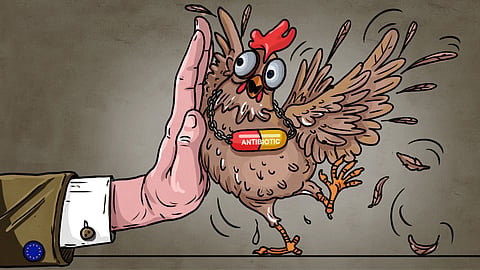


A few years ago, the EU issued directives on the use of antibiotics in the food it imports. This meant animal products, including fish, dairy and honey, produced using antibiotics as growth promoters or to increase yield would not be allowed into the bloc. It also put out a list of antibiotics, deemed critical for humans, which would be banned for veterinary use. When this was released in 2023, India was omitted from the list of countries allowed to export aquaculture and poultry products to the EU from September 2026, when the directive would come into force. This was done, according to the EU, because of lack of information and regulations on the use of antibiotics in India’s food-producing sectors.
The Indian government responded. In October 2024, the Food Safety and Standards Authority of India (FSSAI) published a list of antibiotics banned for use at any stage of the production of meat, milk, poultry, eggs and aquaculture products. It also set tolerance limits—also called Maximum Residue Limit (MRL)—for antibiotics that were permissible, requiring producers to ensure that residues in food did not exceed stipulated thresholds. In May 2025, the Union health ministry issued a draft notification banning the veterinary use of 34 of the 37 antibiotics that the EU classifies as critical for humans. It was notified in September that year and stated that safer alternatives were available for treating diseases in animals. In May 2026, the EU revised its exclusion list and added India to the list of countries permitted to export animal products to the bloc after September 2026.
The questions I would like to discuss with you are as follows:
One, why do such critical policies related to food safety and public health have to be driven by external consumer pressure? Antibiotic resistance is a silent pandemic, and we know that the Indian government is deeply committed to the issue. We as a country cannot afford the health burden of lifesaving medicines becoming ineffective and hence, the government has been taking steps to contain the use of antibiotics in food-producing animals. In 2010, based on an analytical study by the Centre for Science and Environment (CSE), the government issued an advisory against the use of antibiotics in honey, which was later followed by a ban. In 2019, it banned the use of colistin in food-producing animals and in aquaculture—this is because colistin is the top-reserved antibiotic for humans and needs full protection against overuse. Then policymakers were contemplating bans on antibiotics in animal feed and other steps but stopped short of adopting a comprehensive framework. This was finally done, prodded by the need to protect our export markets. What is good is that these regulations are not just for food destined for the EU, but will also apply to the meat, milk, eggs, honey and fish sold within India. It will protect our health.
The issue is not just about antibiotic use; it is about the safety of the food we consume. We need robust standards for pesticide residues, food additives and other toxins—not just to ensure that India’s food is good for export but also to protect our health. A quick dive into the US Food and Drug Administration’s import refusal database shows that some 2,700 food consignments from India were rejected in 2024-25. These included spices, rice, pulses and lentils, flagged for excessive or unapproved pesticide residues.
This leads to the next question: how will these standards be enforced? Importing countries have developed monitoring systems based on quality and residue checks in authorised laboratories and even at their borders. The EU plans to ensure compliance with its directive by asking every single shipment to have a health certificate, issued by a government agency and not by the company exporting the food item. It will also conduct audits in exporting countries and spot checks at the border. The system is designed to push the red button and ratchet up the numbers of physical inspection if one item fails the analytic check; multiple failures could lead to serious consequences. But what about the food that is not exported?
The third question is, how can farmers remain productive without the use of antibiotics—or for that matter, pesticides and other toxins? Ultimately, this is not just a regulatory challenge; it requires changes in the way food is grown. Farmers use antibiotics for three purposes—to promote growth in animals; to prevent diseases because of lack of hygiene or because of high density of animals; and then to treat diseases. Now farmers will need to prevent diseases, not by using antibiotics but by improving conditions in which animals are bred and food is produced. The National Dairy Development Board (NDDB) has worked with its farmers to promote ethnomedicine—traditional practices for managing animal health—and showed it is possible to reduce the use of antibiotics. This is the win-win we need in our world.
