
Subscribe

The article examines the backlash against Dhirendra Krishna Shashtri’s call to avoid fish and meat during Durga Puja, contrasting his stance with Shakta scriptures and Bengal’s cultural practices.
It explains how Shaktism venerates the Goddess, cites Devi Bhagavata verses permitting animal sacrifice and meat consumption, and shows that Bengali Hindu food habits reflect a complex mix of Shakta, Vaishnava and external influences.
The recent controversy over the remarks made by Dhirendra Krishna Shashtri, chief priest of Madhya Pradesh’s Bageshwar Dham, refuses to die down.
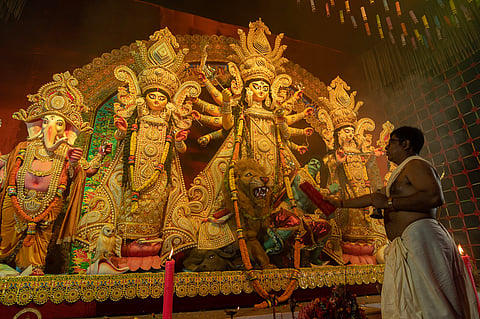
In a recent pravachan (sermon) in Howrah, Shastri appealed to the people of West Bengal not to cook or eat fish or meat during Durga Puja festivities.
Shastri’s comments led to an outcry across the board in Bengal, as well as in Delhi. The state chief minister and local political leaders subsequently defended the consumption of meat as intrinsic to Bengali Hindu identity.
But why is this so? And what does scripture say in this regard?
Hinduism, as The Oxford Centre for Hindu Studies notes, cannot be understood without the Goddess (Devi/Śakti) and the goddess-oriented Śākta traditions.
“The Goddess pervades Hinduism at all levels, from aniconic village deities to high-caste pan-Hindu goddesses to esoteric, tantric goddesses. Furthermore, tantric goddesses have played a significant role in the formation of tantric Buddhism, or what is sometimes referred to as ‘Śākta Buddhism’. Nevertheless, these highly influential forms of South Asian religion have only recently begun to draw scholarly attention. Taken together, they form ‘Śāktism’, which is considered one of the major branches of Hinduism next to Śaivism, Vaiṣṇavism and Smārtism. Śāktism is, however, less clearly defined than the other major branches and sometimes surprisingly difficult to discern from Śaivism in its tantric forms,” notes the Centre.
According to the World Religion Database (WRD), Shaktism is the third-largest Hindu sect, constituting about 305 million Hindus.
The conception of God as female in Hinduism is old.
The Devīsūktam, also called the Aṃbhṛnīsūktam, the 125th sūkta (hymn) occurring in the 10th mandala of the Rigveda, the oldest of the four Vedas, notes:
I am the Queen, the gatherer-up of treasures, most thoughtful, first of those who merit worship. Thus Gods have established me in many places with many homes to enter and abide in. Through me alone all eat the food that feeds them, — each man who sees, breathes, hears the word outspoken. They know it not, yet I reside in the essence of the Universe. Hear, one and all, the truth as I declare it. ....I created all worlds at my will, without any higher being, and permeate and dwell within them. The eternal and infinite consciousness is I, it is my greatness dwelling in everything.
In a letter written from Chicago in 1893 to Haripada Mitra, a sub-divisional forest officer he met during his travels in Belgaum around 1892, Swami Vivekananda remarked: Do you know who is the real “Shakti-worshipper”? It is he who knows that God is the omnipresent force in the universe and sees in women the manifestation of that Force.
In her paper Shaktism, Sneh Lata, a research scholar from the Department of History at Panjab University, Chandigarh, notes that:
Though Shaktism was known in ancient India, it emerged as a distinct religion in the early medieval period. The transformation period from ancient to early medieval period was about the new social and economic set up but it changed radically the complete religious outlook of India. In the age of Guptas, the Shaivaites did try to supersede the Shaktas by making the Shakta goddess the wife of their own lord Shiva. The Vaisnavaites also attempted, but could not succeed as Shaivites did, because Shiva absorbed more popular elements than Vishnu. Thus, Devi naturally came to be associated with Shiva.
Today, Shaktism has its largest followers in the Himalayan and eastern regions of the Indian subcontinent, stretching from Jammu, Punjab, Himachal Pradesh, Uttarakhand, Nepal, Bihar, Bengal, Odisha and Assam.
Like other Hindu sampradayas, Shaktism too has its own revered canon of scripture. These include the Devi Mahatmya, Devi-Bhagavata Purana, Kalika Purana, and Shakta Upanishads like the Devi Upanishad.
It is in these texts that we find evidence of the Shakta relationship with food, especially meat and fish.
The Srimad Devi Bhagavatam or Devi Purana, is along with the Devi Mahatmya (part of the Mārkanḍeya Purāna), the most important religious text for followers of Shaktism.
Consisting of 12 skandhas (books), 318 adhyayas (chapters) and 18,000 verses, it is ascribed to the sage Krishna Dvaipayana, also known as Veda Vyasa.
In Book 3, Chapter 26 has two verses, which address the issue of sacrifice and meat consumption.
Verse 32 says: Those who eat meat, they can sacrifice animals in this worship of the Devî; and, for this purpose, goat and wild boars are the best.
Verses 33 and 34 note: O sinless one! The goats, etc., offered as a sacrifice before the Devî attain to unending heavens. Therefore persons offering the sacrifices of goats do not incur any sin. O king! The goats, etc., and other beast offered as a sacrifice before the Devas undoubtedly go to the heavenly regions; therefore, in all the S’âstras, it has been decided that this killing of animals in a sacrifice is considered as non-killing.
The text thus permits the sacrifice and eating of animal meat as part of the worship of the Devi, with the assurance that the animals thus sacrificed will attain a heavenly realm and that the one who has performed the sacrifice has not committed a sin.
In her 2004 work, Offering flowers, feeding skulls: popular goddess worship in West Bengal, June McDaniel, assistant professor in the Department of Philosophy and Religious Studies at the College of Charleston in South Carolina, United States, also notes the role of Tantric (esoteric) rituals in Shakta worship:
The Bharatvarsiya upasak-sampradaya gives a definition of Shakta that is quite different, and its definition includes both tantra and brahmanical ritual worship or puja:
Those who are worshipers of Shakti or Shiva’s wife are called Shaktas. The tantric literature is full of rules regarding this lineage. The style of worship is different from that of the Vedas. What is special about tantric worship is that the worshiper must first build an image of the goddess, then bring “life” into it by chanting mantras, and welcome her descent as a living and physically visible goddess. The worshiper must offer water, offerings, objects for bathing, perfume, clothing, and other items. Some people who are eligible worship with liquor and meat. The Shakti lineage worships Shakti, Kali, Tara, Shiva-shakti, or other deities. However, the personal deity may not be the same for all, depending on the lineage of guru and disciple. Some worship Kali, or Tara, or Jagaddhatri, or others.
Tantrism or esoteric rites and rituals, began by the end of the fifth century in the subcontinent. There is Tantric Hinduism as well as Tantric Buddhism (Tibetan or Vajrayana Buddhism). The goal of Tantra is the search for spiritual power and ultimate release. Practitioners do this by means of the repetition of sacred syllables and phrases (mantras), symbolic drawings (mandalas), and other secret rites elaborated in the texts known as Tantras (“Looms”).
While the practices slowly disappeared from other parts of India, it survived in its main centres of Kashmir, Bengal and Assam. In Kashmir, it became interwoven with Kashmir Saivism while in the east, it did so with Shaktism.
It would be wrong though to classify and categorise Bengal as a mostly Shakta land. Chaitanya Mahaprabhu, the 15th-century saint, is known for his role in spreading Vaishnavism in the province.
Ultimately, attitudes of food in Bengal became a mix of both Shakta and Vaishnava practices as well as outside influences.
As Somshankar Ray, Assistant Professor, Department of History, Vidyasagar College for Women, Kolkata, notes:
Eighteenth-century Bengali cuisine went through some important modifications. During this time Bengal was in communication with the Mughals and the Europeans, Vaishnava and Shakta ideologies became more clearly defined, and increasing urbanization and the growth of urban culture was also significant. This led to a curious combination of culinary cultures developed in 18th century Bengal which is relevant to an extent even today.
