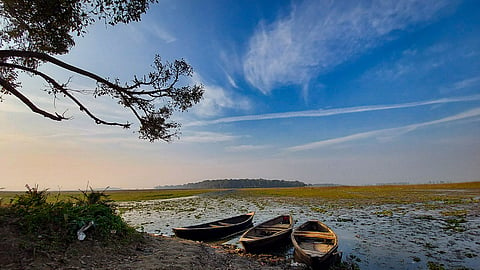


Sakhichand Sada, a middle-aged landless farm labourer, recalls that Kanwar Lake in Bihar remained dry this year (2025) till July 18 and reported water only after it rained on July 2025. This is badly affecting the growth of wild edible plants. Till last year, he collected kamal gatta (Nelumbo nucifera), sarrukha (Nymphaea sp.), khubahi (Scirpus articulatus), bhent (Nymphaea alba) and water spinach (Ipomoea aquatic) from the wetland for food and also sold part of the collection and earned a few rupees. “Without edible plants and fish, our livelihood is impacted,” says Sakhichand, who belongs to the Musahar community, one of the most marginalised in the state.
Bihar has around 0.47 million hectares (Mha) of land under wetlands, accounting for 5 per cent of the state’s total geographical area. These sponges are very important for the state as it is under constant threat of floods. Kanwar lake is Asia’s largest freshwater oxbow lake and a unique wetland, which supports around 17 villages and over 15,000 households. It was the first wetland in Bihar to be listed as a site of international importance under the Ramsar Convention.
Kanwar is part of an extensive floodplain wetland in the lower reaches of the Gandak–Koshi interfan in north Bihar. Gajanan Mishra, retired Additional Secretary of Water Resources Department, Government of Bihar, said the age-old connection of river and wetland has snapped due to the construction of embankments, roads, and railways and human settlements. These are real culprits in wetlands dying as in the case of Kusheshwarsthan wetland in Darbhanga district. Mahesh Bharti, who has run Kanwar Nature Club for over three decades, says that even after Kanwar Lake was declared a Ramsar Site in 2020, no serious effort was made to save it, and in the last two decades it has deteriorated quickly. Arvind Mishra, an expert on wetlands who formed the Mandar Nature Club, says that officials have made repeated attempts to downsize wetlands in the Kanwar lake area and they have been encroached upon for agricultural purposes. The government’s apathy towards saving the lake, which is in dire condition, needs a specific plan for its conservation. Even before the wetland was declared a Ramsar Site, local as well national-level environmentalists and experts demanded an action plan to conserve and protect Kanwar Lake.
Vidyanath Jha, retired Professor of Botany from L N Mithila University, Darbhanga, Bihar, who has extensively researched on wetlands and edible plants, says the focus has shifted to cultivating priced commodities like makhana on a large scale in different wetlands spread in different districts and due to this, wild edible plants like the char kantewala singhara (an indigenous Trapa natans var. quadrispinosa) and even karmi saag are on their way to extinction due to lack of conservation.
The Bihar State Wetland Authority accepts that there is no official data on the status of the wetlands in the state despite the recognition that they are very important in view of increasing challenge of climate change and the water crisis in the state. S Chandrasekhar, member secretary of Bihar State Wetland Authority, informed that the authority has information on only two plant-based foods, makhana and singhara.
The government, he says, is however trying to protect wetlands. Bihar already has three wetlands—Kanwar Jheel, Baraila and Kusheshwarsthan—that are listed as Ramsar Sites. These were identified by the state government as wetlands of national importance under the National Wetland Conservation Programme. Chandrasekhar says, “We have sent a proposal for three more wetlands, Gogabeel Lake in Katihar district, Gokul reservoir in Buxar district and Udaipur Lake in West Champaran district, for declaring them as Ramsar Sites.”
“Our main focus is to complete the notification of all existing wetlands in the state. If notification is implemented, it is enough for the conservation of wetlands. We have completed digital demarcation and ground truthing of several wetlands and a similar exercise for other wetlands is under process. We have not taken any step so far to protect and promote food biodiversity in wetlands yet, but we will take this up once we stabilise after notification work of all wetlands is completed,” he says.
Global nonprofit Wetlands International South Asia was assigned the task of developing the management planning framework for Kanwar Lake. In 2016, they released a document for wetland conservation An Integrated Management Action Plan to ensure ‘conservation and wise use’. To implement the action plan, around Rs 150 crore over a period of five years was needed. No work has, however, started on this, department officials say. The report documented 46 macrophytes and 75 terrestrial plants around the Kanwar wetland. But their food potential was not indicated in this report.
“Farmers used to cultivate special variety of paddy and maize, and fishing was common. Three crops were grown annually without chemical and irrigation, so the cost of production was almost zero as only seeds required. The stems of 15-foot-long paddy and maize were the best fodder for their animals. “But all this has gone. Nothing is left now,” says Arvind Mishra, who had spent over three decades in the field in north Bihar and closely studied wetlands. “Productivity was very high in wetlands, without fertiliser, and people collected 2-4 quintals of small fishes in 1 hectare of wetland.”
Former Divisional Forest Officer of Begusarai, Abhishek Kumar Singh, who held the post till July 2025, confirms that the drying of the Kanwar Lake has adversely affected the livelihood of local communities which has forced many to migrate outside in search of other jobs. Krishnanand Sada, a boatman who lives around Kanwar Lake, is in his mid-20s. He says there is no work and no food if there is no water in the lake. “Water in the lake generates work for us as boatmen for tourists. Many people like me earn Rs 400-500 per day during the season from both food and tourism,” he says.
Nutrition security is also under threat. Kalo Devi, a landless labourer in her 50s, collects these edibles along with lotus flower and khubahi and sells them. She says that these plants are nutritious, and the poor ensure that they consume them during the monsoon season. “When there is water in Kabartal, we have a source of food free of cost. But in dry season we have no such source.” Khubahi is especially nutritious, and Kalo Devi collects the mature infructes after the rainy season and dries them. These are processed in the winter season (December-February) for obtaining seeds that are popped and sold in the market for making a local sweet.
In folklore, wetlands are described as brothers of rivers as they keep rivers alive in the dry season. Now, the closely interlinked relationship between rivers and wetlands has almost ended as many wetlands have dried up. “It is very difficult to revive the wetlands,” Mishra said.
To find out more about CSE's work on food systems based in wetlands here
