
Subscribe

In the forest villages of Odisha’s Kalahandi district, tribal communities are asserting rights long guaranteed by law but denied in practice.
Under the Forest Rights Act, Gram Sabhas are reclaiming ownership over bamboo, kendu leaves and other minor forest produce.
Years of confrontation with the forest department have given way to community-led forest governance, transparent trade and local employment.
From Jamguda and Palki to Golamunda and Kelia, collective action has transformed forests into sources of dignity, income and stability.
Those living in the forest villages of Odisha’s Kalahandi district — mostly tribal communities — are increasingly coming together to assert their rights over forests: rights granted by law but often denied in practice. Section 3(1)(c) of the Forest Rights Act (FRA) grants forest-dwelling communities ownership rights to collect, use and dispose of minor forest produce (MFPs). The FRA Amendment Rules, 2012 further clarified that “disposal” includes sale, processing, storage, value addition and transportation of MFPs within and outside forest areas. Crucially, the Rules established that transit permits (TPs) must be issued by Gram Sabhas or their authorised committees, not by the forest department. However, state departments continued to resist, preventing Gram Sabhas from exercising their ownership rights.
Across Odisha, the struggle for ownership over minor forest produce continues to be marked by confrontations between forest-dwelling communities and the forest department. Nearly every Gram Sabha carries its own story of resistance and assertion. What emerges from these struggles is a model of community forest governance and sustainable forest management led by Gram Sabhas, creating new opportunities for forest-dependent communities.
Kalahandi, one of Odisha’s most underdeveloped regions, has witnessed profound changes in recent years. The district’s Gram Sabhas, once perceived as dormant local institutions, are today at the forefront of protecting and managing forest resources under the landmark Forest Rights Act (FRA) of 2006.
In line with the goals of the Forest Rights Act (FRA), 2006, the Kalahandi Gram Sabha Mahasangha (KGSM) has emerged as a powerful federation of right-holding communities, creating sustainable forest-based livelihood opportunities across six blocks of Kalahandi. By facilitating the sustainable harvest of tendu leaves and bamboo, the Mahasangha has generated business worth several crores of rupees, ensuring that benefits flow directly to the people.
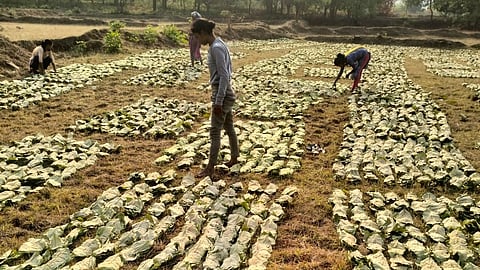
Under this system, revenue from tendu leaves and bamboo goes first to the pluckers and cutters. For example, in the 2024 crop year, a bundle of 50 tendu leaves fetched Rs 7 — more than double the amount offered by the Tenduleaf Department or local traders. Of this, Rs 6 went directly to the plucker as wage payment, while the remaining Re 1 was divided towards management and development costs: 40 paise went to the CFRMC committee for managing NTFP sales, 50 paise to the Gram Sabha development fund used for forest and community development, and 5 paise each to the block- and district-level federations for management expenses.
A key achievement of KGSM has been its focus on women’s livelihood security. With federation-issued identity cards, more than 9,000 women pluckers have each earned an average of Rs 5,000 in just one to two weeks of plucking. This income in women’s hands has translated into greater financial autonomy, personal savings and stronger participation in community decision-making.
The kendu leaf trade alone generated revenues of over Rs 15 crore in 2023 and 2024, benefitting more than 7,000 households across 78 villages in 2023 and 75 villages in 2024. The system guarantees 100 per cent buyback, eliminates middlemen and ensures immediate cash payments — preventing distress sales that were once common. By collectivising trade, KGSM has reduced exploitation, strengthened bargaining power and boosted the local economy.
Importantly, this higher and more reliable income has also curbed long-term migration. In villages across Lanjigarh, Madanpur Rampur and Koksara blocks, many young people now prefer to stay back, contributing to both household prosperity and sustainable forest management.
The journey of community-led forest governance in Kalahandi district of Odisha has been marked by steady progress and collective assertion:
2010: Approval of 110 Community Forest Rights (CFR) titles to Gram Sabhas in Kalahandi by the Sub-Divisional Level Committee.
2012 (16 July): Jamuguda Gram Sabha harvested its first lot of bamboo under CFR.
2013 (3 March): Jamuguda Gram Sabha sold its first batch of bamboo using a state-issued transit permit (issued by the forest department), setting a precedent for other villages.
2016: Tarkabahali Gram Sabha asserted its rights to harvest and sell bamboo.
2017: Lamer Gram Sabha followed suit, exercising its rights over bamboo. In the same year, Gram Sabhas in Golamunda block (Jamjharan, Kanakpur and Jamugudabahali) began harvesting and selling kendu leaves.
2018: Pipadi, Bakshandi and Dholpada Gram Sabhas expanded the scope by harvesting and selling a range of non-timber forest produce (NTFPs). The same year saw the creation of the Kalahandi Gram Sabha Mahasangha, with 38 Gram Sabhas from Bhawanipatna, Junagarh, Madanpur Rampur and Golamunda blocks joining hands.
2019: Membership of the Mahasangha grew to over 50 Gram Sabhas.
2020: The Mahasangha successfully collectivised the kendu leaf trade at the district level, ensuring better prices and minimising the role of middlemen.
2022: Membership rose further to 70 Gram Sabhas.
2023: The Mahasangha collectivised bamboo trade at the district level, enhancing bargaining power and revenues.
2024: The Mahasangha expanded its operational presence to six blocks — Koksara, Golamunda, Junagarh, Bhawanipatna, Lanjigarh and Madanpur Rampur — with over 100 member Gram Sabhas. It also began mobilising Gram Sabhas in Jaipatna to assert their rights.
2025: A landmark year, with 20 Gram Sabhas asserting their rights over bamboo and 95 Gram Sabhas exercising their rights over kendu leaves.
Jamguda: Odisha’s pioneer in forest rights assertion
Jamguda, a small village in Barabandha Gram Panchayat of Madanpur Rampur block in Kalahandi district, has 75 households — 70 Gonda Scheduled Tribe households and five Scheduled Caste households, including six landless families. The village has long depended on forests for survival, collecting mushrooms, fruits, mahua flowers, siali leaves, honey, tubers and bamboo.
In 1990, its youth formed a committee to stop illegal felling, and by 2004 a Van Suraksha Samiti (VSS) under Joint Forest Management was created. Villagers soon realised, however, that this arrangement limited their autonomy. The Forest Rights Act (FRA), 2006 recognised bamboo as a Minor Forest Produce (MFP) and enabled community ownership, prompting Jamguda to apply for Community Forest Rights (CFRs) in 2008.
Despite resistance from the forest department, their CFR claim was approved in 2010, though only 123.5 hectares were recognised against their claim of 500 hectares. This granted rights to collect and sell MFPs, including bamboo and kendu leaf. The VSS was dissolved and the Gram Sabha took charge of forest management.
In June 2012, following large-scale bamboo flowering, the Gram Sabha marked 170 clumps for harvest, and on 23 June the bamboo depot was inaugurated with the purchase of 100 culms for Rs 3,000. However, the forest department refused to issue a transit pass, leading to losses. Even interventions from the Ministry of Tribal Affairs failed to resolve the issue. Jamguda hit national headlines as the denial was exposed, and although FRA Rules were amended in September 2012 to empower Gram Sabhas to issue transit permits, Odisha’s forest department continued to delay.
Finally, on 3 March 2013, following pressure from civil society and local leaders, the forest department issued the first official transit pass at Jamguda. In a symbolic gesture, the first bamboo was transported directly from the Gram Sabha. This made Jamguda the first village in Odisha and the second in India (after Mendha Lekha in Maharashtra) to sell bamboo under FRA rights, marking a turning point in Odisha’s forest rights movement.
Since then, Jamguda has managed its forests collectively, with a 15-member Gram Sabha committee — including five women — overseeing conservation and community enterprise, ensuring sustainable harvesting, revenue sharing, ecological regeneration and community benefit. For Jamguda, bamboo is not just a resource but a symbol of dignity and self-rule, as one villager explains:
“I entirely depend on bamboo for my livelihood. Earlier, I could not sell it due to restrictions by the forest department. Now, I am happy that I can sell freely and get a better price.”
Palki, nestled in the hills of western Odisha’s Kalahandi district, is a tiny, remote village of 57 tribal households with no proper road or public transport. For generations, people here grew up in hardship, and no one studied beyond Class 8. Two years ago, the villagers engaged directly with a trader from Maharashtra, earning Rs 26 lakh from bamboo sales and exercising their rights over forest resources — especially bamboo and kendu leaves — under the Forest Rights Act, 2006.
Previously, forest produce was controlled by government intermediaries, but now Palki’s villagers manage pricing and marketing themselves. Bamboo is sold at Rs 30-40 per pole through a sustainable system: the forest is divided into four sections, with one section harvested each year and revisited only after four years to allow regeneration. Revenue is shared transparently: one-third goes to local bamboo cutters, while two-thirds remain with the Gram Sabha — 50 per cent for forest development, 30 per cent for a village fund, 10 per cent for management costs, and 5 per cent each to block- and district-level federations.
In 2025, Rs 2.5 lakh was spent on bamboo regeneration, creating 635 labour days — 400 of them for women earning Rs 300 per day. Though slightly below Odisha’s minimum wage of Rs 462, this steady local employment has stopped migration for construction work. Palki’s story shows how community control over forests can transform incomes, dignity and stability in some of Odisha’s most remote areas.
Pipadi, about 40 kilometres from Palki, is a pioneering Gram Sabha in exercising its rights under the Forest Rights Act (FRA), 2006. With 45 households, the village independently manages over 4,300 acres of forestland. Holding a CFR title since 2010-11, Pipadi formed a Community Forest Rights Management Committee (CFRMC) in 2017 to strengthen governance.
Over the past five years, the village has sold bamboo worth Rs 7-8 lakh annually and has even begun issuing its own transit passes for bamboo trucks to Telangana — a rare example of grassroots governance. The journey, however, has faced hurdles. The Divisional Forest Officer repeatedly denied official transit permits, citing CFR deed restrictions and arguing that sales were limited to head-loads or cart-loads. This contradicted Section 3(1)(c) of the FRA and the 2012 FRA Amendment Rules, which grant Gram Sabhas full rights over minor forest produce.
Despite this, Pipadi’s assertion has inspired wider community movements. Byasadev Majhi, Secretary of the Kalahandi Gram Sabha Mahasangha and a Pipadi resident, states: “We don’t dismiss government agencies, but communities should decide how and where to sell their produce. The State should intervene only if traders manipulate the market.”.
Dakibandel, a tribal-dominated village in Sagada Gram Panchayat of Bhawanipatna block, received its CFR title in 2010 under the FRA, 2006, and formed a CFRMC in 2019 to govern forest use. In 2020, the Gram Sabha applied to the Divisional Forest Officer (DFO), North Forest Division, Kalahandi, for a transit permit to sell bamboo, but the request was repeatedly denied, blocking villagers from exercising their legal rights over minor forest produce.
Frustrated, the community petitioned the National Human Rights Commission (NHRC), submitted complaints to the National Commission for Scheduled Tribes (NCST), and wrote to the Governor of Odisha. With 107 households dependent on bamboo, the denial threatened livelihoods. The struggle culminated in 2021 when, following NCST intervention, a hearing was organised at the Gram Sabha level (Gram Adalat), which secured the transit permit book for the Gram Sabha, enabling legal bamboo sales. Since then, Dakibandel has earned Rs 7-10 lakh annually, marking a major step towards economic self-reliance and community empowerment.
Tarkabahali, another forest village in Kalahandi district, has also faced long struggles to exercise its community rights over bamboo. Although the Gram Sabha was entitled to harvest and sell bamboo under the FRA, 2006, the forest department repeatedly delayed issuing a transit permit — essential for transporting bamboo to markets.
After years of follow-ups, the community was forced to seek justice by appealing to the National Human Rights Commission (NHRC) for a permanent transit permit book in favour of the Gram Sabha. As a result, the village finally received its first transit permit for bamboo on 21 December 2016.
In 2017, the Lamer Gram Sabha received its first transit permit for bamboo. The assured income from bamboo harvesting created local employment opportunities, leading to a trend of reverse migration during the bamboo season.
Golamunda block in Kalahandi district — home to Gonda, Kondha and other forest-dwelling tribes — has centred its struggle on kendu leaf plucking, a crucial livelihood due to poor agricultural conditions. Between 2010 and 2011, six villages — Jamjharan, Jamgudabahal, Khasiguda, Kanakpur, Kasturapadar and Kalipur — received CFR titles recognising Gram Sabha ownership over minor forest produce and formed CFRMCs in 2012.
Dissatisfied with government procurement prices of only Rs 2.40-3 per bundle, the Gram Sabhas in April 2017 negotiated directly with a private trader from Gondia, Maharashtra, who offered Rs 7.50 per bundle. Of this, Rs 7 went directly to pluckers and Rs 0.50 to the Gram Sabha fund, ensuring immediate and transparent payments under Gram Sabha control.
Conflict arose when forest officials seized leaves before the second round of transportation, citing kendu as a “nationalised product”, denying transit permits and threatening legal action. The Gram Sabhas resisted through resolutions, petitions to district authorities, letters to the Commissioner-cum-Secretary of the SC & ST Development Department, and even intervention from the Union Tribal Affairs Minister.
After six months, in November 2017, the Odisha government deregulated kendu in Golamunda, allowing both government and private procurement. On 22 November 2017, over 1,000 pluckers witnessed MLA Dibyasankar Mishra hand over the order, enabling legal direct sales. The success inspired 13 more villages by 2021, and a federation of Gram Sabhas was formed to set prices and negotiate with traders under fair terms, including direct labour payments, prompt collection payments, contractor liability for accidents, and transit permits issued only after full payment. This shift empowered communities, boosted household incomes and reduced distress selling.
Nagjhari, with 70 households, received its CFR title in 2020-21. The following year, in 2022, the village constituted its CFRMC to oversee sustainable management. By partnering with the Kalahandi Gram Sabha Mahasangha (KGSM), Nagjhari secured a transit permit and began selling kendu leaves in 2022. This marked the community’s first step towards exercising its rights under the Forest Rights Act and creating a steady livelihood stream from forest produce.
Kelia received its CFR title in 2010 and gradually moved towards collective trade in forest produce. In 2019, the village began selling kendu leaves, earning an annual income of about Rs 5 lakh. With the support of the Kalahandi Gram Sabha Mahasangha, villagers obtained official kendu leaf plucking cards, which not only formalised their rights but also ensured direct income for pluckers, strengthening household economies.
The story of Kalahandi is not just about asserting legal rights; it is about reshaping the relationship between community, state and forest. From bamboo in Jamguda and Palki to kendu leaf in Golamunda and Kelia, Gram Sabhas are demonstrating that sustainable forest management and economic empowerment go hand in hand.
The author extends sincere thanks to Tushar Dash, secretary-cum executive director at Vasundhara Odisha for his valuable guidance and insightful inputs in preparing this article.
Nivedita Panda is a researcher working on forest rights, governance, biodiversity conservation, ecological justice, and community-based natural resource management with Vasundhara, Odisha, and Dasharathi Behera has been involved in efforts to strengthen local self-governance through Gram Sabhas in forest-dependent areas of Kalahandi.
Views expressed are the author’s own and don’t necessarily reflect those of Down To Earth