
In western Odisha, the Gandhamardan Hill range is deeply embedded in the region’s spiritual memory. Local belief links it to the Ramayana, where Lord Hanuman is said to have carried a portion of the Gandhamardan mountain while transporting the Sanjeevani herb to save Lakshmana. Such narratives continue to shape how people relate to the forest, not as a resource frontier, but as sacred terrain.
Yet beyond mythology lies an ecological reality of immense significance. Gandhamardan is widely regarded as one of eastern India’s richest repositories of medicinal plants. Field interactions with traditional healers and local collectors reveal a living pharmacopeia, indigenous knowledge transmitted orally across generations. The forest still yields species used in Ayurvedic and folk practices, reinforcing its role as a biological as well as cultural archive.
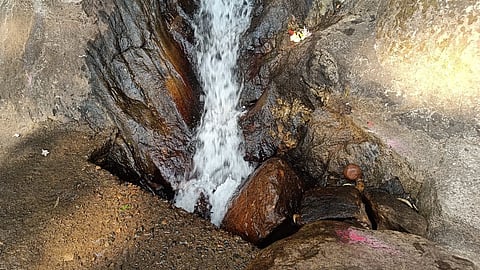
My recent visit to Jalamahadev, a hilltop shrine dedicated to Lord Shiva, offered a deeper understanding of this intertwined relationship. The trek to the temple passes through dense forest and across nearly 17 perennial streams. Even at higher elevations, water flows steadily, a reminder of the hill’s hydrological importance. In a climate-stressed region increasingly facing erratic rainfall, such perennial water systems are ecological assets that warrant stronger conservation attention.
The shrine itself is uniquely situated beneath a natural waterfall. Water continuously flows over the sivalingam, creating what devotees describe as a divine abhishekam performed by nature. During Mahashivratri, thousands undertake this uphill journey. The forested slopes turn into a vibrant corridor of devotion, songs, chants and ritual offerings echoing through the trees.
But beyond the pilgrimage, what stands out is how forest ecology sustains local livelihoods. Along the trekking route, we encountered villagers collecting Pit Konda, a wild edible tuber offered at nearby temples and consumed locally. Such seasonal forest foods remain critical for nutrition security, especially among forest-dependent households.
We also observed the collection of non-timber forest produce and medicinal species such as Harida (Terminalia chebula), Giloy (Tinospora cordifolia), Satabari (Shatavari), and Kafgajri. For many families, income from minor forest produce supplements agricultural earnings, which are often vulnerable to climate variability.
This raises important development questions. How do we conserve Gandhamardan’s ecological wealth while ensuring sustainable livelihood access? How do we recognise and strengthen community stewardship without over-commercialising medicinal resources? Increased pilgrim footfall and expanding local markets are already putting subtle pressure on forest trails and plant extraction.
Gandhamardan demonstrates that sacred landscapes often function as de facto conservation zones. Cultural reverence has historically limited destructive exploitation. However, changing consumption patterns and external market demand could alter this equilibrium. There is a need for community-led conservation planning, sustainable harvesting protocols, and value addition models that do not erode the ecological base.
The perennial streams, dense sal forests, medicinal undergrowth and wildlife habitats together form a fragile yet resilient ecosystem. It supports not only birds and animals, but also spiritual practices, seasonal food systems and informal health traditions.
For development practitioners, Gandhamardan offers an important lesson: conservation cannot be alienated from culture, and livelihood security cannot ignore ecology. The hill is a living system where faith reinforces stewardship, forests sustain nutrition and income, and water defines resilience.
In an era of climate uncertainty and growing ecological stress, landscapes like Gandhamardan remind us that community knowledge and cultural values remain powerful allies in environmental conservation.
Abhisek Hota is a Programme Officer with Watershed Support Services and Activities Network (WASSAN) in Nuapada, Odisha
Views expressed are the author’s own and don’t necessarily reflect those of Down To Earth
