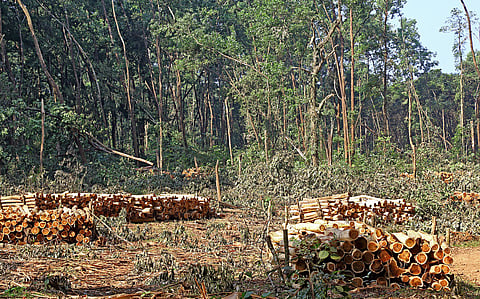


Around 215,943 hectares (ha) of forestland was approved for diversion for non-forest use between the period, 2014–15 and 2025–26. Nearly 62 per cent of this land was cleared for mining, hydropower, irrigation and road projects, showed an analysis of official data provided by the Union Ministry of Environment, Forest and Climate Change in the parliament.
The pace of forest diversion has accelerated sharply in recent years reveals the official data. From 2014–15 to 2018–19, a total of 74,705.68 ha of forestland was approved for diversion. In the next five years from 2019–20 to 2023–24, this increased by nearly 29 per cent to 96,112.90 hectares.
However, the most disturbing trend is seen in the last two years. In just two years (2024–25 and 2025–26), India has already approved the diversion of 45,124.64 ha of forestland for for non-forestry purpose under the Van (Sanrakshan Evam Samvardhan) Adhiniyam 1980, according to data presented by Kirti Vardhan Singh, Minister of State in the Ministry Of Environment, Forest And Climate Change in July 2026.
This forestland diversion approved in just two years is equal to nearly 60 per cent of the total forestland (74,705.68 ha) approved for diversion during the entire five-year period from 2014–15 to 2018–19. It is about 47 per cent of the total forestland diverted (96,113 ha) during the five-year period from 2019–20 to 2023–24.
The rate of forestland diversion for non-forest use has increased shows the annual average of the forestland diverted.
The annual rate of forest diversion has risen from an average of 14,941 ha a year (or 41 ha every day) during 2014–15 to 2018–19 to 19,223 ha a year (or 53 ha every day) during 2019–20 to 2023–24.
In the recent two years (2024–25 and 2025–26), forestland diversion increased to an average of 22,562 ha annually, or about 61 hectares every day.
Such trends have been observed at state-level too. For example, in 17 states and Union Territories the forestland diversion in just two years (2024–25 and 2025–26) was at least 60 per cent or more than the total diverted during the entire five-year period from 2014–15 to 2018–19.
The increase is most evident in ecologically sensitive Himalayan and North Eastern states. For instance Arunachal Pradesh recorded one of the sharpest increases. Between 2024–25 and 2025–26, 6,038.43 ha of forestland was diverted in the state. This is more than eight times the 751.21 ha diverted during 5-year period from 2014–15 to 2018–19, and 69 per cent of the 8,744.79 ha diverted during 2019–20 to 2023–24.
The trend is even more concerning in Sikkim. In just two years, 778.95 ha of forestland was diverted. This is almost 19 times the 41.87 ha diverted during 2014–15 to 2018–19, and nearly 3.7 times the 212.56 ha diverted during 2019–20 to 2023–24.
In Himachal Pradesh, 1,295.4 ha of forestland was diverted during 2024–25 and 2025–26. This is nearly 92 per cent of the total diversion of forestland during 2014–15 to 2018–19, and about 63 per cent of the total diversion recorded during 2019–20 to 2023–24.
In the recent one year too, forestland diversion has increased. In 2025–26 alone, India approved the diversion of 26,858 ha of forestland for non-forest activities. This is not just 47 per cent increase over 2024–25, but also the highest diversion recorded in the last 12 years. Six states too which include --Himachal Pradesh, Jammu and Kashmir, Jharkhand, Mizoram, Nagaland and Sikkim recorded their highest-ever forestland diversion since 2014-15.
In 22 states and Union territories the forestland diverted in the year 2025-26, was higher than in the previous year, 2024-25. These include the four states -- Madhya Pradesh (+116 per cent), Arunachal Pradesh (+43 per cent), Jharkhand (+82 per cent), Chhattisgarh (94 per cent), which together account for over 57 per cent of the total forestland approved for diversion in the financial year 2025-26.
These recent trends show that the rate of forest conversion continues to increase as alerted by the experts. Recent changes to India's forest governance framework may be one of the factors contributing to this acceleration. The Forest (Conservation) Amendment Act, 2023 narrowed the legal definition of forests and exempted certain strategic linear projects from forest clearance requirements.
The Van (Sanrakshan Evam Samvardhan) Amendment Rules, 2025 notified on August 31, 2025 also allow some defence, strategic and public-interest projects to apply for approvals offline. As a result, such projects may bypass the state government's clearance process.
If the current pace continues, forestland diversion during the five-year period from 2024–25 to 2028–29 may exceed 110,000 hectares. This could be around 50 per cent more than the total forestland diverted for non-forest use during 2014–15 to 2018–19, and about 17 per cent higher than during 2019–20 to 2023–24.
