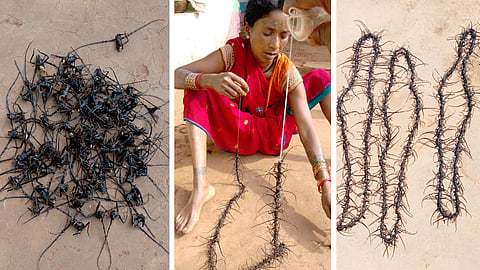


Madhya Pradesh’s Dindori Forest Department has sought central approval to fell 147,380 sal trees in Dindori district after a severe sal borer infestation.
Officials say more than 1.4 million insects have already been collected, with local tribal residents paid Rs 2 for each insect.
East Karanjia is the worst-affected range, accounting for about 90% of the insects caught so far.
The outbreak has also reached the Amarkantak region, where about 24,000 infested sal trees are at risk of being felled.
The Madhya Pradesh forest department has sought permission from the central government to fell nearly 150,000 sal trees in Dindori district after a severe infestation of sal borer insects. Officials say 147,380 trees have been affected in the district. If permission is granted, felling could begin in September or October.
The sal borer is a destructive forest pest that damages sal trees. The current outbreak has affected parts of Dindori and the Amarkantak region of neighbouring Anuppur district. The forest department has also launched a campaign to catch the insects and is paying local tribal residents Rs 2 for each insect collected.
As of July 21, 2026, the department had bought more than 1.4 million insects in Dindori, officials said. Some local residents have been stringing the insects into garlands before selling them to the department.
Surendra Jatav, Sub-Divisional Officer with the Dindori Forest Department, told Down To Earth (DTE) that 1.47 million insects had been caught in the district by July 21. At Rs 2 per insect, the department has paid Rs 29.4 lakh so far, he said.
Jatav said the Forest Department was using the ‘trap tree’ method in three ranges: East Karanjia, West Karanjia and South Samanpur. East Karanjia is the worst-affected area, accounting for about 90 per cent of the insects caught so far.
He said the department had set up five collection centres to buy insects from local residents, and cards had been issued to those involved in the collection drive.
According to the department, 1,417,915 insects had been purchased as of July 21. Jatav estimated that the number could eventually reach about 2.5 million.
He said local tribal communities were cooperating with the campaign because it provided work and because they wanted to help protect the forest.

Officials said 147,380 sal trees had been identified as affected by the infestation in Dindori.
The forest department has sought permission from the Government of India to fell these trees. Jatav said approval could come in August, after which cutting may begin in September or October.
He said the affected trees fall under T1 to T6 categories, indicating varying levels of infestation or damage.
In the Amarkantak region, senior journalist Dhananjay Tiwari told Down To Earth that about 24,000 sal borer-infested trees were at risk of being felled.
He said insects were also being caught there using the trap tree method through forest committees and forest protection committees. According to him, 6,000 insects were burned on July 21, while about 15,000 were purchased.
When Down To Earth visited the region in December 2025, it found that the sal borer insect was spreading rapidly and could develop into a wider outbreak.
At the time, officials said increased rainfall and humidity had created favourable conditions for the pest. The effects became visible months later, as the insect was then inside the trees in the larval stage.
During the visit, Down To Earth observed several trees with sawdust-like material around their trunks, a sign of infestation.
In December 2025, Dindori Divisional Forest Officer Puneet Sonkar said the impact of the sal borer was high that year and that early signs were being reported from villages.
He said insect numbers were increasing near villages and that adult insects were gathering around household lights.
Sonkar said sal borer outbreaks followed a natural cycle of about 30 years. The last major outbreak was in 1997, he said, and its impact was expected to increase again in 2026-27.
Officials say that concern is now being borne out. With the onset of the monsoon, adult insects have emerged from the trees, prompting the forest department to intensify efforts to control the infestation.