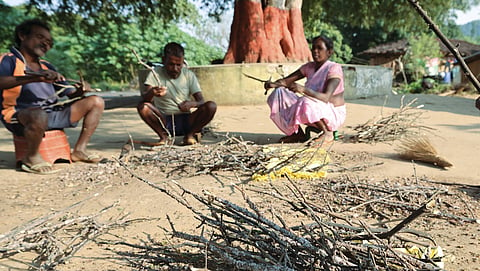


Lac cultivation these days is no less than a gamble; it all hinges on the weather,” says Mahavir Sahu, a farmer from Tangkarkala village in Jharkhand’s Khunti district. “Last winter, I lost half of my lac crop because of dense fog and excessive mist,” Sahu tells Down To Earth (DTE). This spelt huge losses for Sahu and his two farm partners, who have for the past three years leased over 100 trees of Indian jujube (Zizyphus mauritiana) in the village to grow lac.
Secreted by lac insects, primarily Kerria lacca, this natural polymer is used in products ranging from bangles to cosmetics to food processing. Its refined form, shellac, is used in pharmaceuticals as a moisture-resistant coating agent for tablets and capsules. In defence, shellac is used to coat small arms and power cartridges. Different forms of lac find use in aircraft, furniture polish, perfumes and toys. In India, Kerria lacca has two genetically distinct forms: rangeeni and kusmi, which differ by lifecycle, host plants and nature of lac. Rangeeni lac, named for its deep red colour, is harvested from trees like Indian jujube and palash (Butea monosperma). It is cultivated in two cycles: summer (October-November to June-July) and winter (June-July to October-November). The lighter-coloured kusmi lac comes from trees like kusum (Schleichera oleosa). Its cycles are shorter, with the summer crop grown from January-February to June-July and winter crop from June-July to January-February.
Though a few Southeast Asian countries also produce lac, strong global demand for rangeeni and kusmi lac has made India the world’s largest producer and supplier of the resin, with most cultivation concentrated in Jharkhand, Chhattisgarh and Madhya Pradesh. Farmers tell DTE that lac cultivation is a meticulous process. First, the host trees need to be pruned. Then the branches are inoculated with broodlac seeds, or resin-encrusted twigs containing mature and juvenile lac insects. The insects spread across the branches and eventually become sedentary. As they feed on the tree’s sap, female insects secrete lac. During this sedentary stage, they are vulnerable to excessive rain and hail, and attacks by pests.
Sahu and his partners grow rangeeni lac, which saw heavy losses. “We inoculated as much as 5 kg of broodlac seed per tree, but the yield was less than 1 kg. Earlier this quantity of broodlac seed would produce 50 kg of lac,” Sahu says. “The three of us expected to earn around Rs 10 lakh, but we only got Rs 2 lakh each, less than input cost.”
Such losses are common, be it in rangeeni or kusmi lac. In July 2025, kusmi lac in some villages of Khunti district was damaged by heavy rainfall. “Due to excessive rain, branches of kusum trees did not dry properly and fungal and insect attacks spread, causing major losses to farmers,” says Rajesh Tirkey, a farmer from Pulahande village.
In Khunti, most farmers grow lac to supplement their agricultural income. They usually sell it raw at weekly markets, where traders purchase it for sale to processing units. Ravi Gupta, a trader at one such market, buys small quantities for about Rs 1,000 per kg. He says supplies at markets have fallen by 20-30 per cent …
This article was originally published in the July 1-15, 2026 print edition of Down To Earth, which also features exclusive data on lac production in India
