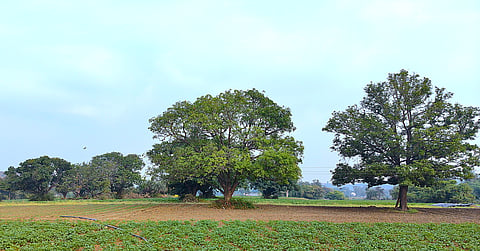


In a village near Indore, the afternoon sun beats down on bare fields. A lone neem tree stands in one corner, its branches once spreading wide but now scarred by saw cuts and seasons. In a landscape that was earlier dotted with tamarind, neem and mango trees, it now serves as a quiet reminder: India’s farmland canopy is steadily disappearing, and very few people seem to have noticed. Recent satellite surveys show that such trees — which provide shade, habitat, and countless ecological services — are rapidly vanishing from India’s agricultural lands.
A May 2024 study in Nature Sustainability titled Severe decline in large farmland trees in India over the past decade mapped roughly 0.6 billion individual farmland trees across India (excluding block plantations). The study found that nearly 11 per cent of India’s large farm trees (those with crown areas around 96 m²) present in 2010–11 had disappeared by 2018. More concerning, over five million additional trees were lost between 2018 and 2022 alone. These are conservative estimates, yet they already reveal a massive shake-up of the country’s rural canopy.
The losses are not uniform. Some areas, particularly in central India—like Telangana and Maharashtra—lost nearly half of their big farm trees in 2010–2018. Even regions around Indore in Madhya Pradesh recorded sharp declines. The analysis presents a disturbing picture: a nationwide erosion of mature farmland trees.
The magnitude of this loss is deeply worrying. A recent land-cover map shows that only 20 per cent of India is officially classified as “forest,” while 56 per cent is farmland. This means that most India’s trees stand in cultivated fields, hedgerows, and villages—the very trees now disappearing. These on-farm giants act as natural green infrastructure: cooling fields in the intense heat, enriching soils, supporting pollinators, boosting biodiversity, and storing carbon. Losing them weakens soil health, reduces crop productivity, and undermines climate resilience.
Despite their importance, the disappearance of farmland trees has gone largely unnoticed because of the way India measures its tree cover. The study relied on high-resolution satellite imagery and machine-learning tools to identify each tree on farms and track its survival over time. By comparing images from 2018–19 with those from 2020–22, researchers marked any tree absent in all three later years (with over 70 per cent confidence) as “disappeared.” This individual-tree method—applied to nearly 600 million mapped crowns—revealed 5.3 million losses in only four years.
Traditional monitoring methods cannot detect this. The Forest Survey of India (FSI) records “tree cover” only for contiguous patches larger than one hectare. Lone trees, or even small clusters, do not get counted. Madhya Pradesh’s own 2023 FSI report shows only a minor decline in “trees outside forests” for the state—barely a fraction of what the new satellite analysis reveals around Indore.
Local revenue records are equally blind. They rarely document the number or exact location of trees on private farmland. Ironically, scattered trees in India have no official identity. They do not appear in maps or land documents, so when a farmer cuts one, nothing in the system records its absence. Millions of mature farmland trees therefore exist in a bureaucratic blind spot—and they vanish without a trace.
Satellites reveal where trees are disappearing, but only fieldwork explains why. Interviews across Mhow, Manpur and Sanwer—areas that show sharp canopy decline—offer clear insights. Farmers are not cutting trees out of hostility towards nature. Most removals arise from economic pressure, convenience or shifting agricultural practices.
Few farmers today see trees as beneficial. Only a few could link trees with soil conservation, moisture retention, or pollination. Most considered them boundary markers or obstructions to modern farming. In their eyes, a large tree occupies space, casts shade and complicates field operations.
There is virtually no incentive to keep mature trees. As one village resident noted, a tree in the field is a “notional loss” of cultivation area. When output is measured in kilograms per square metre, every square metre occupied by a tree feels like a direct loss of revenue. Cash-intensive crops like soybean, wheat and maize require every bit of available land, and irrigation costs further push farmers toward maximising open space. Any ecological benefit appears distant; the opportunity cost feels immediate.
Government rules intended to protect trees have limited effect. Although permissions for felling on farm land have been simplified, many farmers still find the process cumbersome. They prefer removing trees quietly rather than navigating paperwork. Enforcement is weak because, without a registry, illegal felling is almost impossible to track.
Local markets also play a role. Indore’s Guru Nanak Timber Market—one of central India’s largest—welcomes farm-sourced logs. Farmers have learned that cutting large trees into smaller firewood packets helps them pass through checkpoints with minimal scrutiny. This blurs the line between legal and illegal markets, allowing farm wood to flow into timber channels unnoticed.
Changing farming practices intensify the pressure. Widespread irrigation has reshaped cropping patterns. Water-intensive crops have replaced mixed or traditional systems. With tractors and combine harvesters now common, any tree canopy becomes a physical barrier. Shade that once helped farm labourers now obstructs machinery. Meanwhile, landholdings shrink with each generation, compounding the urge to clear every corner of the field.
Urbanisation adds another layer. On Indore’s outskirts, land is increasingly converted into residential plots or farmhouses. Trees are often removed to make way for construction or to fit modern landscaping designs.
Natural forces contribute too. Strong monsoon winds topple shallow-rooted trees. With little interest in maintaining them, fallen trees are simply removed. They are rarely replaced. Over time, natural blowdowns and deliberate felling combine to steadily thin the canopy.
These on-ground observations align with the satellite findings. Even FSI’s modest TOF decline hints at the same trend, though much less clearly due to its methodology. Because FSI counts only one-hectare tree patches with 10 per cent canopy cover, many mature farmland trees fall outside its radar entirely.
Today, millions of trees have been lost without raising any alarm. There is a shared view among several farmers that ancient trees have existed well before their time and deserve to stay for generations after them.
A single tree in a field may look insignificant, but mature farmland trees hold rural ecosystems together. A century-old mango or neem draws up groundwater, enriches soil through fallen leaves, and offers shade to crops and livestock. Its branches support birds, bees and other pollinators that help raise yields.
As summers get hotter and rainfall becomes unpredictable, these trees cool the air and soil, reduce heat stress, slow evaporation, and prevent erosion. In effect, each mature tree is a natural insurance system against climate extremes. Losing them is like dismantling protection at the very moment it is needed most.
They also support rural households. Their fruits provide food and income, and their branches offer fodder and firewood. Cutting an old tree may bring quick cash, but losing its shade, fruit and fodder makes families more vulnerable during droughts or poor harvests.
Indore’s experience shows that reversing this decline requires a new approach. Experts argue for a National Farmland Tree Policy—one that focuses not only on planting saplings but on keeping mature trees alive.
The starting point is data. India needs a FarmlandTree Registry to record scattered trees as part of the country’s green infrastructure. Jointly maintained by forest and revenue departments, the registry would use satellite mapping and field verification to list each significant privateland tree. Mapping and tagging trees would help track removals, discourage clandestine felling, and identify where compensatory planting is needed. A registry would also formalise the ownership of trees, encouraging farmers to retain them rather than treat them as unrecorded liabilities.
Some trees, especially old or culturally important ones, can be designated as “Heritage Trees.” Recognition and small incentives—such as annual stewardship payments—could encourage farmers to preserve century-old neem or tamarind trees. Awards like a “Farming with Trees” prize could shift social norms and create pride around conservation.
Rules governing felling and timber transport also require reform. Current regulations vary wildly across states, and the paperwork remains intimidating. A unified digital permit—through the National Transit Pass System (NTPS)—would allow farmers to obtain approvals online and transport wood with a QR-based pass. Such a system enables real-time tracking of timber, reducing illegal movement and increasing transparency.
Markets must also be regulated thoughtfully. Instead of monitoring small rural woodlots alone, authorities should conduct periodic audits of timber depots, plywood mills, and firewood traders. Public disclosure of wood volumes purchased from farms through a dedicated portal could deter hidden transactions.
Equally important is the need to integrate farm trees into agricultural planning. Extension agencies can recommend native species that enhance soil moisture, biodiversity, and yields. Agricultural statistics should include farm-tree cover, acknowledging each tree as climate-resilient infrastructure.
Above all, India must shift from counting saplings to counting standing trees. Current metrics reward plantations, but tomorrow’s metrics must also celebrate the retention of mature trees. Awarding points for not cutting trees may seem new, but India already rewards tree planting—protecting existing trees is the logical next step.
A dedicated National Farmland Tree Policy could harmonise these measures. Like national forest policies, but tailored specifically to trees outside forests, it would bundle incentives, regulatory reforms, and data systems into one coherent framework. Uniform felling rules across states, budget allocations for tree certification, interlinked forestry-agriculture-revenue databases and monitoring of rural wood markets are crucial steps.
Recognising farm trees as green infrastructure—vital for groundwater recharge, carbon storage, and climate adaptation—must be central to this policy vision.
There are early signs of progress. The 2023 model agroforestry rules streamline registration and allow easier felling of certain species, signaling a change in mindset. The Green Credit Programme too could evolve to reward the retention of mature farm trees, not only sapling plantations.
But reversing the current decline demands a collaborative effort—policy makers, researchers, extension agencies, and farmers must work together to reintegrate trees into India’s agricultural systems.
Farmland trees may not enjoy the legal protection that forests do, yet they provide many of the same ecological services. A dedicated policy does not require rewriting land laws; it requires acknowledging the value of these trees and weaving them into planning frameworks. Farmers already act as informal custodians of rural greenery; with the right incentives, they can become powerful partners in conservation.
The silent loss of India’s farmland canopy urgently needs attention. Millions of deep-rooted allies for food security and climate resilience are disappearing every year—unseen and uncounted. A new policy framework must recognise that a young sapling and a century-old neem tree are not the same, and that protecting mature trees is indispensable for rural stability.
The broader goal is simple: to transform every farmer into a partner in conserving India’s rural tree cover. Preserving the patchwork of field trees will require legal reform, public support, and empathetic implementation—but the benefits will be immense. Healthy on-farm trees strengthen soils, improve crop outcomes, and protect rural communities from climate shocks. In the end, safeguarding these veterans of the fields is essential for long-term ecological balance and rural well-being—far more than any single tree-planting drive can achieve.
(Source: Nature Sustainability (May 2024), “Severe decline in large farmland trees in India over the past decade.”)
Pradeep Mishra is an Indian Forest Service (IFS) officer posted in Madhya Pradesh. He writes on forest governance, community forestry, and environmental policy.
Views expressed are the author’s own and don’t necessarily reflect those of Down To Earth